Last updated 2026-08-18
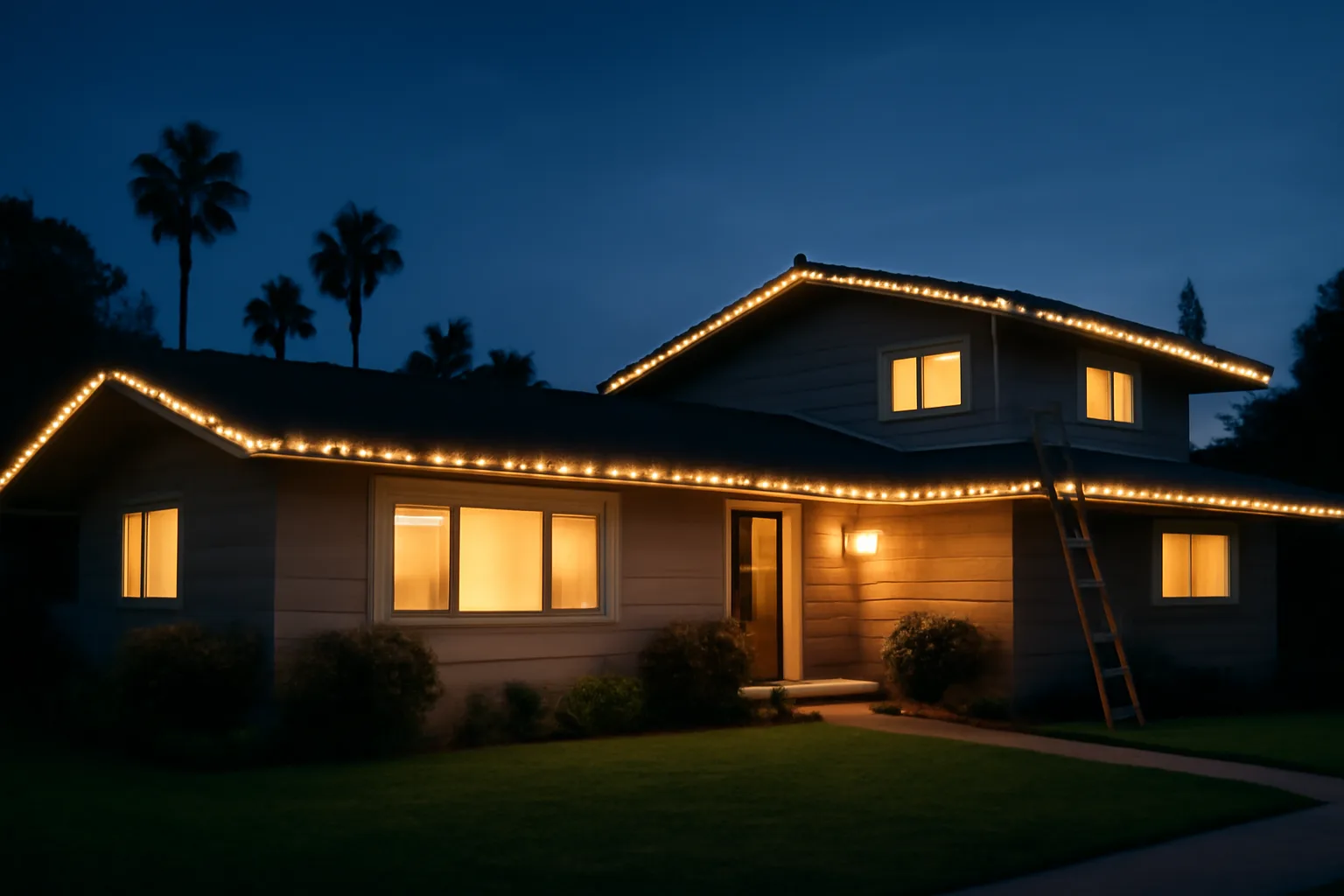
TL;DR
Professional holiday light installation in California costs $3 to $8 per linear foot for rooflines, or $4,000 to $25,000+ for a full home design. No state license exists for hanging lights, but any permanent wiring or new outlet work requires a C-10 electrical contractor. A standard single-family install takes one day. Design work adds 2 to 3 weeks before the crew shows up.
how much does professional holiday lights installation cost in california?
Pros price California rooflines at $3 to $8 per linear foot [1]. A 200-foot single-story home in the Bay Area or coastal Southern California lands between $600 and $1,600 for the roofline alone. Wrap trees, light shrubs, run pathways, or go multi-story, and the number climbs fast.
Full-service design, supply, install, maintenance, and takedown on an average California home runs $4,000 to $25,000 or more. Size matters. So does access. A two-story home with steep rooflines in Pacific Palisades costs far more per foot than a single-story ranch in Elk Grove, because the crew needs taller ladders, more safety gear, and more minutes per fixture.
Here is what you're actually buying, broken out:
| Component | Typical Range | Notes |
|---|---|---|
| Roofline lights (per linear foot) | $3 - $8 | Basic C9 bulbs and clip-on installation [1] |
| Tree wrapping (per tree) | $150 - $600+ | Height and branch density drive cost |
| Shrubs and bushes (per shrub) | $30 - $100 | Net lighting or mini-light wraps |
| Pathways and ground lighting | $10 - $25 per linear foot | Requires stakes and extension cords |
| Giant displays (rooftop Santas, etc.) | $500 - $2,000+ | Labor for securing large objects |
| Design fee | $0 - $500 | Some companies fold it into the bid, others charge separately |
| Supply only (lights you buy) | $2 - $6 per linear foot | Commercial-grade LED C9 strings and bulbs, clips |
| Takedown and storage | Included or $200 - $800 | Always confirm. Some companies bill takedown separately [2] |
California's cost of living and workers' compensation premiums shove these numbers toward the top of the national spread. A 2019 survey by the Christmas Light Contractors Association put the national average for pro installation around $1,600, but that folds in cheap markets. In California metros the real average sits closer to $3,000 to $5,000 for a standard full install [1].
Someone quotes you $1.50 per foot? Walk away. That price can't cover legal labor and insurance in this state.
do you need a license to install holiday lights in california?
No single "holiday light installation license" exists in California. The answer people want is a clean yes or no, and it isn't one. It depends entirely on what you do to the house's electrical system.
Clip string lights onto existing gutters, eaves, and rooflines using outdoor-rated cords plugged into existing exterior outlets, and you need no state contractor license for the hanging itself. The Contractors State License Board (CSLB) has no classification for temporary decorative lighting [3].
That's the narrowest case. Touch the building's wiring and you're in C-10 territory.
The C-10 Electrical Contractor license covers electrical work involving "the installation, construction, alteration, or repair of electrical systems" [4]. Here's what flips you into needing one:
- Adding a new outdoor outlet or circuit for the lights
- Hardwiring any permanent fixture to the home's panel
- Installing timers or controllers that connect, hardwired, to the electrical system
- Running permanent wiring through walls or conduit for future seasonal use
The CSLB enforces this. Its own consumer guidance says: "If you are not sure whether you need a contractor license, check with the CSLB. It is better to be safe than sorry" [5]. Work without a required license and you're looking at fines, stop-work orders, and liability exposure. If a company you hire does electrical work unlicensed, your homeowner's insurance may deny a fire or accident claim.
Hiring a light-hanging company? Ask one thing: "Will you modify any electrical in any way?" If yes, verify their C-10 number at cslb.ca.gov. If no, and they're only clipping lights onto the house, no state license exists for that work, but you still want proof of general liability and workers' comp. Anyone can buy a ladder and call himself an installer. Insurance is what separates the pros from the guys with a truck.
Some cities pile on their own rules. Beverly Hills requires a city business license for any commercial activity inside city limits [6]. San Francisco, Los Angeles, and San Diego all carry local business tax or registration requirements. The installing company should know its own city's rules. You, the homeowner, don't need a permit to hire a pro for temporary lights.
Running a holiday lights business is a different picture. You'll need a general business license from your city [7], a state seller's permit from the California Department of Tax and Fee Administration if you sell lights or materials [8], and an Employer Identification Number from the IRS if you hire anyone [9]. Workers' comp is mandatory for any California business with employees [10].
how long does holiday lights installation take in california?
A standard single-family home takes one day, sometimes eight to ten hours on a complex job. That assumes the crew arrives with a finished design, all the lights and clips loaded, and no surprises. Two-story homes with hard roof access or big trees can spill into a second day.
Nobody has published a rigorous study of install times by state. The closest steady benchmark comes from the Christmas Light Contractors Association, which reports most residential installations finish within one to two days [1]. California installers describe the split like this:
| Scope | Time on Site | Notes |
|---|---|---|
| Roofline only, single-story | 2-4 hours | Straightforward clip-on; crew of two |
| Roofline + entryway + two trees | 5-8 hours | Longer if roof pitch is steep |
| Full property (trees, shrubs, paths, roof) | 1-2 days | May require multiple crew visits |
| Design phase (concept to final) | 2-3 weeks | Mostly wait time; actual design is hours of CAD and sourcing |
What adds time in California specifically:
- Coastal properties with salt-pitted gutters. Clips won't grip corroded metal, and that slows the crew.
- Steep hillside homes where ladders can't sit level. Setup and safety checks per ladder position add minutes that compound.
- HOA approvals. Many California HOAs require 10 to 30 days of review before visible work starts. The design gets done early, then you wait.
- High-fire-risk zones. Where ladder sparks are a wildfire concern, crews prep and shield ladder feet. That adds 10 to 20% more labor time.
Scheduling is its own California variable. Most companies book out 3 to 6 weeks ahead for November installs [1]. Wait until after Thanksgiving and you'll pay a premium (if anyone has room) or land on a waitlist.
what drives cost up or down in california markets?
California carries the most expensive workers' compensation insurance in the country. For roofers and exterior workers, base rates run $20 to $45 per $100 of payroll depending on the classification code [11]. A crew member earning $28 an hour costs the employer roughly $8 to $13 more per hour in comp premiums alone. That feeds straight into your per-foot price.
Geography moves the needle inside the state. A job in Fresno costs materially less than the same job in Palo Alto, because Central Valley labor is priced lower and workers' comp territorial multipliers are smaller. The gap can hit 20 to 30% for identical scope.
What pushes you to the high end: steep roof pitches (anything over 6:12), second-story work, large trees needing bucket trucks or climbing gear, custom design with multiple 3D renderings, and rush scheduling after December 1.
What keeps costs down: single-story ranch homes with easy roof access, roofline-only scope, supplying your own commercial-grade lights (bought during off-season sales), booking in July or August, and sitting outside the major coastal metros.
One note on the "provide your own lights" move. It saves money, but most top California installers won't hang customer-supplied lights unless they're specific commercial brands they trust. Their liability and warranty are on the line. If your Amazon C9 strings die in week two, the installer looks bad even though he didn't sell you the product. Some companies warranty their own lights all season and include replacement-bulb service calls. That's worth paying for.
are permanent holiday lights cheaper than seasonal installs in california?
A permanent track system pays for itself around year five or six. Brands like Trimlight, JellyFish, and EverLights mount flush under the eaves and stay on the house year-round, nearly invisible when off. Installed, they run $25 to $40 per linear foot [12].
Permanent lights flip the math. Instead of paying $3 to $8 per foot every year for install and takedown, you pay once and the lights last 10 to 15 years. A 200-foot roofline runs $5,000 to $8,000 installed. Ten years of seasonal installs at $6 per foot with supply included totals $12,000. Breakeven lands around year five or six.
The California catch: permanent track installation almost always needs a C-10 electrical contractor. The track has to be hardwired to a power source. Even if it plugs into an existing outlet, the track itself is permanently affixed to the structure and the wiring passes through the building envelope [4]. That's construction. Hire a properly licensed electrical contractor and confirm your city doesn't require a building permit for fixing tracks to eaves.
Check your HOA too. Some don't allow permanent architectural additions. Seasonal lights are explicitly temporary and often skip architectural review. Permanent tracks don't.
how much does diy holiday lights cost in california?
DIY materials for a 200-foot roofline run $340 to $550 at supplier prices. That's the floor, and people routinely underestimate it. Here's the build for commercial-grade C9 LED bulbs spaced 12 inches apart:
- 200 feet of SPT-2 wire string with sockets: $140 to $200 (buy from holiday-light discounters like Christmas Light Source or Novelty Lights, not big-box stores)
- 200 C9 LED bulbs (warm white, 0.96W each): $80 to $120
- Gutter clips or shingle tabs: $40 to $60
- Outdoor-rated extension cords (heavy-gauge, 12AWG or 14AWG): $60 to $120 depending on runs
- Timer: $20 to $50
Materials total: roughly $340 to $550 [13]. Add $100 to $200 if you need a tall ladder and don't own one. Compare that to a $1,200 to $1,600 pro install on the same roofline and the savings look real.
You're trading money for time and risk. The ER data on holiday ladder falls is grim. The U.S. Consumer Product Safety Commission estimates about 14,800 people visited emergency rooms in November and December 2019 from holiday decorating injuries, with falls the leading cause [14]. California ER bills are high. The math shifts again with a steep roof or a second story.
For DIY to pencil out, you need to already own or be willing to buy a safe, properly rated ladder, have a helper, and be comfortable on a roof for several hours. Miss any of those and the pro quote starts looking reasonable.
What you save is cash. What you lose is a full weekend (or more), plus the warranty and the January takedown labor. Takedown is the worst part, cold and often wet in Northern California. HolidayLightPath sells a $129 one-time Hang + HOA + Take-Down Kit that bundles the compliance paperwork, install guide, and takedown checklist if you want structure (see /start). But the raw materials above are the real floor. You can't get quality outdoor lights onto a California roofline for much under $300, even doing it all yourself.
what electrical rules apply to holiday lights in california?
The lights must be UL or ETL listed for outdoor use. That's a requirement, not a suggestion. The California Electrical Code (Part 3 of Title 24) adopts the National Electrical Code, which requires listed equipment for all installations [15]. Outdoor extension cords must be rated for wet locations and marked "SJTW" or "SJTOW" for the jacket. Indoor-only cords break down fast outside and turn into a fire risk, especially in California's dry autumn.
GFCI protection is required for every outdoor outlet, no exceptions. If your exterior outlet has no GFCI (test and reset buttons on the outlet, or a GFCI breaker in the panel), don't plug holiday lights into it until it's upgraded. An electrician can swap a standard outdoor outlet for a GFCI for a few hundred dollars. The requirement lives in NEC 210.8(A)(3), adopted by California [15].
Daisy-chaining extension cords is banned by code and by every fire marshal in the state. One cord from the outlet to the first light string, period. Strings can connect end-to-end as long as you honor the manufacturer's wattage rating and don't exceed the string's maximum connected length (for LED C9 strings, usually 750 to 1,000 feet depending on wire gauge). This is the part homeowners get wrong most, and it's another quiet argument for hiring a pro.
In high fire-hazard severity zones mapped by Cal Fire, temporary outdoor electrical decorations can draw extra scrutiny during red flag warnings. Some local fire authorities ask residents to keep lights off during extreme wind events. Check your county's fire district rules.
what insurance do i need when hiring holiday lights installers in california?
Demand the certificate of insurance before anyone climbs a ladder. This is the section people shrug off until they need it. If a worker falls off your roof and the company carries no workers' compensation, your homeowner's policy can become the target. California law requires all employers to carry workers' comp, but enforcement runs thin on small seasonal operations [10]. Ask two questions before you sign:
1. "Email me a copy of your certificate of insurance showing general liability and workers' comp, with my address listed as certificate holder." 2. "Are all workers on my property covered as W-2 employees under your workers' comp?"
A legitimate California installer has a current COI ready within hours. A company that stalls, mentions "exemptions," or claims install workers are 1099 independent contractors is a red flag. The California Department of Industrial Relations has gone after misclassification in construction and contracting occupations [16].
General liability of at least $1 million is the industry standard. It protects your property if a ladder wrecks gutters, shingles, or windows, or if an overloaded circuit causes damage. Confirm the policy is in force for the exact dates the crew will be on site.
Go DIY and your own homeowner's policy almost certainly covers accidental damage you cause to your own home while decorating (ladder through a window) and a guest getting hurt. It may not cover a day laborer you paid cash. That's one more reason to use a fully insured company or do the work entirely yourself.
how do i read and compare holiday lights quotes in california?
A real quote line-items the work: design fee (if any), supply of lights and clips (specified by brand and bulb type), install labor, takedown labor, and a note on in-season maintenance calls. One line reading "$3,400 - holiday lights install" tells you nothing about what you bought.
Ask every bidder:
- Is takedown included, and what's the window? (You want a firm date range, not "sometime in January.")
- What brands of lights and clips do you use? (Commercial-grade from a known name like Christmas Designers or Wintergreen Corporation. Big-box retail lights fail faster.)
- What happens when a bulb dies mid-December? (Some include service calls, some don't. Get it in writing.)
- Do you handle HOA or architectural committee approvals for me? (Some do, most don't.)
Get three quotes if you can. In California's metro markets the spread between bids can run into thousands. Don't reflexively grab the lowest. Price here tracks insurance status, employee training, and equipment quality. The cheapest bid is often the one with no workers' comp and a guy who subcontracted to another guy.
Booking timeline: reach out in September for a November install. By mid-October the best crews in Los Angeles, San Diego, and the Bay Area are booked solid. Reading this in November and needing lights this season? Call every company and ask about cancellations. Expect a rush premium.
does installing holiday lights affect my property taxes in california?
No. Temporary holiday lights aren't permanent improvements to real property and don't trigger reassessment under California Proposition 13. The California State Board of Equalization assesses property based on real property improvements [17]. Lights removed within 30 to 60 days are plainly temporary.
Permanent track systems (JellyFish, Trimlight, and the like) sit in a gray area. Because they're affixed to the structure and meant to stay for years, they could technically read as a fixture improvement. In practice, the Assessor's office doesn't chase holiday light tracks, since they don't materially move property value. But if you sell and a permanent lighting system conveys with the house, it can nudge the appraised value, which could indirectly touch the buyer's tax bill. For 99% of homeowners this isn't a real cost.
do california fire codes restrict holiday lights?
The California Fire Code adopts the International Fire Code with amendments [18]. Section 308 covers open flames and decorative lighting. It's less about the lights and more about proximity to combustible material. The code doesn't ban holiday lights. It bans using them in a way that creates a fire hazard.
The practical homeowner summary: keep lights away from dry leaves in gutters (clean gutters before install), don't overload circuits, don't run cords under rugs or through doorways where the insulation heats and degrades, and use outdoor-rated equipment only.
In Wildland-Urban Interface (WUI) zones, the fire code adds restrictions on ignition sources during fire season. Cal Fire and your local fire authority map these areas. December lights usually fall outside core fire season, but Southern California's Santa Ana wind season now stretches into the holiday period. If you're in a WUI zone, ask your local fire district whether they restrict temporary electrical displays during red flag days.
what are the hidden costs of holiday lights in california?
Labor and materials are the costs you see. The ones that catch people are invisible until the bill lands.
Electricity. A 200-foot LED C9 roofline, bulbs at 12-inch spacing burning 0.96 watts each, 6 hours a night for 40 nights, uses about 46 kWh for the season. At PG&E's average residential rate of roughly $0.45 per kWh (Tier 2), that's $21 for the season [19]. Barely noticeable. A large display with 2,000 LED bulbs and several inflatables can cross $100 to $150 for the season. Old incandescent C9 bulbs? A 7-watt incandescent stack of 200 bulbs burns 336 kWh over the same season, running $151 at PG&E rates. That gap alone justifies an LED upgrade in two seasons.
Time off work. If your installer needs you home for access (common in gated communities or properties with locked side yards), you might burn partial vacation days. Three half-days off the clock is a real cost for a salaried worker.
Repairs. A ladder bump chips a stucco corner. A clip scratches a gutter. Most installers carry liability for obvious damage, but minor cosmetic stuff often goes unreported. If you care about your exterior paint, photograph everything before the crew arrives.
Storage. Own the lights and store them yourself, and you need dry, ventilated space in a garage or shed. Bad storage kills light strings faster than weather does. The $129 HolidayLightPath kit mentioned earlier includes a storage guide that heads off the tangled mess that forces a rebuy next year.
what can california hoas restrict about holiday lights?
California has more HOAs than any other state, and the Davis-Stirling Common Interest Development Act governs most of them [20]. Under Civil Code Section 4715, an HOA cannot prohibit displaying holiday decorations in a separate interest unit (your home and exclusive-use area), in any building window, or on the entry door or doorframe. It can enforce reasonable time, place, and manner restrictions.
What that looks like in practice:
- An HOA can require lights down by January 15. Enforceable.
- An HOA can limit install hours (no crews before 8 a.m. or after 6 p.m.). Enforceable.
- An HOA can restrict colors or ban roof-mounted giant inflatables if the CC&Rs say so and the rule applies uniformly. Generally enforceable, subject to some case law.
- An HOA cannot ban all holiday lights outright. Davis-Stirling blocks that.
If your installer's ladders or gear will sit on common-area walkways, the HOA may require a certificate of insurance naming the HOA as an additional insured. Some installers charge $25 to $50 extra for that. Get the HOA's insurance requirements in writing and forward them to the installer before you sign.
Smart move: submit your lights plan (even a marked-up photo of a decorated house from the installer's portfolio with your address) to the architectural committee 30 days before install. Most committees approve within two weeks if the plan follows the rules. The headache is skipping it, getting a violation letter in December, and defending your lights over the holidays.
Frequently asked questions
do i need a business license to run a holiday lights company in california?
Yes. Every California city and county requires a business license for commercial activity within its boundaries. Install lights in multiple cities and you typically need a license in each one. A few cities share reciprocity, but most don't. The license is a tax registration, not a competency credential. Expect $50 to $400 annually per city depending on gross receipts [7].
how much does holiday lights cost per foot in los angeles specifically?
Los Angeles proper averages $4 to $8 per linear foot for roofline installs, with the top end in hillside neighborhoods like Bel Air, the Sherman Oaks hills, and Pacific Palisades where roof access is hard. Single-story homes in the flatlands trend toward $4 to $6. LA carries high workers' comp territorial rates and a high cost of living, both of which push labor pricing above the state median [1].
what is the cheapest month to book holiday lights installation in california?
July and August. Most companies offer early-booking discounts of 10 to 15% to fill their November schedule before the rush. January and February can also yield discounts if a company will book a year ahead, but fewer actively sell that far out. The most expensive time to book is the week after Thanksgiving, when capacity is near zero and rush fees kick in [1].
can an unlicensed person install holiday lights as a side business in california?
If they only clip lights onto existing structures and plug into existing outlets, they may not need a state contractor license. They still need a city business license, a seller's permit if they sell materials, and workers' comp if they hire helpers. Cash-only side hustles without insurance or city registration are common, but they carry real liability risk for the homeowner [3] [7] [8].
how long does it take to get a c-10 electrical license to do permanent holiday lights in california?
The C-10 requires four years of journeyman-level electrical experience and passing a two-part state exam. The CSLB application process usually takes 3 to 6 months from submission to exam scheduling, plus another 4 to 6 weeks for issuance after you pass. It's slow. Most seasonal installers partner with a licensed electrical subcontractor for hardwiring instead of getting their own C-10 [4].
are holiday lights considered a fire hazard in california wildfire zones?
LED holiday lights, properly installed with outdoor-rated cords and GFCI protection, are a low fire risk. The California Fire Code doesn't restrict holiday lights specifically in WUI zones outside red-flag periods. During high-wind red flag events, local fire authorities can ask residents to shut off non-essential outdoor displays. Check with your county fire district for standing orders [18].
what happens if my holiday lights installer damages my roof in california?
If the installer carries general liability (you verified this before they started), their policy should cover roof, gutter, or shingle damage. File a claim directly with their insurer. If the installer is uninsured, your recourse is small claims court plus a claim against your own homeowner's policy, which may or may not cover damage caused by an uninsured contractor you hired. This is exactly why you demand the COI before any work begins [10].
how much electricity do holiday lights add to my california utility bill?
For a typical 200-foot LED C9 roofline, the seasonal cost at California residential rates is $20 to $45 over 40 nights of 6-hour operation. Large displays with thousands of bulbs and motorized elements can reach $100 to $200. Still running incandescent bulbs? Switch to LED. The electricity savings cover the bulb cost in two seasons at PG&E or SCE rates [19].
do i need a permit from my city to put up holiday lights in california?
Generally no. Temporary decorative lighting plugged into existing outlets doesn't require a building permit in most California cities. The exceptions show up when permanent structures or electrical changes are involved (permanent tracks, new outdoor outlets, hardwired timers). Those can trigger a building permit and a licensed electrical contractor. Check your local building department if you're doing more than clipping lights on [6].
what are the most common holiday lights complaints to the cslb?
The CSLB doesn't publish holiday-light-specific complaint data. Seasonal decorating complaints generally mirror general contracting ones: unlicensed operators taking deposits and never finishing, subcontractor payment disputes, and property damage not covered by insurance. The CSLB advises verifying license status before hiring and never paying more than 10% or $1,000 as a deposit, whichever is less [5].
is it cheaper to rent or buy holiday lights in california?
Most California pros run full-service: they supply and install their own commercial-grade lights and pull them at season's end. You're effectively renting the lights for the season and paying for the service. Buy the lights yourself and you save about $2 to $6 per linear foot on supply, but you inherit storage, bulb replacement, and an installer who may refuse to hang your lights or warranty them. For most homeowners the full-service model is simpler and priced similarly over a three-year window [1].
what does the cslb holiday lights license check tell me?
A CSLB license check at cslb.ca.gov shows license status (active, expired, suspended), classification (C-10 for electrical, B for general building), bond amount and status, workers' comp status, and any disciplinary actions or complaints on file. For permanent electrical work, you want a C-10 in good standing. For clip-on installs, no state license exists to check, but you can still verify the company's city business registration and insurance [5].
Sources
- Angi (formerly Angie's List), Holiday Lighting Installation Cost Guide 2023: Takedown costs $200-$800 when billed separately; full install ranges $200-$980 for basic projects nationally
- California Contractors State License Board, License Classifications: No specific holiday lights classification exists in CSLB license categories
- California Code of Regulations Title 16, Division 8, Article 3, Section 832.10 - C-10 Electrical Contractor: C-10 required for electrical work involving installation, construction, alteration, or repair of electrical systems
- Internal Revenue Service, Employer ID Numbers (EIN): EIN required for businesses with employees
- California Department of Industrial Relations, Workers' Compensation Requirements: All California employers must carry workers' compensation insurance; liability insurance of $1M typical industry standard
- U.S. Consumer Product Safety Commission, Holiday Decoration Injuries Report 2019: 14,800 ER visits for holiday decorating injuries in Nov-Dec 2019, falls leading cause
- California Building Standards Commission, 2022 California Electrical Code Title 24 Part 3: California Electrical Code incorporates NEC including GFCI requirements in 210.8(A)(3) and listed equipment requirements
- California Department of Industrial Relations, Independent Contractor vs. Employee Information: California has specific enforcement against worker misclassification in construction and contracting
- California Department of Forestry and Fire Protection, 2022 California Fire Code: California Fire Code Section 308 covers decorative lighting and open flames; temporary decorative lighting permitted with proper safeguards
- Pacific Gas and Electric Company, Residential Rate Schedules 2024: PG&E Tier 2 residential rate approximately $0.45/kWh; LED C9 bulb at 0.96W typical consumption
- California Civil Code Section 4715, Davis-Stirling Common Interest Development Act: HOA cannot prohibit display of holiday decorations in separate interest unit or door/frame; can enforce reasonable time, place, and manner restrictions