Last updated 2026-08-18
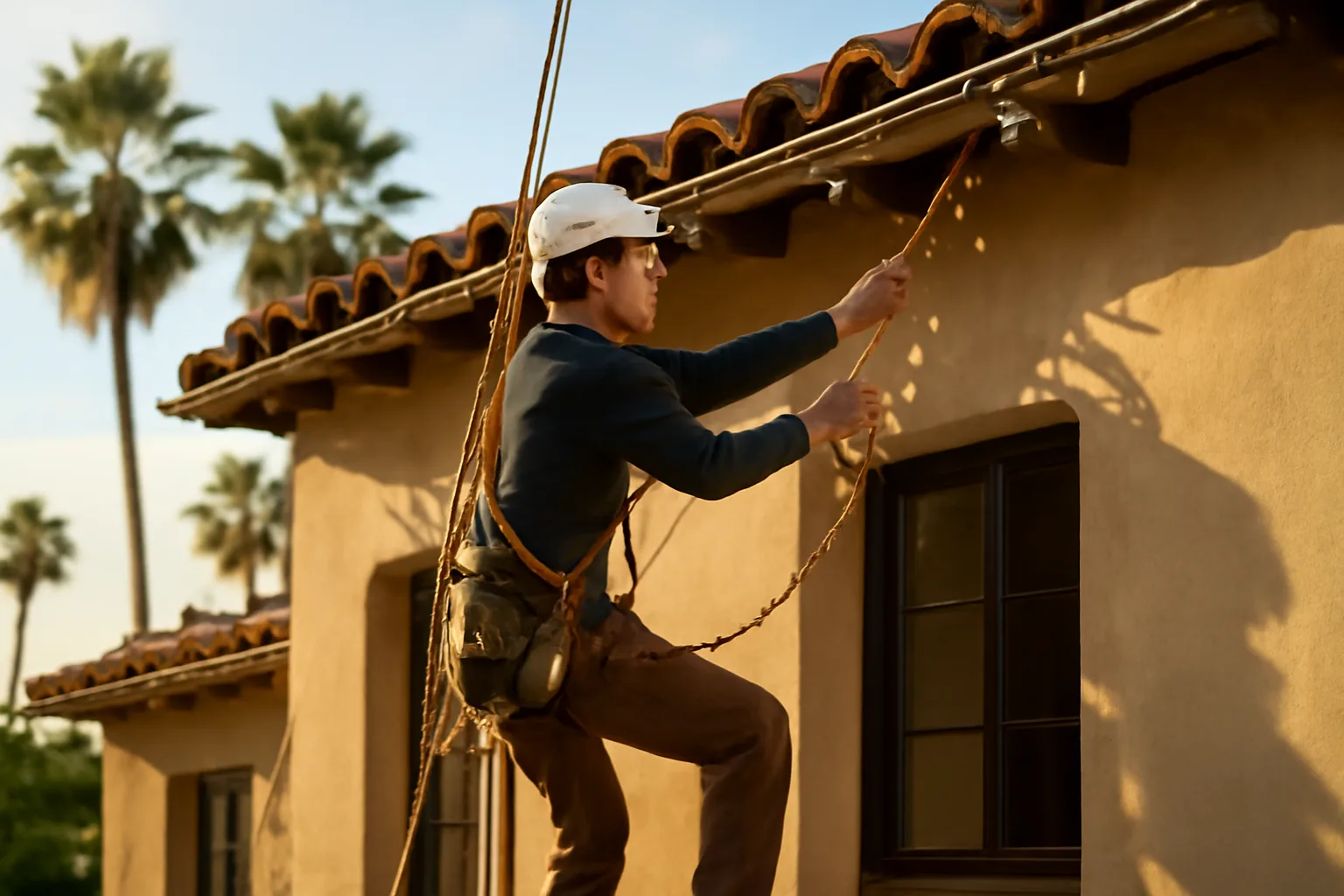
TL;DR
In California, anyone installing holiday lights for compensation needs a contractor license from the Contractors State License Board (CSLB). The most common classifications are C-10 (electrical) and C-7 (low voltage). The application fee is $330, plus a $200 initial license fee after passing the exams. You'll also need a $15,000 contractor bond and general liability insurance. The process typically takes 6-8 weeks from application to license issuance, but confirm with the CSLB for current processing times.
Do you need a license to install holiday lights in California?
Yes. California law requires anyone who contracts to perform construction work, including the installation of holiday lights, to hold a state contractor license [1]. You can't just hang lights for a neighbor's cash and call it a side hustle. The CSLB enforces this strictly. If you're caught without a license, you face fines up to $5,000 and possible jail time [2].
But it's not a single license for all holiday lights. The classification you need depends on the voltage of the lights and whether you're modifying existing wiring. Most first-year holiday lights pros go for a C-10 (Electrical) or C-7 (Low Voltage Systems) license. The CSLB defines a contractor as "any person who undertakes to or offers to undertake to... install... any electrical device or system" [3]. That covers you.
There's a common misconception that low-voltage 12V lights don't need a license. The CSLB's position is clear: if you're connecting to a transformer that plugs into an outlet, you're still doing electrical work that requires a C-7 license. The only exception is if you're purely plugging in pre-assembled light strings without any cutting, splicing, or permanent attachment. That's rare for a paid service.
What license classification does California require for holiday lights?
You have two realistic options. The C-10 Electrical Contractor license allows you to install, modify, or repair any electrical wiring, fixtures, and equipment [4]. This covers both line-voltage (120V) and low-voltage lights. The C-7 Low Voltage Systems Contractor license is limited to systems under 91 volts, like 12V landscape lighting, LED holiday lights, and fiber optics [5].
Most holiday light installers start with the C-7. It's easier to qualify for because the exam is narrower and the experience requirement is less burdensome. But if you plan to install permanent roof outlet systems or power panels, you'll need the C-10. Whichever you pick, you'll also need to pass the CSLB's Law and Business exam, which is the same for all classifications.
You can't avoid the license by calling yourself a "decorator" or "lighting consultant." The CSLB looks at what you actually do. If you're climbing ladders and attaching lights to structures for pay, you're a contractor [6].
How much does the CSLB contractor license cost?
The total out-of-pocket to get licensed is around $530 in CSLB fees, plus the bond and insurance. Here's the breakdown:
The original application fee is $330, non-refundable [7]. After you pass the exam, the initial license fee is $200 [7]. You'll also need a $15,000 contractor bond, which typically costs 1-3% of the bond amount annually, so $150 to $450 per year, depending on your credit [8].
You'll also need general liability insurance. The CSLB does not require it, but virtually every client, HOA, or property manager will demand it before you step on site. Expect to pay $500 to $1,500 per year for a basic policy [9].
If you have employees, workers' compensation insurance is mandatory. The CSLB will not issue a license to an employer without proof of coverage [10]. For a sole proprietor with no employees, you can file an exemption, but that's risky if you ever hire help.
To put it in perspective, the total first-year hard costs, fees, bond, insurance, exam prep materials, run about $1,200 to $2,500. After that, annual renewal fees are $450 for a sole proprietor [7].
How long does it take to get a contractor license in California?
Plan on 6 to 8 weeks from the day you mail your application, but there's no guarantee. The CSLB's published processing times reflect average workloads; during peak seasons, it can stretch to 10 weeks [11].
Here's the typical sequence. You submit your application and fee. The CSLB reviews it within 4 to 6 weeks. If accepted, you receive a notice to schedule your exams. You then have 18 months to pass both exams. Once you pass, the license is issued within 2 weeks if all other requirements (bond, insurance, workers' comp) are met [11].
A common mistake is waiting until October to apply. By then, you'll miss most of the holiday season. Apply in July or August. The CSLB does not expedite for seasonal demand. There's no "holiday rush" exception.
Do you need a business license and local permits too?
Yes, on top of the state contractor license. Most California cities and counties require a general business license to operate within their jurisdiction [12]. The cost varies. In Los Angeles, it's as low as $91 for a small home-based business; in San Francisco, it's $150 or more. You'll need to check with the city clerk's office where your business is located.
Some cities also require a separate permit for temporary installations, especially if you're working in HOAs or on public streets. It's rare for a single home install, but common for commercial holiday displays. Always ask the city before you start.
If you sell lights or materials to customers, you'll need a seller's permit from the California Department of Tax and Fee Administration (CDTFA). This allows you to collect sales tax. The permit is free, but you must file returns [13].
What insurance do you really need?
The $15,000 contractor bond is not insurance. It protects consumers if you violate the law or fail to pay subcontractors. It does not cover property damage or injuries. That's why you need general liability insurance. A standard $1 million policy costs about $800 to $1,200 per year for a new holiday lights business [9].
If you're a sole proprietor with no employees, you can skip workers' comp. But if you hire even one helper, you must get it. The CSLB will suspend your license if you don't [10].
Also consider inland marine insurance for tools and equipment, especially if you invest in commercial-grade light strings and ladders. It's cheap, about $200 a year, and can replace stolen gear.
Steps to apply for a CSLB contractor license
1. Verify your experience. You need at least 4 years of journey-level experience in the classification you're applying for [14]. If you're a newbie, you can qualify by having a responsible managing employee (RME) or officer with the required experience.
2. Complete the application. The original contractor license application is available on the CSLB website. You'll list your classification, business structure, and responsible managing officer [7].
3. Pay the $330 application fee.
4. Wait for the CSLB to review and accept your application. You'll get a notice to schedule exams.
5. Pass the Law and Business exam and the trade exam for your classification. The trade exam for C-7 covers low-voltage theory, installation, and safety. The C-10 exam is wider.
6. Once you pass, submit your bond, insurance certificate, and workers' comp exemption or coverage. Pay the $200 initial license fee.
7. Wait for the license to arrive in the mail. The whole process takes 6-8 weeks on average.
Common mistakes first-timers make
The biggest error is thinking you don't need a license for low-voltage lights. The CSLB has fined plenty of unlicensed installers. Another is applying under the wrong classification and then having to reapply. If you're only doing holiday lights, pick C-7.
Also, don't forget the bond. You can't get a license without it, and the bond must be on file before the CSLB will issue the license. Some people wait until after they pass the exam to buy the bond, which adds weeks.
Finally, don't underprice your work to cover the license costs. A $1,500 first-year compliance cost sounds high, but it's less than $125 a month. If you do 10 installs at $800 each, the license cost is 2% of revenue. It's not the barrier people think it is.
How California compares to other states
California's requirements are stricter than most. In Alabama, for example, holiday light installers may not need a state license at all, relying instead on local business permits [link to /articles/equipment/holiday-lights-board-alabama]. In Arizona, the registrar of contractors requires a license only for electrical work that involves wiring, not for plug-in lights [link to /articles/equipment/holiday-lights-board-arizona]. Florida's rules are similar to California's but with a different board structure [link to /articles/equipment/holiday-lights-board-florida].
If you're planning to operate in multiple states, you'll need to research each one. Georgia, for instance, has a different contractor classification system [link to /articles/equipment/holiday-lights-board-georgia]. Illinois requires a license for electrical work but has a lower threshold for low-voltage [link to /articles/equipment/holiday-lights-board-illinois]. Colorado is somewhere in between [link to /articles/equipment/holiday-lights-board-colorado].
How a hang kit can simplify your first year
Once you've got the license, the job is about efficiency. A system like HolidayLightPath's $129 Hang + HOA + Take-Down Kit gives you a repeatable workflow, measuring, cutting, and mounting lights faster, so you can focus on the paper path and not on reinventing the wheel each install. It's not a replacement for the license, but it's a good complement when you're starting out.
What to do after you get your license
First, get a certificate of insurance and add it to your proposals. Clients will ask for it. Second, register with the CDTFA for a seller's permit if you sell lights. Third, open a business bank account to keep finances separate, it makes tax time easier.
Then, start marketing. Many HOAs require proof of license and insurance before they'll approve you. Having your CSLB number on your website and business cards is a trust signal. Also, join local business groups; word of mouth is huge in this industry.
Finally, stay on top of CSLB renewals. Licenses expire every two years. The renewal fee is $450 for a sole proprietor [7]. If you let it lapse, you have to stop working immediately.
Frequently asked questions
Can I install holiday lights without a license if I only do low voltage?
No. The CSLB considers low-voltage lighting systems as electrical work that requires a C-7 license if you're connecting to a transformer or modifying the system. Simply plugging in pre-assembled strings might not require a license, but any paid service involving cutting, splicing, or permanent attachment does.
What is the CSLB exam like?
The Law and Business exam is multiple choice, covering California contracting laws, safety, and business management. The trade exam for C-7 covers low-voltage theory, National Electrical Code, and installation practices. Both are closed-book. You can take them at PSI testing centers. Study materials are available from the CSLB and third-party publishers.
Do I need workers' compensation insurance?
If you have any employees, yes. The CSLB will not issue a license without proof of workers' comp coverage. If you're a sole proprietor with no employees, you can file an exemption, but it's risky if you ever hire temporary help.
How do I get a contractor bond?
You can buy a bond from any insurance broker or surety company licensed in California. The bond must be $15,000 and filed with the CSLB. The cost depends on your credit score, typically $150 to $450 per year. You'll need to renew it annually.
Can I use my C-10 license to install holiday lights in other states?
No. California contractor licenses are not valid in other states. Each state has its own licensing board. If you plan to work in multiple states, you'll need to check each state's requirements. For example, Arizona has reciprocity agreements with California, but you still need to apply for an Arizona license.
How much does holiday lights cost in California?
The cost to get licensed as a holiday lights contractor in California is about $1,200 to $2,500 in the first year, including CSLB fees, bond, insurance, and exam prep. After that, annual costs drop to around $600 to $1,200, depending on insurance and bond premiums.
How long does holiday lights take in California?
From application to license issuance, the process takes 6 to 8 weeks on average. However, the CSLB's processing times can vary. Applying in the off-season (July or August) helps avoid delays. You cannot start working until you have the license in hand.
Do I need a seller's permit for a holiday lights business?
If you sell tangible goods, like light strings, clips, or timers, to customers, you need a seller's permit from the CDTFA. The permit is free, but you must collect sales tax on those items and file returns. Labor-only installation typically does not require a seller's permit.
What city permits do I need for holiday light installation?
Most cities require a general business license. Some also require a temporary sign or encroachment permit if you're working on public property or in HOAs with strict rules. Check with the city clerk's office. Permit costs range from $50 to $500.
Is there a difference between a C-10 and C-7 license for holiday lights?
Yes. A C-10 allows you to work on any voltage, including line-voltage (120V) systems. A C-7 is limited to low-voltage systems under 91 volts. Most holiday lights are low-voltage, so a C-7 is sufficient for the typical installer. If you plan to install permanent power outlets for lights, get a C-10.
What happens if I get caught working without a license?
The CSLB can issue a citation and fine up to $5,000 for a first offense. Repeat offenses can lead to criminal charges and jail time. You also can't enforce a contract in court if you're unlicensed, meaning you can't sue for non-payment.
Can I qualify for a license without experience?
You must have at least four years of journey-level experience, but you can qualify by hiring a responsible managing employee (RME) who has the experience. The RME must be a full-time employee and pass the exams. That's a common path for new business owners.
Sources
- CSLB, Who Needs a License?: California requires a contractor license for any construction work over $500, including holiday light installation.
- California Business and Professions Code § 7028: Unlicensed contracting is a misdemeanor with fines up to $5,000 and potential jail time.
- California Business and Professions Code § 7026: Definition of a contractor includes anyone installing electrical devices or systems.
- California Business and Professions Code § 7058: C-10 Electrical Contractor license classification defined.
- California Business and Professions Code § 7058.5: C-7 Low Voltage Systems Contractor license classification defined.
- CSLB, Know Your Classification: CSLB determines license requirements based on the work performed, not job title.
- CSLB, Fees: Original application fee $330, initial license fee $200, renewal fee $450 for sole proprietor.
- CSLB, Bond Requirements: Contractor bond amount is $15,000 for most licensees.
- CSLB, Workers' Compensation: Workers' compensation is required for any contractor with employees.
- CSLB, Application Processing Times: Average processing time is 6-8 weeks, but can vary.
- California Business and Professions Code § 7065: Four years of journey-level experience required to qualify for a contractor license.