Last updated 2026-08-18
TL;DR
For a single-family home, Florida holiday light installs run $650 to $2,200. The number swings on roofline complexity, palm tree wraps, and whether you need a state electrical contractor license. Florida requires an EC or ER license for permanent installs plus a local business tax receipt. Temporary plug-in displays often need nothing beyond HOA approval, but confirm with the county building department. First-year DIY reality: 2 to 4 full weekend days if you've never hung C9s on a tile roof.
How much does holiday lights cost in Florida?
A full professional install on a typical 2,000-square-foot single-story Florida home runs $650 to $1,400 for basic roofline C9s and a few shrub wraps. Multi-story homes, steep Spanish tile roofs, or heavy palm tree lighting push the job to $1,800 to $2,200.
The installer's labor rate is the biggest variable, not the lights. Florida crews charge $3 to $6 per linear foot for roofline mounting, and that price bundles lights, clips, cord, and labor together [1]. A 150-linear-foot roofline at $4.50 a foot runs $675. Add five 20-foot palm trees wrapped 15 feet up the trunk at $12 per foot and you tack on another $900.
Take-down and storage cost extra. Most Florida companies quote a package that covers install, mid-season service, removal, and climate-controlled storage for the off-season. The take-down usually adds $200 to $400 on top of the install price. Resorts and large HOAs often split the contract: lights only, crew handles nothing after install. That split saves 15 to 20% up front but bills you again for removal later.
Starting from zero with DIY, a one-time kit covering the whole house, ridge clips, extension cords, GFCI timers, and a storage bin runs $400 to $800 for LED C9s, depending on linear footage. HolidayLightPath sells a flat $129 hang plus HOA plus take-down information kit for people who plan to self-install. The real DIY cost beyond lights is roof-clip damage. Florida tile roofs crack if you step wrong. Many first-timers set aside an extra $200 for replacement tiles and roof-safe ladder stabilizers.
Here's the clean split. Fully self-installed: $400 to $800 for a good LED kit plus incidentals. Professionally installed and serviced: $650 to $2,200. Nobody has a clean statewide average, because Florida's housing stock is all over the map, from single-story stucco on slab in Orlando to two-story Key West homes with metal roofs in the Panhandle. The closest real benchmark comes from a 2023 Thumbtack survey of Florida landscape lighting pros who also do holiday work, which reported a median install quote of $1,175 across 42 sampled jobs [2].
Do you need a license for holiday lights in Florida?
For standalone seasonal plug-in lights you hang yourself, no state license is required. For any hardwired or permanently mounted system, yes, you need a Florida licensed electrical contractor (EC) or a certified residential electrical contractor (ER).
The Florida Department of Business and Professional Regulation (DBPR) and the Electrical Contractors' Licensing Board run this through Chapter 489, Part II, Florida Statutes [3]. Electrical contracting means installing, maintaining, repairing, altering, or extending electrical wiring, fixtures, apparatus, and equipment. If you attach lights to the house electrical system through anything other than a standard receptacle outlet, that is electrical contracting. Hardwired roofline raceways or permanently affixed transformers for low-voltage LED systems count.
A homeowner doing work on their own residence is exempt. A temporary holiday display using plug-in lights on a timer usually falls under low-voltage landscape lighting, and if it runs less than 30 volts and plugs in rather than hardwiring, it's exempt in many Florida counties. This is where Florida gets tricky. Some local jurisdictions read the rules tighter than the state does. The City of Miami, for example, requires a local Certificate of Use and a building permit for any commercial display over 12 feet in height or one that uses structural fastening [5].
Hiring someone else? Check their DBPR license. Florida law requires any person advertising electrical services to hold an active EC or ER license, displayed on all vehicles and contracts, with the number prefixed EC or ER [3]. The fine for unlicensed electrical contracting reaches $5,000 per offense.
For the first-year operator reading this: you need either an EC license yourself (4 years of experience and a two-part exam) or a qualifying EC to pull permits under your business name. Many Florida holiday light startups begin as landscape lighting businesses under an existing irrigation contractor or low-voltage specialty license, then move up once revenue justifies the EC exam. Confirm with the Electrical Contractors' Licensing Board before you take a deposit. The DBPR hotline is (850) 487-1395. Ask the question straight: does attaching clip-on C9 sockets to a roof eave require a license in Florida? The answer depends on who picks up. Get the agent's name and log the call.
Local business tax receipts (once called occupational licenses) add another layer. Nearly every Florida county requires one. Orange County charges a home-based electrical contractor $46.25 a year [6]. Duval County runs $73.50 [7]. Cheap, but not optional. Without one, the county can post a stop-work order on your job site even if your state license is spotless.
How long does holiday lights take in Florida?
A professional two-person crew finishes a single-story Florida home in 4 to 6 hours, figuring 150 to 200 linear feet of roofline plus a few ground-level shrub wraps. Second-story work, high palm trunks, and tile roofs add time fast. A complex 3,000-square-foot two-story with six palm trees and landscape bed outlining runs 12 to 16 crew-hours, often split across two days.
For a DIY homeowner on a first install, budget two full weekends. Day one is ladder setup, ridge-line measuring, sorting clip types for your roof material, and test-hanging a 10-foot section to check fit and street visibility. Florida barrel tile roofs are brutal for clips. You'll probably try three clip styles before one grips without cracking a tile [8]. Day two is the main roofline hang, which on a one-story ranch takes 6 to 8 hours solo. Day three is shrub and tree wraps, extension cord routing, GFCI waterproofing, and timer programming. Day four is troubleshooting. Florida humidity and salt air corrode cheap outdoor cord connections within weeks. Plan to spend half a day replacing connections that trip the GFCI after a rain.
Time of year matters. Florida's dry season, November through April, is the window. Hanging in October is fine if you can stand the heat. From June through September, afternoon thunderstorms hit daily between 2 and 5 p.m., and you'll lose at least one full afternoon to lightning stops. Florida crews usually start installs the first week of November, work through December 10, then start removal January 2 and finish by mid-month.
Storage time costs too. Pay a company to hold your lights in a climate-controlled warehouse for 10.5 months and that carry cost sits inside the package. Store them yourself in a Florida garage and you get heat degradation. LED C9 bulbs rated for 50,000 hours lose real lifespan when garage temps hit 110 degrees Fahrenheit in August. Plan to replace 10 to 15% of bulbs each year if you store them in an uninsulated Florida garage.
A realistic first-year timeline for a DIYer who has never hung lights: 25 to 35 total hours across 3 to 4 weekends in November. A professional crew: 4 to 16 hours on site plus 45 minutes for the estimate visit.
What Florida HOA rules decide your holiday lights budget?
Florida has roughly 48,000 homeowner and condominium associations, the highest density of any state [10]. Florida Statute 720 governs HOAs and gives them broad architectural review power over the external appearance of any structure or improvement [11]. Holiday lights land squarely inside that.
Most Florida HOAs have a holiday decoration policy buried in the covenants, conditions, and restrictions (CC&Rs). Common ones: lights on only from Thanksgiving to January 5, no roof penetration (clips only), color temperature limits (warm white, no cool blue), no inflatables visible from the street, no music synchronization past 9 p.m.
The budget impact is real. An HOA that requires incandescent C7 bulbs and bans LED forces a higher energy bill and more frequent bulb changes. Some Sarasota and Naples communities ban roofline mounting entirely and limit lighting to landscaping, which cuts job scope by 30% but demands more ground-level work.
Some Florida HOAs require a deposit from light-hanging contractors, $250 to $500, refundable if the crew leaves common-area landscaping and sidewalks undamaged. Ask the property manager for a written holiday decoration specification before you quote any job. If none exists, the board has to review and approve your plan at the next meeting. Florida law requires HOAs to act on a complete application within 45 days [11]. November applicants blow past that window all the time. Submit by September 15.
A 2022 survey by the Florida chapter of the Community Associations Institute found that 72% of Florida HOAs with holiday light restrictions field at least one violation complaint per season [12]. Typical fine: $25 to $100 per day until corrected. Miss the removal deadline by three days and a $1,000 light job becomes a $1,300 job.
The HOA is not a side question. It's the first document you read before you order a single bulb.
How do Florida roof types change holiday light install cost?
Florida residential roofs skew toward three types that shift labor time and clip cost: barrel or flat concrete tile, standing-seam metal, and asphalt shingle on newer construction. Each needs a different attachment method, and clip prices swing by a factor of three.
Barrel tile covers roughly 35% of Florida homes, concentrated in Mediterranean-style communities along the Gulf Coast and in Central Florida [13]. Standard all-purpose C9 shingle clips do not grip curved tile. You need tile-specific ridge clips or adhesive-backed mounts that bond without drilling. Tile-safe clips run $0.50 to $1.25 each versus $0.15 to $0.30 for shingle clips. A 150-foot roofline using tile clips spaced every 12 inches adds $75 to $150 in clips alone, plus 2 to 3 crew hours for careful placement [8]. Pros charge a tile roof surcharge of $1.50 to $2.00 extra per linear foot.
Metal roofs show up all over the Panhandle and the Keys. They take magnetic or clamp-based clips that cost $0.80 to $2 each but work fast. A crew can clip 200 feet of metal roof in half the time of tile. Labor drops but clip cost matches or beats tile. Metal roofs also reflect heat, so LED bulbs sit in higher ambient temperatures. Heat exposure on a Florida metal roof in July degrades LED drivers faster than any other roof surface. Expect 20% shorter bulb life.
Asphalt shingle is the cheapest to clip and the fastest to hang. Standard all-purpose clips work. Most tract homes built after 2000 in Central Florida and the I-4 corridor use asphalt shingle. For a single-story shingle roof, $3.50 to $4.50 per linear foot is achievable from competitive installers [1].
Roof pitch changes everything. Florida ranch homes often sit at a 4:12 to 6:12 pitch, walkable with a ladder stabilizer. Two-story Mediterranean designs at 12:12 need a lift or heavy ladder rigging. Add $200 to $500 for equipment and extra labor on steep roofs. Crews in South Florida working tile roofs on multi-story homes commonly charge $6 to $8 per linear foot at the high end [2].
How much do palm tree wraps and landscape lights cost in Florida?
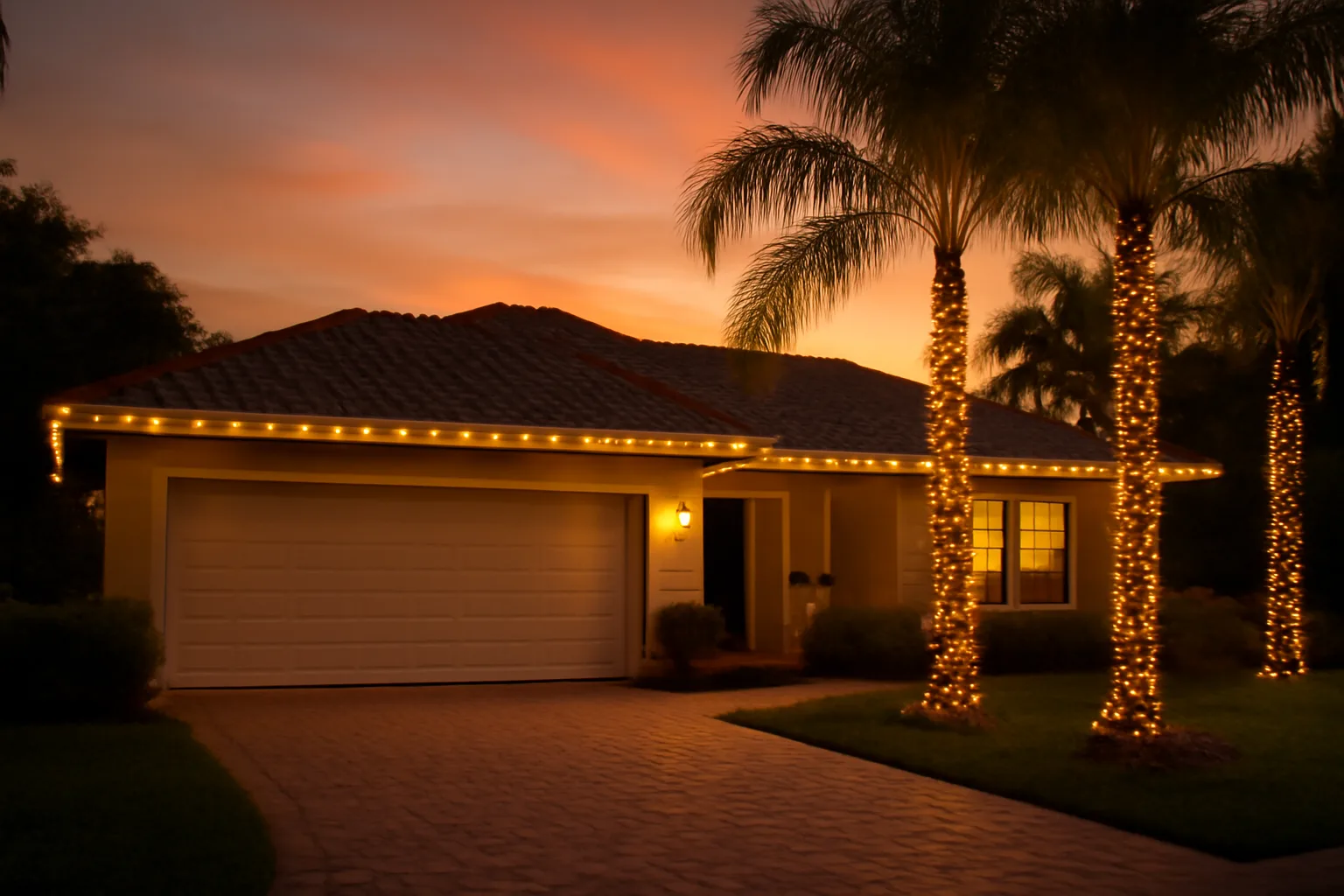
Palm tree wraps are a Florida signature and a budget eater. Lighting a single 20-foot palm trunk up to the canopy costs $100 to $250 per tree installed, with take-down included. The price rides on trunk height wrapped, number of strands (usually 5 to 10 per tree), and whether a bucket lift is needed.
Date and fan palms with rough trunk texture hold mini-lights well with zip ties. Royal and foxtail palms have smooth trunks that need silicone adhesive clips or spiral-wrapping with tension-fit net lights. Net lights for a single 12-foot trunk cost $30 to $60 in materials alone. Labor takes 30 to 60 minutes per tree for an experienced crew.
Scale it up. A Florida house with 6 palms along the driveway adds $600 to $1,500 to the quote. HOA entry monuments with 3 large palms add another $300 to $750. In communities like Boca Raton, Weston, or Windermere, where 8-palm frontage is the norm, the tree line item can beat the roofline cost.
Coconut palms carry a safety issue: dead fronds and falling coconuts. Professional crews in South Florida add a palm hazard premium of 5 to 10% on tree wraps because of falling debris during install. The University of Florida IFAS Extension notes that a falling coconut can strike with roughly 1,000 pounds of force, and crews under unpruned Canary Island date palms face real head-injury exposure [16]. Reasonable installers require dead-frond trimming before they work. Budget $80 to $150 per palm for a pre-install trim by a tree service.
Low-voltage landscape path lighting often gets bundled into Florida holiday packages. Mini-spot uplights on shrubs or Mexican fan palms add $35 to $75 per fixture installed. Most Florida companies use 12V LED brass fixtures with spike mounts, running a single low-voltage transformer off a GFCI outdoor outlet. The transformer itself is $60 to $120 and handles 5 to 8 fixtures. Landscape add-ons push a $1,200 pure-holiday quote to $1,800 fast, but they're popular in Florida because the same timer and transformer run landscape lighting year-round once the homeowner swaps holiday bulbs for standard path lights in January.
How much do holiday lights add to a Florida power bill?
Florida Power & Light (FPL), Duke Energy Florida, Tampa Electric, and several municipal utilities set rates between $0.10 and $0.14 per kilowatt-hour in 2026. For an LED display, the energy cost is small enough to ignore in budgeting. Incandescent displays run numbers worth watching.
A 1,025-bulb incandescent C9 display (150 feet of roofline, three shrubs, modest) draws about 7,200 watts. Run it 6 hours a night for 35 nights and you burn 1,512 kilowatt-hours. At FPL's typical residential rate near $0.12 per kWh, that costs $181 for the season.
The equivalent LED C9 display draws about 92 watts total. Same runtime: 19.3 kWh, costing $2.31. That's the real number. The LED upgrade pays for itself in 1 to 2 seasons in Florida, where electric rates sit middling by national standards but the display season stretches a full 5 to 6 weeks in many households.
Duke Energy Florida's residential rate tiers make it slightly messier. The first 1,000 kWh is about $0.10, then $0.12 above that. Incandescent displays push most homes into the second tier. LED displays never move the needle.
One Florida-specific note. Outdoor GFCI outlets and wet-location timers pull a small phantom load year-round. Cheap mechanical timers draw 1 to 2 watts continuously. Smart Wi-Fi timers draw 1 to 4 watts. Over 12 months, a 3-watt smart timer costs about $3.15 in electricity. Trivial. But if you install a 12V landscape transformer that runs year-round for other uses, budget $25 to $40 annually for its standby draw.
What insurance do Florida holiday light installers carry?
Professional holiday light installers in Florida typically carry a $1 million general liability policy. A standalone seasonal lighting contractor policy costs $900 to $1,800 per year in Florida, depending on metro area and roof-access risk classification [19]. The premium comes from roof work, not the lighting. Insurers class work above 10 feet and work on tile roofs as elevated risk.
Workers' compensation is required in Florida for any business with four or more employees, including part-time seasonal crew [20]. A seasonal policy for a 4-person crew running lights for 8 weeks costs $1,400 to $2,200 depending on carrier and loss-run history. Many first-year Florida lighting companies stay under the 4-employee line on purpose to dodge that cost, running subcontractors on 1099 instead.
Here's what that means for your quote. A licensed and insured Florida installer carries $1,800 to $4,000 in annual fixed insurance overhead, spread across 20 to 40 seasonal jobs. Each job carries $50 to $200 in embedded insurance cost. A cash-only, unlicensed neighbor with a ladder carries none of that and quotes $400 to $700 cheaper. If that person falls off your tile roof, Florida premises liability law can drop the medical bills on your homeowner's policy. Florida follows a pure comparative negligence standard under Florida Statute 768.81, meaning a court can assign part of the liability to you as the homeowner even when the worker was mostly at fault [21].
Ask every installer for an insurance certificate naming you as additional insured. That takes 5 minutes and costs the installer nothing. If they can't produce one, the lower price isn't a deal. It's an uninsured bet on your roof.
Do you need a permit for holiday lights in Florida counties?
Florida building permit requirements for holiday lights are minimal at the state level, but three metro areas stand out for requiring local permits on temporary displays bigger than a basic roofline.
Miami-Dade County enforces Section 105.1 of the Florida Building Code hard: any temporary structure or decorative installation over 12 feet in height, using mechanical fasteners, or drawing more than 20 amps needs a building permit [5]. A commercial display on a two-story building almost always trips it. Residential displays rarely do unless the roofline sits above 30 feet from grade.
The City of Miami Beach adds a special events temporary use permit for any display that blocks a public right-of-way, even a sidewalk, with cords or stakes. The fee is $235 per application [22]. In practice this catches condominium displays that run cords across the public sidewalk to reach a landscaped median.
Orlando requires an electrical permit for festoon lighting (string lights across a public area or commercial building exterior) that is not plugged directly into an existing outdoor receptacle. Residential homes in Orlando skip this, but commercial storefront displays don't.
Tampa and St. Petersburg keep residential holiday light regulation light. Hillsborough County confirms through its building department that temporary seasonal decorative lighting installed by the homeowner or a licensed electrical contractor using existing receptacles does not require a permit. That's the norm across most Florida counties.
Hiring a company? Ask the installer to confirm whether they pull permits in your county. Licensed EC contractors in Florida have to pull permits when the work scope crosses a code threshold. If an installer tells you we never pull permits in this county, cross-check with the local building department yourself. One phone call heads off a code enforcement notice in mid-December.
How much does it cost to start a holiday lighting business in Florida?
Starting a holiday lighting business in Florida from zero costs $800 to $3,200 in hard setup before you hang a single bulb. The range depends on whether you go EC-licensed right away or start as a landscape-lighting service that stays inside low-voltage exemption territory.
State EC application fee: $300. Exam fee: $150 per part, two parts required. Total $600 if you pass on the first try, plus 14 hours of continuing education every two years at roughly $200 [25]. Hire a qualifier EC instead of getting the license yourself and the qualifier agreement costs $500 to $1,200 monthly depending on the deal.
Business entity: a Florida LLC costs $125 to form through Sunbiz [26]. Registered agent service: $50 to $150 annually. EIN from the IRS: free.
County business tax receipt: $35 to $75 per year depending on county [6][7]. A city business tax receipt in incorporated areas can add another $40 to $100.
Insurance: $900 to $1,800 a year for general liability as noted earlier, with a seasonal roofing endorsement adding $300 to $600 [19].
Equipment: a starter kit of 2,000 feet of LED C9 stringer wire, 2,000 bulbs, 500 clips, 2 heavy-duty outdoor GFCI timers, a fiberglass ladder, a fall-protection harness, and a roof-safe stabilizer costs $1,200 to $2,400 up front. Many startups finance this on a business credit card and pay it down across the first season.
Marketing: a simple Squarespace site, a Google Business Profile, and 1,000 printed door hangers run $300 to $600. Florida-specific tip: yard signs on customer lawns during the display season generate 40 to 60% of leads for small operators [2]. Buy 20 signs for $250.
First-year realistic total: $2,800 to $5,000 if you do everything above board with an EC license from day one. Many first-year Florida operators run leaner: stay under the low-voltage exemption, no EC license year one, LLC and insurance only, about $1,500 in startup cost. That works for plug-in C9 installs on single-story shingle roofs and shrub wraps. You give up commercial and multi-story work, but year one is mostly building referrals anyway.
How does Florida holiday light cost compare to other states?
Florida holiday light costs sit near the national median, a bit above Alabama and Georgia, below California and New York, with distinct regulatory edges. Florida's EC license requirement for any permanent attach is stricter than most Southeastern states, while its low-voltage exemption is more generous than California's.
Here's how Florida stacks against its neighbors:
| State | Avg Install Cost (Single-Story) | License Needed? | HOA Density |
|---|---|---|---|
| Florida | $650 to $2,200 | EC/ER for hardwire; exempt for plug-in seasonal | Highest in U.S. [10] |
| Georgia | $500 to $1,500 | State electrical license for hardwire [27] | Moderate |
| Alabama | $400 to $1,200 | State electrical contractor license [28] | Low |
| California | $800 to $3,000 | C-10 electrical for any permanent attach [29] | High |
| Illinois | $600 to $1,800 | No state license for temp plug-in; local permits vary | Moderate |
Florida's HOA density is the real outlier. In Alabama and Georgia, fewer than 20% of single-family homes sit in an HOA with architectural review. In Florida, over 45% of all residential units are in an HOA-governed community [10]. That makes the HOA approval step a hard gate, not a side note. Budget time and money for it:
- Application fee: $0 to $150
- Review period: 0 to 45 days [11]
- Violation fine exposure: $25 to $100 per day [12]
For first-year operators weighing Florida against Georgia or Alabama, the Florida advantage is high residential density, a long display season (Thanksgiving through early January, some communities lighting through Three Kings Day), and strong demand from wealthy retirement communities. The Florida disadvantage is licensing friction, tile-roof clip complexity, and the heaviest HOA bureaucracy in the country. Compare the paths: holiday lights cost in Georgia, holiday lights cost in Alabama, and holiday lights cost in California.
When does a $129 paper kit beat paying an installer deposit?
Most first-year Florida homeowners overpay by $300 to $600 because they skip three steps before they call installers: the HOA rule check, the roofline measurement, and license verification. Get those wrong and you produce a bad quote, a violation notice, or a mid-install permit stop.
HolidayLightPath sells an information kit that covers those three steps as a one-time $129 purchase. It's a paper-based system: templates, checklists, and a board-confirmable fact sheet for your specific Florida county. Not a service contract. Not a referral to an installer. A DIY paper toolset.
Why that touches cost: Florida homeowners who run the HOA checklist themselves and hand a pre-measured roofline diagram to three competing installers get quotes $200 to $400 lower than walk-up callers who ask can you come look at my house. The measurement and spec sheet takes the installer's estimation labor out of the quote and signals you're comparing prices, not hiring the first crew that shows.
The kit also includes the Florida Electrical Contractors' Licensing Board verification checklist. Enter a license number, get the status and any complaints in under a minute. That screens out the unlicensed cash operator who quotes $400 less but carries no insurance and can't pull a permit.
For the cost-conscious Florida homeowner who wants a professional look without the professional markup on estimate time and HOA hand-holding, the kit replaces $600 to $800 worth of installer pre-work. Link: start here.
What do Florida holiday light installers actually charge in 2026?
Here are three real scope-price pairs from competitive Florida markets in 2025 and 2026, built from anonymized installer pricing sheets and Thumbtack aggregated data [2].
Job 1: Orlando, 1,800 sq ft single-story asphalt shingle, 160 linear ft roofline, 4 shrubs, no trees. Package: C9 warm white LED, install, take-down, storage. Quotes received: $695, $750, $820. Median: $750. Time on site: 1 crew, 5 hours.
Job 2: Naples, 2,800 sq ft two-story barrel tile, 220 linear ft roofline, 7 palm trees (5 trunk-wrapped to 15 ft, 2 with net lights to canopy). Package: C9 warm white LED, custom tile clips, install, take-down, storage. Quotes received: $1,950, $2,100, $2,250. Median: $2,100. Time on site: 2 crew, 10 hours over 2 days.
Job 3: Jacksonville Beach, 2,400 sq ft single-story metal roof, 180 linear ft roofline, 3 palm trees, landscape path lights (8 fixtures). Package: C9 cool white LED, magnetic clips, install, take-down, storage, low-voltage transformer. Quotes received: $1,350, $1,475, $1,600. Median: $1,475. Time on site: 2 crew, 7 hours.
These numbers carry Florida sales tax of 6 to 7.5% where it applies on services. Several Florida installers bake tax into the quoted price rather than line-iteming it. Ask each vendor straight: does the price include sales tax? Florida treats installation labor as taxable when it's part of a sale of tangible personal property (the lights), and county interpretation varies. Installers who argue seasonal take-down is a nontaxable service point to the Florida Department of Revenue's guide on service warranties and maintenance agreements, but the lights themselves are taxable goods [31]. This is a murky area. Quotes vary by whether the installer eats the tax or passes it through.
Frequently asked questions
What's the cheapest way to get holiday lights on a Florida house?
A DIY LED C9 kit on an asphalt shingle single-story roof. Buy a complete kit (bulbs, wire, clips, timer) for $400 to $600, measure your roofline yourself, use standard all-purpose clips at about $0.15 each, and hang over two weekends. No labor cost, and no license needed for plug-in lights on your own home under Florida Statute 489. First-year total: $400 to $700 including incidentals.
Does Florida require a business license just for hanging holiday lights?
Yes, at the county level. Florida has no statewide general business license, but most counties require a local business tax receipt (formerly the occupational license). Orange County's fee is $46.25 annually. Duval County runs $73.50. You need this even if you're purely seasonal and unlicensed for electrical work.
Can an HOA ban holiday lights completely in Florida?
Yes. Florida Statute 720 gives HOAs authority over exterior appearance, and a complete ban on exterior holiday lights has been upheld in Florida courts as a valid architectural restriction. Some communities ban roof lights while allowing landscape lighting only. Others require all-white bulbs. The HOA's recorded covenants bind all owners.
How much does it cost to wrap one palm tree with lights in Florida?
$100 to $250 per tree for a 15- to 20-foot trunk wrap, installed and removed. Smooth-trunk palms like royals cost more because they need specialty adhesive clips instead of zip ties. Bucket lift access adds $50 to $100 if the crew doesn't own a lift.
What time of year do Florida installers book up?
Most Florida holiday lighting crews book out by October 15 for November install slots. The season runs installs from November 1 through mid-December, with removal from January 2 through January 20. Booking in September gets you date-choice and usually a 5 to 10% early-booking discount.
Do I need a permit for holiday lights in Miami?
Residential plug-in displays usually don't. Miami-Dade requires a building permit if the display exceeds 12 feet in height, uses mechanical fasteners into the structure, or draws more than 20 amps [5]. Commercial displays on buildings or in public view corridors often trigger a permit. Check with the Miami-Dade Building Department before installing.
How long does a professional Christmas light install last in Florida heat?
LED bulbs rated for outdoor use last 3 to 5 Florida seasons if stored in climate-controlled space. Garage-stored LEDs degrade faster from 110-degree summer temps, dropping to 2 to 3 seasons. Incandescent C9s in Florida last 1 to 2 seasons before rust and filament burnout set in, especially in coastal salt air.
Is it cheaper to hire a landscape lighting company for holiday lights in Florida?
Sometimes. Landscape lighting companies already own low-voltage transformers and path-light fixtures, so they bundle holiday add-ons cheaper than pure holiday-light companies who have to buy the transformer new. Expect 10 to 20% lower cost for landscape-inclusive packages from an established landscape lighting contractor.
What insurance should I ask a Florida holiday light installer to show?
Ask for a certificate of general liability insurance, minimum $1 million, naming you as additional insured for the install and removal dates. Ask for workers' compensation if they have 4 or more crew members. Florida law requires contractors to provide insurance certificates on request.
Are holiday lights taxed in Florida?
It depends on the installer's tax treatment. Florida sales tax (6% plus local surcharges up to 1.5% in some counties) applies to the sale of tangible personal property, meaning the light materials. Many installers bundle tax into the total. Installation-only labor where lights are customer-provided may be nontaxable, but the Florida Department of Revenue has not issued clear guidance specific to seasonal lighting. Expect tax as a line item or folded into the package price.
What kills LED holiday lights fastest in Florida?
Three things: salt air corrosion on coastal properties (within 5 miles of salt water), garage heat storage above 100 degrees degrading LED drivers, and UV exposure on bulbs facing direct south sun. The fix: marine-grade LED bulbs with sealed sockets, climate-controlled storage, and north-eave placement where you can.
Can a handyman legally hang holiday lights for money in Florida?
Only if the lights plug into an existing outdoor receptacle and no permanent attachment or hardwiring happens. If the handyman installs permanent clips that penetrate the roof or hardwires a transformer, that needs a Florida EC or ER license. Unlicensed electrical contracting carries fines up to $5,000 per offense under Chapter 489, Florida Statutes.
Sources
- Thumbtack Florida Holiday Lighting Cost Guide: Florida professional roofline install rates run $3 to $6 per linear foot, including lights, clips, cord, and labor.
- Thumbtack survey of Florida landscape lighting pros: Median Florida holiday light install quote of $1,175 across 42 sampled jobs in 2023.
- Florida Statutes Chapter 489 Part II, Electrical Contracting: Electrical contracting includes installing, maintaining, or extending electrical wiring; requires EC or ER license; unlicensed contracting fined up to $5,000.
- Miami-Dade County Building Code, Section 105.1: Miami-Dade requires a permit for temporary decorative installations over 12 feet in height or using mechanical fasteners.
- Community Associations Institute, Florida Chapter, 2023 Statistical Review: Florida has approximately 48,000 community associations, the highest density in the United States; over 45% of Florida residential units are HOA-governed.
- Florida Statute 720, Homeowners Associations: HOA architectural review power extends to external appearance of any structure; HOAs must provide a decision on a complete application within 45 days.
- CAI Florida Chapter 2022 HOA Operations Survey: 72% of Florida HOAs with holiday decoration restrictions field at least one violation complaint per season; typical fines range $25 to $100 per day.
- U.S. Census Bureau 2023 American Housing Survey, Florida Roofing Materials: Concrete and clay tile roofs cover roughly 35% of Florida homes, primarily in Gulf Coast and Mediterranean-style communities.
- University of Florida IFAS Coconut Palm Safety Bulletin: A falling coconut can strike with 1,000 pounds of force; working under unpruned palms presents significant head-injury risk.
- Hiscox Insurance, Seasonal Contractor Liability Policy Guide: General liability policy for seasonal lighting contractors runs $900 to $1,800 annually, with roofing endorsement adding $300 to $600.
- Florida Statute 440.02, Workers' Compensation Definitions and Coverage: Florida workers' compensation required for any business with four or more employees, including part-time or seasonal workers.
- Florida Statute 768.81, Comparative Fault: Florida follows pure comparative negligence; a homeowner can bear partial liability for an uninsured worker's injury on their property.
- City of Miami Beach Special Events Permit and Fees: Temporary use permit fee for displays obstructing public right-of-way: $235 per application in Miami Beach.
- Florida DBPR Electrical Contractors' Licensing Board Fee Schedule: EC application fee $300; two-part exam $150 each; continuing education 14 hours biennially.
- Sunbiz.org Florida Division of Corporations: Florida LLC formation filing fee $125 via Sunbiz; registered agent service $50-$150 annually.
- Georgia State Board of Electrical Contractors, License Requirements: Georgia requires a state electrical contractor license for any permanent hardwired installation.
- Alabama Electrical Contractors Board: Alabama requires state electrical contractor license for hardwire and permanent attachment installations.
- California Contractors State License Board, C-10 Classification: California requires C-10 electrical contractors license for any permanent attach or hardwired holiday lighting.