Last updated 2026-08-18
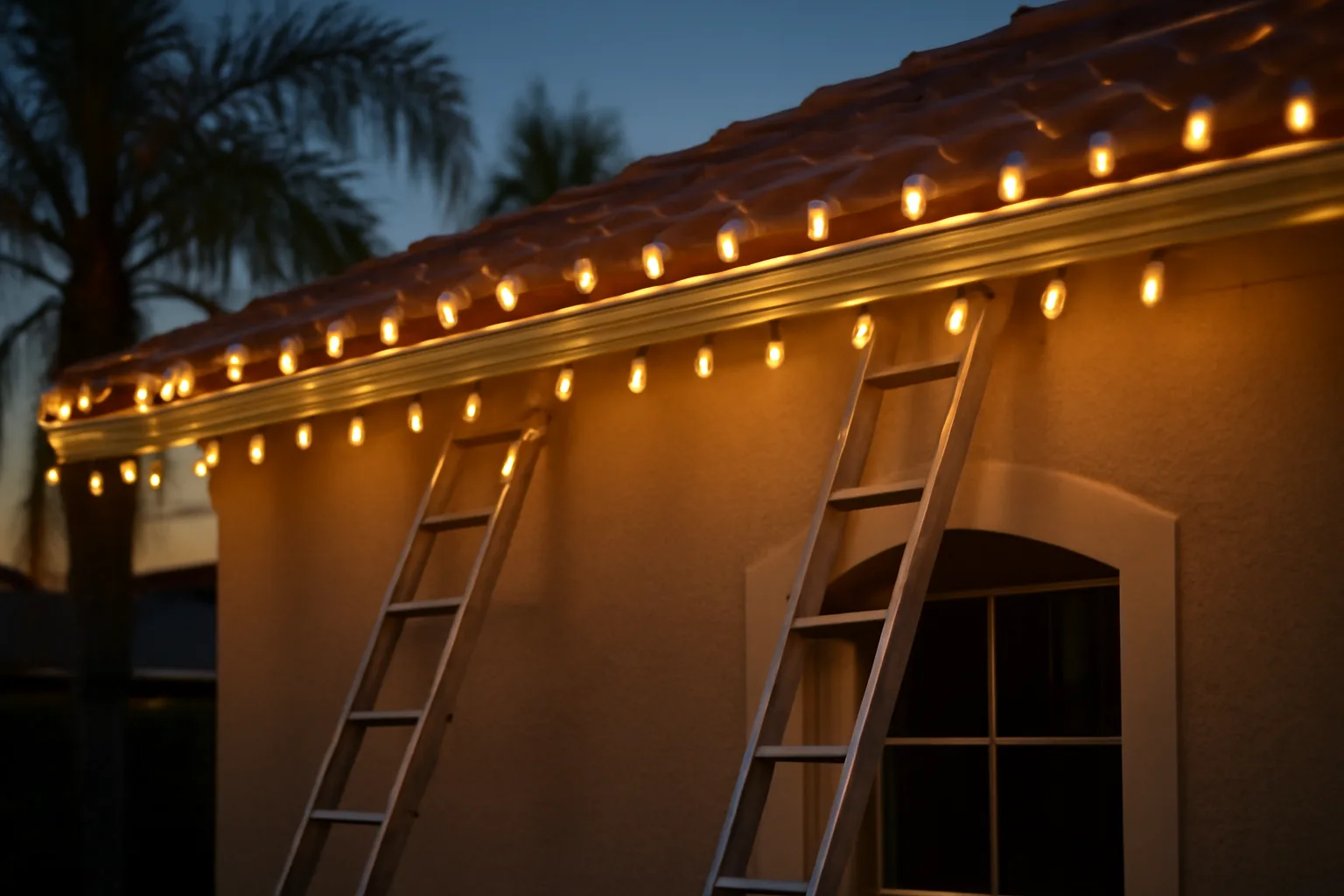
TL;DR
Florida has no single holiday lights board. Commercial installers need a business tax receipt from the county or city where they work, plus a county or state electrical contractor license if they do any wiring beyond plug-in lights. Pro installation runs $150 to $200 per labor hour. Start the paperwork 60 days before your first hang, and check the rules in every city you serve.
Is there a holiday lights board in Florida?
No. Florida charters no holiday lights board and issues no seasonal lighting license. The state regulates electrical work through the Department of Business and Professional Regulation (DBPR) and the local construction industry licensing boards in each county. Holiday lights installers land in two existing buckets: electrical contracting (low voltage or line voltage), and general business operations.
For most plug-and-play residential installs, you operate as a general service business. The moment you splice wire, install dedicated outlets, or touch the home's electrical system, Florida Statute Chapter 489 may require a certified electrical contractor's license from the Electrical Contractors' Licensing Board [1].
"A person may not engage in the business of contracting in this state without first being certified or registered," reads F.S. 489.113 [1]. The DBPR's Certified Electrical Contractor definition covers anyone who installs, repairs, or maintains electrical wiring, fixtures, or apparatus [2]. Temporary outdoor lights with factory sealed plugs usually stay outside that scope. Hardwired permanent trim lights do not.
Do you need a license for holiday lights in Florida?
Yes, for most commercial work. The answer splits in two: a local tax receipt, and maybe an electrical license. Every for-profit business operating in a Florida municipality needs a local business tax receipt, often still called an occupational license. You get it from the city or county where your business sits, and sometimes from each municipality where you work.
Miami-Dade County requires a Local Business Tax Receipt for "any person who maintains a business location or who solicits or transacts business in the county" [3]. The county charges a base rate and municipalities like the City of Miami add their own fee. Orange County's Tax Collector issues receipts and tells applicants to check with individual cities for extra requirements [4].
For electrical work, county rules control. Broward County's Central Examining Board requires a Certificate of Competency for electrical contractors working on any electrical system [5]. Pinellas County's Construction Licensing Board licenses electrical contractors doing work beyond plug-in devices [6]. Hang only C7 or C9 bulbs with factory leads into existing GFCI outlets, and you're selling labor, not regulated contracting, in most Florida jurisdictions. Confirm it with the local building department by phone before you quote.
The DBPR also issues state certified licenses. A state certified electrical contractor works anywhere in Florida with no county competency exams [1]. That path costs more and takes longer. The state electrical contractor exam fee runs $215 for the application and $80 for the exam, and biennial renewal is $300 [7].
How much does holiday lights cost in Florida?
Homeowners hiring a pro in Florida paid a median of $150 to $200 per labor hour for full service holiday light installation in 2024 and 2025, based on national service platform data across Sun Belt markets [8]. A single story roofline with one peak and two gutter lines runs 2 to 3 hours and totals $500 to $1,500 including lights, hanging, and takedown.
Larger homes break down roughly like this for a full design and install package with premium commercial grade LED bulbs (C9 warm white, roof clips, custom cut strings):
| Home Size | Typical Labor Hours | All-In Cost Range |
|---|---|---|
| Single story, basic roofline | 2-3 | $500-$1,500 |
| Two story, roofline plus windows | 4-6 | $1,500-$3,500 |
| Large estate, full wrap plus trees | 8-15+ | $3,500-$8,000+ |
These rates reflect a Florida market where cheap labor and mild weather keep overhead below snowbelt states. Bulk commercial LED C9 bulbs run about $0.30 to $0.60 each from wholesale distributors. A 1,000 foot spool of SPT-2 wire costs roughly $0.15 per foot. A $129 kit like the Hang + HOA + Take Down Kit from HolidayLightPath handles the paperwork side, but materials alone on a typical 2,500 square foot home start around $200 to $600 depending on bulb spacing and clip style.
Installers billing their own jobs should target a 40 to 50 percent gross margin on materials, and bill labor separately at the $150 to $200 rate. Some Florida crews charge a flat design fee of $75 to $200 for the consultation and render. Others fold it into the job. The market supports both.
How long does holiday lights take in Florida?
Three clocks run at once: startup, per-job installation, and season schedule. Startup to legal operation takes 30 to 60 days. A local business tax receipt clears in 1 to 3 weeks in most counties. Miami-Dade's online system issues receipts in about 10 business days once you submit the application and $57.50 minimum fee [3]. Need a county electrical competency card in Broward or Pinellas? Add 4 to 6 weeks for application review, reference checks, and the exam date [5][6].
On install day, a basic roofline takes 2 to 3 hours with a 2 person crew. Complex designs with multiple rooflines, dormers, bushes, and tree wraps eat a full 6 to 8 hour day. Florida's flat terrain and lack of ice dams speed up ladder work compared to northern markets, though afternoon thunderstorms in July and August can push pre-season installs. Most veteran crews book Florida installs between October 1 and November 15.
Takedown runs faster, about half the install time, and starts January 2 through January 31. The full cycle for one home, proposal to takedown, spans about 90 days: 30 days lead time for design and prep, install day, then 60 days lit before takedown. Some HOAs enforce shorter display windows. Read the covenant before you quote.
Permits rarely slow you down. Most Florida building departments require no stand-alone permit for temporary holiday lighting that plugs into existing circuits and leaves the structure alone. Confirm it by email with the local building official before your first season and you avoid the surprise.
What Florida county and city business tax receipts do holiday lights installers need?
Every Florida holiday lights installer, even a one person sole prop, hits the local business tax receipt first. The state killed its flat business license in 1971. Each county and city now sets its own tax rate and receipt classification.
Here is what the major metro areas require, from their published fee schedules as of 2026:
| Jurisdiction | Receipt Name | Minimum Fee | Renewal Cycle |
|---|---|---|---|
| Miami-Dade County | Local Business Tax Receipt | $57.50 | Annual by September 30 |
| City of Miami | Local Business Tax Receipt | Varies by category, ~$55 | Annual |
| Broward County | Local Business Tax Receipt | $39.00 | Annual by September 30 |
| Palm Beach County | Local Business Tax Receipt | $38.50 | Annual by September 30 |
| Orange County | Business Tax Receipt | $46.25 | Annual by September 30 |
| Hillsborough County | Business Tax Receipt | $41.00 | Annual by September 30 |
| Duval County (Jacksonville) | Business Tax Receipt | $46.25 | Annual by September 30 |
These are floor numbers. Your exact fee depends on the business classification. "Service establishment, miscellaneous" is the usual catch-all for seasonal lighting. Some counties tack on $10 to $25 for each branch location if you operate in multiple cities. Call the city tax collector in bigger municipalities like Orlando, Tampa, and St. Petersburg even if you already hold a county receipt. The Florida League of Cities represents more than 400 municipalities in the state, and many issue their own tax receipts on top of the county's [9].
Miss the September 30 renewal deadline and most counties start the penalty at 10% of the tax, climbing to 15% after the first month and 20% after two months. Miami-Dade charges a $5 late fee per month capped at 25% of the tax due [3].
What electrical licensing rules apply to seasonal lighting in Florida?
Florida draws a line between plug-in temporary lighting and electrical contracting. That line matters. Cross it without a license and you face a first-degree misdemeanor under F.S. 489.127, up to one year in jail and a $1,000 fine [1]. The DBPR can pile on a $500 to $5,000 administrative fine per occurrence.
Here is where the line sits in practice. Hanging factory-made light strings with fused plugs into an existing outdoor GFCI receptacle: not contracting. Installing a new 15-amp outdoor outlet to power the lights: contracting. Splicing custom C9 sockets onto SPT-2 wire with a vampire plug: the state and county boards split on this one. Broward County's Central Examining Board treats any field assembly of lighting components as electrical work requiring a license. Pinellas County looks harder at whether the work touches the home's permanent wiring [6].
"Certified Electrical Contractor means a contractor whose services are unlimited in the electrical trade and who is qualified to install, repair, alter, add to, or design electrical wiring, fixtures, apparatus, and equipment," states DBPR Rule 61G6-6.015 [2]. Most seasonal crews dodge the ambiguity by installing factory-sealed products only, or by subcontracting a licensed electrician for any outlet or panel work.
The DBPR application for a state certified electrical contractor requires 4 years of verifiable experience, a credit report, proof of general liability and workers' compensation insurance, and a passing score on the two part exam [7]. That path costs roughly $900 to $1,300 in application, exam, and initial license fees, plus the required 14 hour continuing education course every biennium.
Insurance and workers' comp requirements in Florida
Florida's workers' compensation law, Chapter 440, requires coverage for any construction industry business with one or more employees, including part time and seasonal hires [10]. An installer who owns the business and does all the work alone may qualify as an exempt corporate officer, but only after filing a notice of election to be exempt with the Florida Division of Workers' Compensation.
General liability insurance is not a state requirement for a business tax receipt. It is a practical one. Homeowner associations and property managers in Florida almost always demand a certificate of insurance naming the HOA as an additional insured before you set a ladder on a roof. A $1 million per occurrence, $2 million aggregate liability policy is the standard ask. Policies for seasonal lighting businesses in Florida run $400 to $800 per year through specialty insurers like Next or Hiscox.
Drive for the business and Florida Statute 627.733 requires personal injury protection (PIP) and property damage liability on every titled vehicle. A commercial auto policy costs $50 to $120 per month for a single van, depending on your driving record and the vehicle's value.
HOA rules and local ordinances: what they can and can't restrict
Florida HOAs hold broad power under Chapter 720, the Homeowners' Association Act, to regulate exterior holiday displays: installation methods, bulb colors, and how long the display stays up [11]. The statute lets HOAs regulate the exterior appearance of structures as long as the restriction lives in the recorded governing documents.
An HOA cannot ban holiday lights outright if the declaration never granted that power. It can require specific clip types that spare shingles, mandate removal by January 15, and bar certain colors or blinking patterns visible from the street. Request the current architectural guidelines from the management company before you submit a proposal.
City noise ordinances matter too. Most Florida cities restrict amplified music past 10 p.m. and cap generator noise after 8 p.m. These rules live in the municipal code, not a holiday lights board. Orange County's noise ordinance bars sounds plainly audible at 50 feet from the property line for more than 30 minutes between 10 p.m. and 7 a.m. [12]. It rarely bites on Christmas music, but a loud generator running a mega display in a dense subdivision draws code enforcement complaints fast.
For commercial installers, these rules are a sales opportunity. Every HOA runs its own playbook. Every job needs a quick document pull. A $129 system like the HolidayLightPath Hang + HOA + Take Down Kit keeps the board-relevant paperwork in one place, which helps when you're filing your 15th HOA architectural review of the week.
Steps to start a holiday lights business in Florida
1. Choose a business structure and register with Sunbiz, the Florida Division of Corporations. An LLC costs $125 to file online and clears in about 3 to 7 business days. Check name availability first.
2. Get an EIN from the IRS at irs.gov. Fifteen minutes online, and free.
3. Apply for your county business tax receipt through the county tax collector's online portal. Budget $40 to $60 for the initial fee. Serve multiple cities, and check each municipal clerk's office for extra business tax requirements.
4. Decide if you need an electrical contractor license. Call the local building department in your primary county. Describe the exact work: "I hang factory sealed C9 LED light strings with plastic clips on gutters and shingles, plug into existing exterior GFCI outlets. No new wiring." Get their determination in writing, ideally by email.
5. Buy general liability insurance. Minimum $1 million per occurrence. Add HOAs as additional insureds on a certificate. Budget $400 to $800 annually.
6. File for a workers' comp exemption if you do all the work yourself, or buy a policy if you have any employees. The Division of Workers' Compensation exemption application is free and processes in 10 to 14 days.
7. Set up sales tax collection with the Florida Department of Revenue. Florida charges a 6% state sales tax on tangible personal property, including Christmas lights sold to the customer [13]. Most counties add a discretionary sales surtax of 0.5% to 2%. Itemize materials separately on the invoice and you collect sales tax on that portion. Labor to install the materials is generally not taxable if you state it separately.
8. Open a dedicated business bank account. Business tax receipts, insurance certificates, and client payments all belong in a business account, not a personal one. It keeps the corporate veil intact for your LLC.
Common mistakes new Florida installers make
Skipping city-level business tax receipts is the mistake I see most. A county receipt in Orange County does not cover work inside Orlando city limits. Orlando issues its own receipt with its own fee and its own renewal date. Ignore it and the city may hand you a code enforcement citation, usually $100 to $250 for a first offense.
The second common error: calling the DBPR, asking "do I need a license for holiday lights," and treating a verbal no as final. DBPR phone staff answer from state statutes. County construction licensing boards enforce their own rules. Broward County can and does issue cease and desist orders to unlicensed contractors doing field assembled lighting work [5]. Get the county's determination in writing.
Third mistake: starting late. Early September is too late to apply for a county electrical competency card and expect to work in October. Exams schedule months out. Broward's Certificate of Competency exam runs quarterly, and the application deadline falls 45 days before the test date. Miss it and you wait three months for the next sitting.
Fourth: skipping Florida sales tax on materials. The Department of Revenue runs audit sweeps. An audit that finds unreported material sales over two seasons can generate a back tax bill with a 10% penalty and interest running from the original due date.
How to check licensing and tax rules in your specific Florida location
No statewide tool aggregates every municipal tax receipt requirement. You check three layers by hand.
Layer one: your home county tax collector's business tax receipt page. Start at flcounties.com, find your county, and follow the link to the tax collector site.
Layer two: the Florida DBPR license search at myfloridalicense.com for any electrician you plan to subcontract. Confirm the license is active and complaint free.
Layer three: the city clerk's office for every city where you'll quote a job. Call and ask: "I hold a county business tax receipt. Does your city require an additional business tax receipt for a seasonal lighting service business?" Write down the clerk's name and the date. That note protects you if a different city employee later claims you needed one.
For electrical scope questions, the local building department is the authority. Find the phone number on the county or city website under Building and Permitting. Florida Building Code Administrative Chapter 1 gives local building officials authority to determine the scope of work requiring a permit [14].
Florida holiday lights cost and timeline by the numbers
Here are the real numbers pulled together from the sources above, plus market data, as a reference table you can screenshot and save:
| Item | Range | Source |
|---|---|---|
| County business tax receipt | $38.50-$57.50 initial | [3][4] |
| State electrical contractor exam + application | $295 initial | [7] |
| General liability insurance (annual) | $400-$800 | National avg for seasonal |
| Workers' comp exemption filing | $0 | FL Div. Workers' Comp |
| LLC filing (Sunbiz) | $125 | Sunbiz fee schedule |
| Commercial LED C9 bulbs (each, wholesale) | $0.30-$0.60 | Industry suppliers |
| SPT-2 wire (per foot, bulk) | $0.15 | Industry suppliers |
| Labor rate (per hour, Florida pro) | $150-$200 | [8] |
| Basic install time (single story) | 2-3 hours | Industry surveys |
| Full install to takedown cycle | 60-90 days | Operational norm |
| Startup timeline (all clearances) | 30-60 days | Processing averages |
These numbers assume a plug-in residential lighting service using factory sealed products, no structural changes, and no hardwired outlets. Every variable shifts with county rules and the specific house. Confirm before you quote.
What Florida's mild winter means for the holiday lights season
Florida's climate changes the seasonal lighting business in three ways. Demand peaks earlier. Snowbirds arrive in October and November, and HOAs want common area decorations up by Thanksgiving week at the latest. The booking window runs tight: August through October for residential installs.
Heat and UV degrade components faster. Commercial grade LED bulbs rated for 50,000 hours in northern climates still hit that rating in Florida, but wire insulation, clips, and plastic stakes crack after two to three seasons if they bake in direct sun year round. Use UV stabilized components and store off-season inventory in a climate controlled unit.
Hurricane season overlaps with peak install prep. September is the most active month for Florida hurricane landfalls, and that is exactly when you should be quoting and booking. Put a weather contingency clause in your contract. Standard language: "Installer reserves the right to delay installation up to 7 calendar days if a tropical storm or hurricane watch has been issued for the installation zip code."
Most Florida holiday lights pros build route density in gated communities and subdivisions, where one HOA approval opens dozens of homes. Cost per acquisition drops. The referral network tightens. The seasonal rhythm syncs across the whole neighborhood. That geography driven route density is why many Florida installers net $30,000 to $60,000 in a two month season, even at the moderate labor rates quoted above.
Frequently asked questions
Do you need a license for holiday lights in Florida?
A local business tax receipt from your county and city is required for any for-profit holiday lights installation business in Florida. If you perform electrical work beyond plug-in lights, the state requires a certified electrical contractor license through the DBPR and possibly a county competency card. Contact your county building department for the exact scope determination.
How much does holiday lights cost in Florida?
Professional installation ranges from $500 to $1,500 for a standard single story roofline, including lights and labor. Larger homes with full wraps run $3,500 to over $8,000. Labor rates in Florida average $150 to $200 per hour. Material costs add $200 to $600 for a typical home using commercial grade LED bulbs and custom cut wire.
How long does holiday lights take in Florida?
A basic roofline takes a 2 person crew roughly 2 to 3 hours to install. Full estate wrap projects take a full 6 to 8 hour day. The startup timeline to get licensed, insured, and tax compliant averages 30 to 60 days. Start the process by August to be ready for October bookings.
What is a local business tax receipt in Florida?
A local business tax receipt, formerly called an occupational license, is a tax that Florida counties and cities impose on any person or business operating within their jurisdiction. The fee typically runs $38 to $58 annually in Florida. You obtain it from the county tax collector's office and possibly from each city where you work.
Do I need an electrical license to hang Christmas lights in Florida?
If you only hang factory-made light strings with molded plugs that connect to existing GFCI outlets, most Florida counties do not require an electrical contractor license. Any new wiring, hardwired outlets, or field splicing of custom components likely triggers the license requirement. Confirm in writing with the local building official.
Do Florida HOAs have rules about holiday lights?
Yes. Florida Statute Chapter 720 grants HOAs the power to regulate exterior appearance, including holiday displays. Common restrictions include approved clip types to prevent shingle damage, color and blinking pattern limits, display window dates, and a mandatory takedown by mid-January. Always request the current architectural guidelines.
How do I start a Christmas light installation business in Florida?
Register an LLC with Sunbiz ($125), get an EIN from the IRS, obtain your county and city business tax receipts, secure general liability insurance, file for workers' comp or an exemption from the state Division of Workers' Compensation, and register for sales tax collection with the Florida Department of Revenue. The full process takes about 30 days.
What insurance do I need for a holiday lights business in Florida?
At minimum, general liability insurance of $1 million per occurrence and $2 million aggregate. HOAs and property managers demand it and usually require being named as an additional insured. Workers' compensation is mandatory under Florida law if you have any employees. Policies for seasonal work run $400 to $800 per year.
How do I check if an electrician is licensed in Florida?
Use the Florida DBPR license search tool at myfloridalicense.com. Enter the contractor's name or license number. The database shows current status, complaint history, and expiration date. Verify this before subcontracting any electrical work to a third party.
What is the penalty for working without an electrical license in Florida?
Under Florida Statute 489.127, unlicensed electrical contracting is a first-degree misdemeanor, punishable by up to one year in jail and a $1,000 fine. The DBPR can also levy administrative fines of $500 to $5,000 per incident. County building departments may issue stop work orders and code enforcement fines.
Do I need to collect sales tax on holiday light installation in Florida?
Yes, on the tangible personal property portion. Florida charges a 6% state sales tax plus a county discretionary surtax on Christmas lights, wire, clips, and other materials sold to the customer. Labor to install those materials is generally not taxable if stated separately on the invoice. Register with the Florida Department of Revenue.
When is the best time to book holiday light installation in Florida?
Bookings open in August and fill through October. Snowbird arrivals and HOA requirements push the demand curve earlier than Northern states. Installations begin in October and run through Thanksgiving week. Waiting until November means most established crews are fully booked.
Does Florida have a statewide holiday lights license?
No. Florida issues no seasonal lighting license and charters no holiday lights board. Regulation happens at two levels: the county or city business tax receipt for operating a business, and county or state electrical contractor licensing if the work goes past plug-in lights. Check both layers in every jurisdiction where you work.
Do I need a separate business tax receipt for every Florida city I work in?
Often yes. A county receipt does not always cover work inside a city's limits. Cities like Orlando, Tampa, and St. Petersburg issue their own receipts with separate fees and renewal dates. The Florida League of Cities represents more than 400 municipalities, many of which impose their own tax. Call each city clerk before quoting.
Sources
- Florida Legislature, F.S. 489.113 and 489.127: Qualifying for electrical contracting licensure in Florida and penalties for unlicensed work.
- Florida DBPR, Rule 61G6-6.015: Definition of Certified Electrical Contractor.
- Orange County Tax Collector, Business Tax Receipts: Orange County business tax receipt requirements and fees.
- Broward County Central Examining Board, Electrical Contractor Licensing: Broward County requirements for electrical contractor licensing and scope of regulated work.
- Pinellas County Construction Licensing Board: Pinellas County electrical contractor licensing authority and scope.
- Florida DBPR, Electrical Contractors' Licensing Board Fee Schedule: State certified electrical contractor application fee $215, exam fee $80, biennial renewal $300.
- Angi, Cost to Hang Christmas Lights: National labor and all-in cost ranges for professional holiday light installation.
- Florida Legislature, F.S. Chapter 440: Florida workers' compensation coverage requirements for construction industry businesses with employees.
- Florida Legislature, F.S. Chapter 720: HOA authority to regulate exterior appearance of structures, including holiday displays.
- Orange County Code of Ordinances, Sec. 15-181: Orange County noise ordinance restrictions on plainly audible sounds at property line.
- Florida Department of Revenue, Sales and Use Tax Guide: Florida 6% state sales tax on tangible personal property, county discretionary surtax, and general exemption for separately stated service labor.
- Florida Building Code, Administrative Chapter 1: Authority of local building officials to determine scope of work requiring a permit.