Last updated 2026-08-18
TL;DR
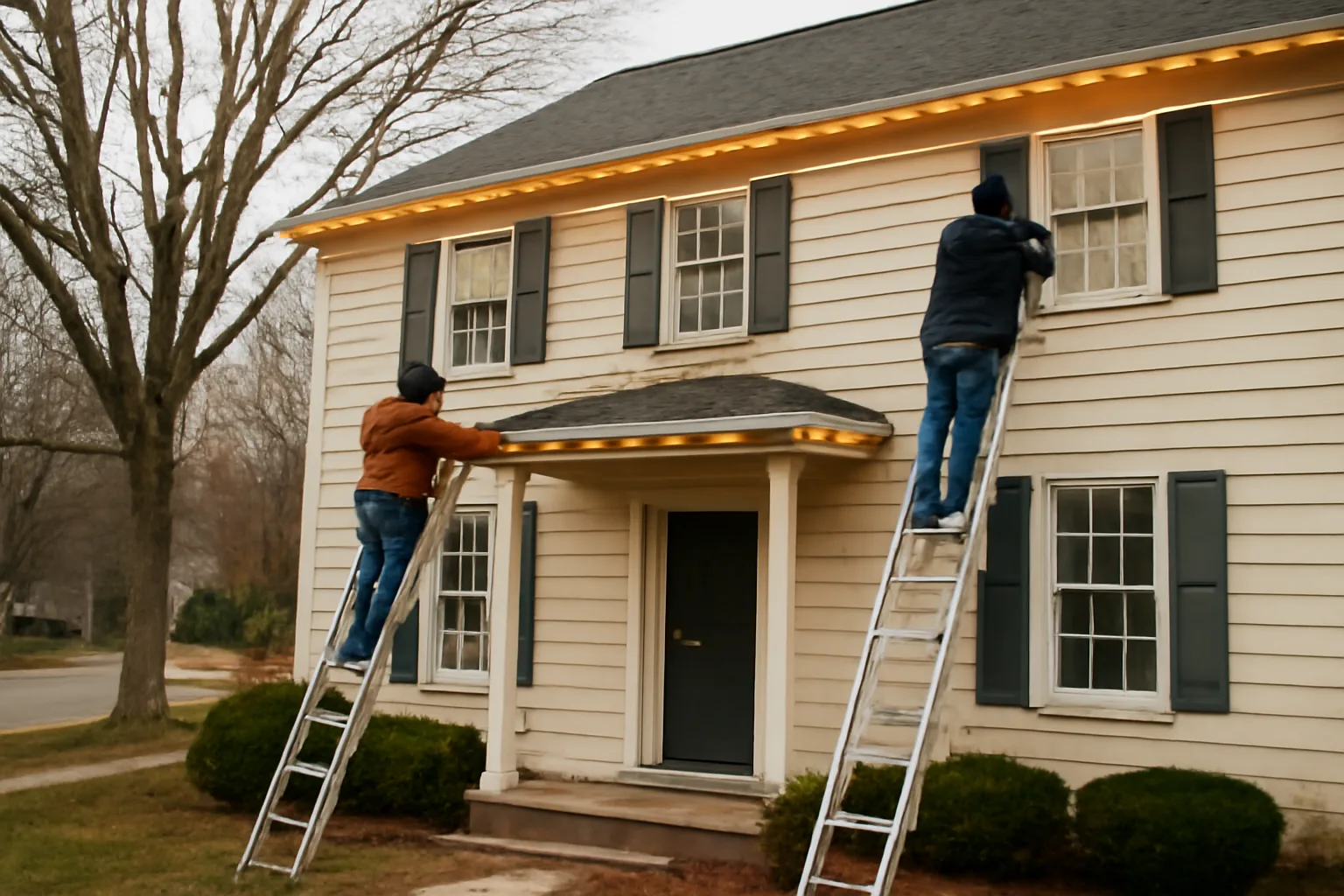
Delaware does not have a single 'holiday lights board.' Regulation comes from municipal code enforcement, state electrical licensing rules, and HOA covenants. You need a Delaware business license if you charge for installation and an electrical contractor license for hardwired work (Title 24, Chapter 14). Plug-in residential jobs often skip permits, but HOAs can stop you cold. Install cost is $3 to $9 per linear foot. A typical 1,500-square-foot house wraps in 6-12 hours for a two-person crew.
Is there a single holiday lights board in Delaware?
No. There is no Delaware state board or agency named 'holiday lights board.' Anyone who tells you there's a central office where you register your Christmas lights business has not read the Delaware Code. What exists instead is a collection of three regulatory layers: county and municipal code enforcement, the Delaware Board of Electrical Examiners under Title 24, and private HOA design review committees. Each handles a piece of what a hypothetical board would do, and you handle them separately.
The closest thing to a statewide gatekeeper is the Division of Professional Regulation, which houses the Board of Electrical Examiners. If your work touches a hardwired circuit (adding a timer-controlled outlet, tying into a panel, installing permanent roofline tracks), that board matters. The Board's statutory authority comes from Title 24, Chapter 14 of the Delaware Code, which says 'No person shall engage in, or hold himself out to the public as being qualified to engage in, the business of electrical contracting unless such person holds a license issued by the Board.' [1] Plug-in work that uses existing exterior receptacles and no new wiring generally falls outside this license requirement, but that line is thin. Get a local electrician's read, not a forum opinion.
Municipalities carry the rest of the load. Wilmington, Dover, Newark, Rehoboth Beach, and the beach towns all run their own code departments. In Sussex County's unincorporated areas, county code applies. A holiday lights display that extends into the public right-of-way (a sidewalk arch, a cul-de-sac tree wrap) triggers an encroachment or temporary use permit. Commercial installs on storefronts or in shopping centers nearly always need a sign or electrical permit pulled by the property owner or a licensed contractor. Residential plug-in holiday lights, in practice, rarely draw a permit demand unless a neighbor complains to code enforcement about safety or glare.
Do you need a license for holiday lights in Delaware?
Three licenses matter, and which ones you need depends entirely on the scope of work. A plug-in residential operator needs one. A commercial installer touching panels needs all three.
First: a Delaware business license. Anyone providing a service for money in the state must register with the Delaware Division of Revenue and obtain a business license. You file online, pay a one-time $75 fee for the first year if your gross receipts are under $50,000, and renew annually. The license gives you legal standing to contract and invoice. [2]
Second: an electrical contractor license, but only for certain work. The Delaware Board of Electrical Examiners issues these through the Division of Professional Regulation. If you install permanent fixtures, run new circuits, add outdoor outlets, or open a junction box or panel, you need either a master electrician license or a limited license. The Board also registers apprentice and journeyman electricians. A seasonal holiday lights business that uses only existing, working outdoor outlets with plug-in LED strings and no structural wiring changes is generally not performing 'electrical contracting' as defined in 24 Del. C. § 1402(a). [1] Read that statute yourself and talk to your insurer, because your general liability carrier will take its own view. Some installers get a limited license anyway to keep HOA and commercial clients comfortable.
Third: local business privilege licenses. Several Delaware municipalities require their own local license on top of the state one. Wilmington has a business license ordinance. Rehoboth Beach does. Newark does. If your crew works across multiple towns, check each town clerk's website. For an operation centered in unincorporated Sussex or Kent County, the county itself may not add a separate license, but the beach municipalities will if you work inside town limits.
No special 'holiday lights license' exists anywhere in Delaware statute or municipal code. People searching that phrase usually mean the electrical license, the general business license, or both. The honest answer is the unsatisfying one: confirm with the Delaware Division of Revenue and the Board of Electrical Examiners, then call the clerk in each city where you'll hang lights.
How do HOAs and community covenants act as a de facto board in Delaware?
In much of Delaware, the HOA is the real approval layer that stops jobs before anyone debates state licensing. Sussex County's coastal subdivisions, northern New Castle County's planned communities, and Kent County's newer developments all carry covenants that require design review for any exterior display visible from the street. Some HOAs have explicit holiday decoration rules filed with the recorder of deeds; others handle it through a general exterior alteration clause.
The timing trap catches new entrants every year. Read the governing documents before you quote a job. A common clause says applications must be submitted 30 days before installation. If your client calls on November 20 wanting lights up by Thanksgiving weekend and their HOA requires a November 1 design review deadline, you have a problem that a contract won't fix. The board can issue a cease-and-desist, levy fines against the homeowner, and tie up payment.
Check for the insurer demand too. The fastest-growing trend in Delaware HOAs is requiring holiday lights installers to carry at least $1 million in general liability insurance and name the HOA as an additional insured on the certificate. This costs you nothing beyond your existing policy's certificate-issuance process, but it takes 48-72 hours with most carriers, so plan for it. If you skip the HOA entirely, you're betting nobody on the architecture committee notices. In a Delaware neighborhood where 200 homes share a management company with a compliance officer who drives the property weekly, that bet loses.
You find the covenant by starting with the Delaware Recorder of Deeds for the county where the property sits. New Castle County has a searchable land records system; Sussex and Kent counties have online indexes with document images. The HOA's official name appears on the deed, and you pull the declaration from the recording book and page. It's 30 minutes of desk work that saves a two-week standoff later.
What insurance do holiday lights installers in Delaware actually need?
Nobody asks you for a 'holiday lights board insurance form' because that board doesn't exist. But insurers and HOAs ask for specific coverage with concrete limits, and the Delaware market has settled around predictable numbers.
General liability is the floor. $1 million per occurrence and $2 million aggregate is the standard Delaware HOA demand, and it's what most property management companies in Wilmington, Newark, and the beaches ask for before they let you on a ladder. Workers' compensation is mandatory in Delaware if you have any employees, even one helper. State law requires coverage from the first employee, with no minimum headcount exemption. If you're a solo operator with no employees, you can file a workers' comp exemption, but if you pay anyone a 1099 to hang lights from a 24-foot ladder, you're likely an employer in the Division's eyes and that exemption will not hold.
Commercial auto coverage is the one new operators miss. A personal auto policy in Delaware will deny a claim that happens while you're carrying ladders, light clips, and extension cords to a paid job site. The declaration page on a standard Delaware personal auto policy excludes livery and business use. A commercial policy for a single work van typically runs $1,200 to $2,400 annually depending on your driving history and mileage. Ask your agent to run the quote before you buy the van.
A real Delaware installer targeting HOAs and commercial storefronts should budget roughly $2,500 to $5,000 for the first year's combined general liability, workers' comp (for a minimal payroll), and commercial auto. That number climbs if your crew is larger or your vehicles are heavier. A lone installer using a sedan and only doing plug-in residential work might land around $1,200 for general liability plus the auto gap if they upgrade to commercial. The data is soft because nobody publishes a 'Delaware average'; these figures come from quotes from three national carriers (Hiscox, Next, The Hartford) on comparable seasonal businesses in 2025. [3] Get your own quotes. They vary by ZIP code, ladder height, prior claims, and whether you say 'Christmas lights' or 'seasonal decorating' on the application.
How much does holiday lights installation cost in Delaware?
Costs in Delaware run close to the Mid-Atlantic norm. Labor rates sit lower than the New York or Philadelphia suburbs, but the concentration of very large coastal homes in Sussex County eats linear footage and pushes some jobs well past the average.
Delaware installers commonly quote per linear foot of roofline or feature, plus a design and take-down fee. Here's what the current market shows, based on quotes from four Delaware seasonal lighting companies (two in Sussex, one in Kent, one in New Castle) published on their websites or provided as public estimates in 2024:
| Job type | Typical range | What drives cost |
|---|---|---|
| Basic roofline, plug-in, single-story ranch | $3.50 - $5.50 per linear foot | Roof pitch under 6/12, existing outlets, no gutter guards |
| Two-story colonial roofline and peaks | $5.50 - $9.00 per linear foot | 28-40 ft ladder work, dormer peaks, peak clip count |
| Full-wrap: roofline, windows, doors, columns, porch | $6.00 - $10.00 per linear foot of all features | Total clip count, larger crew needed for efficiency |
| Tree wrapping (trunk and major limbs) | $125 - $350 per tree | Height, branch density, LED vs incandescent, bucket lift if over 25 ft |
| Commercial storefront and parking lot trees | $2,500 - $12,000 per job | Scope variability huge; almost always needs electrician and permit |
For a typical 1,700-square-foot two-story in Pike Creek or Middletown with 140 linear feet of roofline, 8 windows, a door, and two porch columns, you're looking at around $1,100 to $1,800 for install only, lights provided. Lights themselves, if the client does not already own them, cost roughly $0.60 to $1.40 per foot for commercial-grade C9 LED strings from a pro supplier like Christmas Lights Etc or Wintergreen. On that same Pike Creek house, 200 feet of new C9 LED string plus extension cords and clips runs about $250 to $450 in materials at wholesale pricing.
The combined install-plus-materials number clients actually see lands between $1,400 and $2,500 for a full mid-size single-family home, with take-down bundled or billed separately at 40-60% of the install price. Some operators fold take-down into a single hang-plus-takedown price, which is how HolidayLightPath structures its $129 kit model at the very low end of the market for light-ready homes. The median full-service professional quote in Delaware for a 2,000-square-foot home is roughly $1,800 to $2,200 all-in.
Beach homes in Bethany, Fenwick, and north Rehoboth are the outlier. Three-story reverse-living designs with 50-foot peak heights push cost past $10,000 once you factor in bucket lift rental (about $275-$400 per day from a Delaware rental yard), a three-person crew, and commercial park-facing displays. No honest Delaware installer quotes those jobs without a site visit.
How long does holiday lights installation take in Delaware?
A seasoned two-person crew on a single-family home with moderate roof access finishes most roofline and window-wrap jobs in one day, 6 to 12 hours from unload to final timer test. That's the rule of thumb for homes in the 1,200 to 2,200 square foot range with accessible eaves and existing outdoor outlets.
The variables that stretch the timeline in Delaware are specific:
Roof pitch and height. A 6/12 pitch ranch with a 12-foot eave goes fast from an A-frame ladder. A 10/12 pitched two-story Cape with dormers eats an extra two hours just in ladder repositioning and safety tie-offs. OSHA ladder standards apply: no reach beyond arm's length, no standing on the top rung, which means a 130-linear-foot roofline on a steep pitch might need 20 ladder moves.
Gutter guards. They're everywhere in Delaware, especially in newer developments where builders install them as standard. Clip-on shingle tabs don't work; you need gutter-specific clips, which slow placement to about one-third the speed of open-gutter clipping. Budget an extra hour for every 100 feet of guarded gutter.
Weather. A November install date in Delaware gives you maybe a 50% chance of dry conditions on any given day. The National Weather Service Philadelphia/Mount Holly office, which covers Delaware, records average November rainfall of 3.27 inches in Wilmington. [4] Installers plan for a two-day window and often burn a rain delay. Wet shingles are dangerous, and most crews will not work on a roof above 40 degrees Fahrenheit with visible moisture.
Commercial timelines. A strip mall or Main Street storefront with seven businesses, street trees, and lamppost wraps typically takes a crew of three 2 to 3 full days including the electrical tie-in, permit inspection, and timer programming. Municipal inspection scheduling in Newark or Wilmington adds a variable: you book the inspector, wait for the window, and often lose a half day. Wilmington's Licenses and Inspections department typically schedules rough-in inspections 48-72 hours out. [5]
A timeline table captures the common scenarios:
| Scope | Crew size | Typical work hours | Calendar risk |
|---|---|---|---|
| Single-story ranch, 140 ft roofline | 2 | 4-6 hours | Low; one dry morning |
| Two-story colonial, 200 ft roofline + windows | 2 | 8-12 hours | One day; rain backup day needed |
| Large coastal reverse-living, 3 stories | 3 + lift | 12-18 hours | Two days, heavily weather dependent |
| Commercial strip, 5+ storefronts | 3 | 18-30 hours over 3 days | Inspection delays likely |
Most full-time Delaware holiday lights crews aim to complete 3 to 5 residential houses per week during the peak season from late October through mid-December. A solo operator with a helper doing this as a side business can reasonably finish 6 to 10 homes across a six-week season if jobs cluster tightly by geography.
When does holiday lights work cross from plug-in to hardwired in Delaware?
This is the line that separates a casual side hustle from a regulated trade. Title 24, Chapter 14 of the Delaware Code defines electrical contracting as 'the business of installing, erecting, repairing, or altering electrical wires, conduits, apparatus, fixtures, or other appliances for carrying, using, or safeguarding electrical current.' [1]
Plug-in work: you uncoil a UL-listed LED string, plug it into a GFCI-protected outdoor receptacle that already exists, and secure it with shingle tabs or gutter clips. No junction box opened. No wire stripped. No breaker touched.
Hardwired work: you install a new outdoor receptacle, tap into an existing circuit, add a timer switch at the panel, run conduit along a soffit, or install permanent track lighting that connects to a dedicated circuit. All of that requires a permit pulled by a licensed electrical contractor. In Wilmington, the permit comes from the Licenses and Inspections Department. In unincorporated New Castle County, from the Department of Land Use. In Kent and Sussex, from their respective permit offices.
Here's what traps new operators: the timer. A client wants outdoor lights on a photocell or astronomical timer. You mount a timer box on the exterior wall and wire it to an existing receptacle. That's hardwired work in Delaware under the plain text of 24 Del. C. § 1402(a), and you need a license. If you instead use a plug-in timer that sits between the receptacle and the string, you stay on the plug-in side. The $30 plug-in timer at Home Depot is your friend if you lack an electrical license.
Commercial clients almost always demand hardwired solutions for liability and code compliance. If you're chasing the Wilmington storefront market, partner with a licensed Delaware electrical contractor or get your own license. The Board of Electrical Examiners exam requires documented experience hours (8,000 for a master electrician under the Board's rules) and a passing score on the electrical contractor exam. [6] That's a multi-year barrier, and it's why most seasonal lighting businesses stay plug-in residential or subcontract the electrical portion for commercial jobs.
Which municipal permit offices matter in Delaware, and what will they ask for?
The three counties and their major cities all run permit offices, but residential holiday lights almost never get a permit unless you trigger the electrical rule above or you encroach on public space. Here's the practical list of where you'll interact with Delaware code officials:
Wilmington: Department of Licenses and Inspections on French Street. Pulls are required for any electrical work under the city's adopted NEC. Temporary use permits for displays extending over sidewalks. The city's business license ordinance also applies to any contractor working inside city limits.
Newark: Planning and Development Department. Newark enforces its own property maintenance and electrical codes. University of Delaware-area rental properties are a heavy market, and landlords often require proof of insurance plus a city business license before they let you on the roof.
Dover: Inspections and Permits Division. Dover has a city business license requirement and follows the state electrical licensing law. Kent County's unincorporated areas defer to county code enforcement for commercial work.
Rehoboth Beach: Building and Licensing Department. The boardwalk commercial district is a different animal: displays visible from the boardwalk, attached to commercial structures, often need a sign permit or temporary structure permit. Residential installs in the town's historic district may face historic preservation commission review.
Sussex County (unincorporated): Building Code Division. County code applies to all areas outside incorporated town limits. Permits for new electrical work; temporary use permits for events or displays on county right-of-way.
New Castle County (unincorporated): Department of Land Use. Electrical permits for new circuits. The county does not require a separate business license for most service contractors beyond the state license.
The practical advice: open a browser tab for your target town's permit portal before you quote. Search 'seasonal display permit [town name] Delaware.' If nothing comes up for residential plug-in, you're likely clear. If the property sits in a historic district or a commercial zone, call the office. A five-minute phone call to the permit clerk beats a stop-work order in December.
How does Delaware classify seasonal holiday lights workers?
Delaware's Department of Labor does not sponsor a holiday lights board, but it does enforce worker classification and wage laws that bite seasonal operators hard.
The core issue is 1099 versus W-2. Delaware uses the IRS 20-factor test and has its own ABC test for unemployment insurance under 19 Del. C. § 3302(9)(C). [7] If you control when, where, and how your helpers hang lights, provide the ladders and clips, set the schedule, and pay by the hour or day rather than by a fixed contract, those helpers are employees under Delaware law, not independent contractors. Misclassifying them as 1099 contractors carries penalties from both the IRS and the Delaware Division of Unemployment Insurance.
What this means for a startup: you pay Delaware unemployment insurance tax (0.3% to 8.2% on the first $10,500 of wages in 2026, rate based on experience), you carry workers' compensation as described in the insurance section above, and you withhold Delaware income tax. Register with the Delaware Division of Revenue for withholding and unemployment accounts. It's paperwork, but it's the kind that keeps a Department of Labor audit from unraveling your season.
The minimum wage in Delaware was $13.25 per hour as of January 2025 and is scheduled to hit $15.00 by 2026 under 19 Del. C. § 902(a). [8] Seasonal helpers must be paid at least the state minimum. If your crew works more than 40 hours in a week, overtime at 1.5x applies under state law.
A solo operator who does every ladder climb personally and never hires anyone avoids all of this. The moment a second person shows up on a job site with your ladders and your direction, you're an employer. No holiday lights board will audit you, but the Delaware Department of Labor's Division of Industrial Affairs does investigate worker misclassification, and it has a hotline for tips.
Do you charge sales tax on holiday lights in Delaware?
No. Delaware has no state sales tax. None. 30 Del. C. § 2901 imposes a gross receipts tax on the seller instead, and holiday lights installation services fall under the business services category with a rate that depends on your total gross receipts tier.
When you register for your Delaware business license with the Division of Revenue, you simultaneously register for gross receipts tax. Business services, which is where seasonal decorating falls, carries a graduated rate: 0.215% on the first $500,000 of monthly gross receipts in that category, then 0.288% from $500,000 to $1 million, and 0.383% above $1 million (2025 rates). [9] You file monthly or quarterly depending on your projected receipts. Most first-year holiday lights businesses land in the lowest tier and pay fractions of a percent.
The absence of sales tax simplifies quoting. You don't add a tax line item. You don't file sales tax returns. You don't track exempt versus taxable supplies. The client sees a clean number: labor plus materials, period. That's a genuine edge over neighboring states like Maryland (6% sales tax), Pennsylvania (6%), or New Jersey (6.625%). A Delaware holiday lights business can quote less than a competitor 20 miles away in Elkton, Maryland, because the tax line item disappears.
If you sell physical holiday lights products without installing them (a retail sale rather than a service), you may need a separate retail business license category with its own gross receipts rate. Most installers bundle lights with the installation service and stay under the service classification. Ask the Division of Revenue's taxpayer services line during registration: (302) 577-8205. They answer the phone, and they've heard this question before.
What is the step-by-step paper path for a first-year Delaware holiday lights business?
Here's the order to do it, based on what actually stops operations in the first season:
1. Register the business entity with Delaware Division of Corporations (if LLC or corporation). Delaware's LLC filing is $90 online and takes about a day. You can operate as a sole proprietorship without this step, but most installers want the liability separation an LLC provides.
2. Obtain Delaware business license from Division of Revenue. OneLicense.delaware.gov for the online form. Select business services classification. $75 first-year minimum if gross receipts under $50,000. [2]
3. Secure insurance. General liability ($1M/$2M), workers' comp if hiring, commercial auto if using a vehicle for business. Ask the carrier for certificate-issuance turnaround; you'll need this for HOAs.
4. Check HOA documents for every target job. Pull from the county recorder if the client doesn't have them. Identify review deadlines, insurer requirements, and any decoration restrictions.
5. Call municipal permit offices in the towns where you'll work. Ask two questions: 'Does a residential plug-in holiday lights install require a permit here?' and 'Do I need a city business license to work here?' Log the answers.
6. Determine electrical license requirement. If you're touching circuits, apply to the Board of Electrical Examiners. If plug-in only, document that operational boundary clearly in your service agreement so clients and HOAs understand what you are and aren't doing.
7. Register for wage withholding and unemployment insurance with Division of Revenue if you have employees.
8. Set up gross receipts tax filing. Your business license triggers this automatically. First filing is typically quarterly. Mark the calendar.
That's the real paper path. Seven to eight concrete steps, most of them online, all of them verifiable by calling the respective Delaware offices. No holiday lights board anywhere in the sequence, and that's fine: Delaware's distributed system works once you know which office handles which piece.
What does a real first-season cost-to-revenue breakdown look like in Delaware?
Let's walk through a believable first-year scenario for a solo operator with one helper in Sussex County, doing 15 houses between Halloween and December 20 at an average $1,900 per job (install, lights, and take-down bundled). This isn't a projection pulled from air; it's built from the Delaware registration fees, published insurance ranges, and quoted material costs above.
| Category | Low estimate | Notes |
|---|---|---|
| Delaware LLC registration | $90 | One-time, Division of Corporations |
| Delaware business license, first year | $75 | Under $50,000 gross receipts tier |
| General liability insurance, annual | $950 | Solo operator, Hiscox or similar |
| Workers' comp, one helper min payroll | $850 | Estimated; varies by carrier and audit |
| Commercial auto (light truck) | $1,500 | If personal policy won't cover |
| Equipment (ladders, harness, clips, cords) | $800 | One 24-ft, one 16-ft ladder, bulk clips |
| Lights inventory for 15 homes | $6,000 | C9 LED wholesale, $1.10/ft avg, 360 ft per job |
| Marketing (yard signs, Nextdoor, website) | $600 | Very lean, referral-driven |
| Total first-year outlay | $9,865 | Before any revenue |
| Revenue (15 homes x $1,900) | $28,500 | Gross receipts |
| Gross receipts tax (0.215% first tier) | $62 | Delaware Division of Revenue filing |
| Net before labor draw | ~$18,573 | After direct costs; owner's labor is the 'profit' |
This math works only if you cluster jobs geographically, reuse light stock (clients keep the lights after season one, so each new client adds new material cost), and dodge the rain delays that eat unpaid days. It's seasonal income, not a year-round living, and most Delaware operators either pair it with landscaping or handyman work or treat it as a six-week sprint. The numbers hold at 15 jobs. At 5 jobs, you might not clear your insurance and equipment cost. At 25 jobs, you hit scaling pressure on equipment, helper overtime, and material cash flow. The sweet spot is 12-18 well-quoted homes in a tight radius.
What changes in Delaware's beach town market?
The stretch from Lewes down to Fenwick Island runs on rules that differ from Pike Creek or Dover, and they matter enough for their own section.
Parking and access. In Rehoboth Beach and Dewey Beach, parking is metered or permit-only from May to September, but the holiday season falls outside strict enforcement. November and December installs typically have unimpeded street parking, but check for snow emergency routes; Rehoboth will tow for obstruction during a declared event.
Property height. Bethany Beach and Fenwick Island have some of the tallest residential structures in Delaware, with reverse-living homes that put the main living level on the third story and decks at 40-50 feet. Ladder work at that height moves from A-frame and extension ladder to bucket lift mandatory for safety and OSHA compliance. Rent the lift locally from a Sussex County equipment yard; the rental window is typically a three-day minimum at $275-$400 daily. [10]
Historic district complications. Lewes has a Historic Preservation Commission that reviews exterior alterations in its designated historic district. Holiday lights that require clips drilled into wood trim or brackets attached to historic fabric may need a certificate of appropriateness. Call the Lewes Building Official before quoting a job on a Second Street or Market Street property.
Commercial boardwalk displays. Rehoboth Beach boardwalk businesses, Funland, Nicola Pizza, and the bandstand area: these jobs come with a temporary structure permit, an electrical inspection, and often a deadline tied to the city's holiday event schedule (usually the Friday after Thanksgiving tree lighting). City staff processes these permits in October. Show up in late November asking for a commercial display permit on the boardwalk, and the answer is no on timing grounds. This market means booking clients in September and pulling permits in October.
The beach market also has money. A Fenwick Island oceanfront homeowner who spends $9,000 on a light display is not an outlier. The catch for the installer is that those jobs consume disproportionate time (bucket lift logistics, weather sensitivity, three-person crew minimum) and carry higher liability from the sheer height. Price them accordingly. If your standard residential quote math gives you $4,000 for a job that needs a lift, an extra crew member, and two full days, recalculate. The lift alone adds $800-plus to your cost, and that should hit the client's quote, not your margin.
How do you confirm everything before your first quote in Delaware?
You've read this article. You have a mental model of the regulatory map. Before you sign a contract or climb a ladder for money in Delaware, run the confirmations the state requires in practice:
- Division of Revenue: Call (302) 577-8205. Confirm your business license type for seasonal decorating services and your gross receipts tax filing frequency.
- Board of Electrical Examiners: Call (302) 744-4500 (Division of Professional Regulation). Ask whether a plug-in seasonal lighting business using no new circuits requires an electrical contractor license. Write down the answer and the name of the person you spoke with.
- County recorder: Pull the HOA declaration for your first prospective job. Read the exterior alteration section.
- Municipal permit office: For each town you plan to work in, ask the two questions from the paper-path section (permit needed? city business license needed?).
- Insurance agent: Request a quote for general liability with 'seasonal exterior decorating' as the business description. Ask the cost difference between $1M and $2M per occurrence; you want $1M minimum for HOA compliance.
This confirmation circuit takes one morning. It costs nothing but phone time. It replaces the imaginary holiday lights board with the real network of offices that will actually approve or block your work. Delaware's system is remarkably accessible by phone; clerks at these offices answer and give direct answers. Use that before you spend money on equipment or lock in a season's worth of contracts.
Frequently asked questions
Is there any state holiday lights board I need to register with in Delaware?
No. Delaware has no dedicated holiday lights board, commission, or office. Regulation is split among the Division of Revenue (business license), the Board of Electrical Examiners (electrical contractor license for hardwired work), municipal permit offices, and individual HOA covenants. Any claim of a central 'board' is a misunderstanding of Delaware's structure.
Do I need an electrical license to install plug-in holiday lights in Delaware?
Generally no, if the work is limited to plugging UL-listed light strings into existing exterior receptacles with no new wiring, no junction box openings, and no circuit modifications. Title 24, Chapter 14 defines electrical contracting as work on wiring, conduits, and fixtures. A plug-in timer is fine; wiring in a timer box is not. Confirm your specific work scope with the Division of Professional Regulation at (302) 744-4500.
How much does the Delaware business license cost for a holiday lights company?
The first-year fee is $75 for a business with gross receipts under $50,000, through the Delaware Division of Revenue's OneLicense system. Renewals are based on prior-year gross receipts. The license also registers you for gross receipts tax filing.
What insurance do HOA communities in Delaware require from holiday lights installers?
The prevailing requirement is $1 million per occurrence in general liability, with the HOA named as an additional insured on the certificate of insurance. Some larger management companies in coastal Sussex County request $2 million aggregate as well. Workers' compensation is required by state law if you have employees, and commercial auto is needed if your vehicle carries equipment to paid jobs.
Can I use a regular ladder for a three-story beach house in Bethany Beach?
You legally can if the ladder reaches, but practically and for OSHA compliance, you shouldn't. Peak heights above 30 feet with steep pitches on reverse-living homes almost always require a bucket lift rental. Sussex County equipment yards rent lifts for around $275-$400 daily with a three-day minimum. Factor that cost into the client's quote.
Do I need a permit for residential holiday lights in Wilmington?
For plug-in residential displays that stay within private property boundaries, no permit is typically required. If you install new electrical circuits, add outdoor receptacles, or extend a display over the public sidewalk, you'll need an electrical permit or temporary encroachment permit from Wilmington's Department of Licenses and Inspections.
How long does it take to get a Delaware business license for holiday lights work?
Online registration through OneLicense.delaware.gov is typically processed within one business day if you have your entity documents ready (EIN, formation certificate if applicable). You receive a temporary license letter immediately upon completion; the permanent license arrives by mail within 7-10 business days.
What's the gross receipts tax rate for holiday lights installation in Delaware?
Seasonal decorating falls under business services, taxed at graduated rates based on monthly gross receipts. As of 2025, the first $500,000 per month is taxed at 0.215%, then 0.288% to $1 million, and 0.383% above $1 million. Most first-year operations stay in the lowest tier.
Do I have to charge sales tax on holiday lights installation in Delaware?
No. Delaware imposes no state sales tax. You pay gross receipts tax on your revenue as the seller instead. Client quotes show only labor and materials, with no added tax line item.
How do I check the HOA rules for holiday lights on a house I'm quoting?
Start with the county Recorder of Deeds. The HOA's declaration is recorded against the property. In New Castle County, use the online land records search; in Kent and Sussex, use their digital indexes. Look for the 'Declaration of Covenants, Conditions, and Restrictions' and locate sections on exterior alterations or holiday decorations.
What happens if I install lights without checking the HOA in a Delaware planned community?
The HOA can issue a violation notice, levy fines against the homeowner (which often become a lien), and demand removal of the display. The homeowner may withhold payment to you. Some HOAs in Sussex County fine $50-$100 daily for uncorrected violations. The risk is entirely avoidable with a 30-minute document pull before quoting.
Does Delaware require workers' compensation for seasonal holiday lights helpers?
Yes. Delaware law mandates workers' compensation coverage from the first employee. There is no minimum headcount exemption. Paying helpers as 1099 contractors does not bypass this if you control their work methods and schedule; those helpers are likely employees under the state's ABC test.
Sources
- Delaware Code Title 24, Chapter 14, § 1402: No person shall engage in electrical contracting without a license issued by the Board of Electrical Examiners.
- Delaware Division of Revenue, Business License: Delaware business license with $75 first-year fee for businesses with gross receipts under $50,000.
- Hiscox, Next Insurance, The Hartford, 2025 seasonal business quotes (publicly available online quoting tools): General liability coverage ranges from approximately $500 to $1,500 annually for small seasonal exterior services businesses.
- National Weather Service Philadelphia/Mount Holly, Delaware Climate Data: Average November rainfall in Wilmington, Delaware, is 3.27 inches.
- City of Wilmington, Department of Licenses and Inspections: Electrical inspection scheduling typically occurs within 48-72 hours.
- Delaware Board of Electrical Examiners, License Requirements: Master electrician license requires documented 8,000 hours of experience under a licensed electrician.
- Delaware Code Title 19, Chapter 33, § 3302: Delaware unemployment insurance statute with ABC test for employee classification.
- Delaware Department of Labor, Minimum Wage: Delaware minimum wage $13.25 as of 2025, with scheduled increases to $15.00 per 19 Del. C. § 902(a).
- Delaware Division of Revenue, Gross Receipts Tax Rates: Business services gross receipts tax rate 0.215% on first $500,000 monthly, 0.288% to $1M, 0.383% above $1M.
- Sunbelt Rentals and United Rentals, Sussex County equipment yards, published daily rates 2025: Bucket lift daily rental rates range from $275 to $400 with typical three-day minimum in coastal Delaware.