Last updated 2026-08-21
TL;DR
Georgia has no holiday lights board. Clip-and-plug installs usually need local occupational tax paper, SOS entity filings if you form an LLC, and a DOR sales tax account if you sell or rent lights. Hardwired work can trigger the Electrical Contractors Division. Confirm every fee and scope with the office that issues the paper. No office promises a fixed approval date.
Do you need a license for holiday lights in Georgia?
You do not apply to a holiday lights board in Georgia, because that board does not exist. You may still need a city or county occupational tax certificate, Secretary of State entity paper if you form an LLC, a Georgia sales tax account if you sell or rent taxable property, and a trade license if the job is electrical contracting or construction contracting. Confirm each item with the office that would issue it.
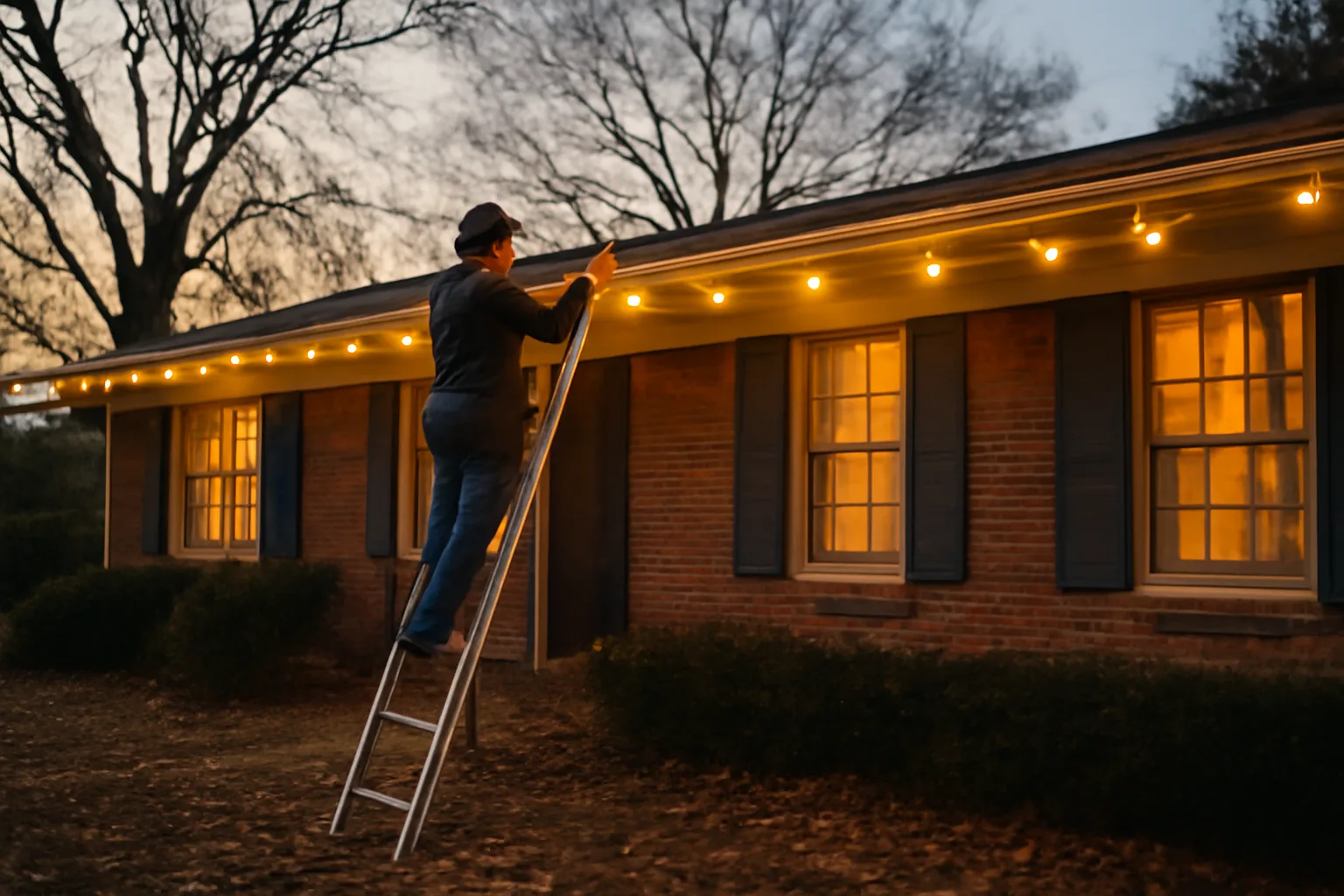
Clip-and-plug holiday lighting on an existing exterior receptacle is usually seasonal decorating. You are hanging listed light strings with clips, timers, and extension cords. You are not building a house. You are not opening a service panel. That is the practical split most operators live in. It is still not a written waiver from a licensing division. If a city clerk or an insurer asks what you do, say seasonal decoration installation, not general contracting and not electrical contracting, unless that is actually what you bid.
The picture changes when you add work the state already regulates. New outdoor receptacles, new circuits, hardwired controllers, permanent low-voltage landscape systems, or structural changes sit under existing boards. Those boards already have names. They are not a holiday lights board.
I would get the local occupational tax certificate in the city or county where I am based before I took a deposit. I would form an LLC if I wanted a clean bank account and a clean contract name. I would not sit for an electrical contractor exam just to clip C9s on a one-story ranch in Marietta. If a homeowner wants a new GFCI on the eave, I would call a licensed electrician or leave that line off the bid.
Private holiday lighting certificates from training companies do not replace Georgia paper. Skills training can be useful. It will not satisfy a revenue office. It will not satisfy the Electrical Contractors Division if your scope crossed the line. Do not buy a framed certificate and call it a license.
Is there a holiday lights board in Georgia?
No. Search results that talk like Georgia chartered a holiday lights board are mixing up a trade nickname with a real agency. Holiday lights Georgia operators deal with ordinary business desks and, only sometimes, with contractor divisions that already license other work.
People want one phone number. Construction has one. Cosmetology has one. Seasonal lighting does not. You will talk to the Georgia Secretary of State Corporations Division for an LLC, the Department of Revenue for sales tax, a city or county business tax desk for the right to work in that locality, and only if your scope requires it the Division of Electrical Contractors or the State Licensing Board for Residential and General Contractors.[4][6][7][11]
That split is annoying. It is also the real path. If someone sells you a single statewide holiday lighting permit, ask them to show the statute. They will not find one.
Neighbor states run the same pattern. If you also hang in Alabama or Florida, read those state guides before you assume the Georgia packet travels. It does not. Start with holiday lights board in Alabama or holiday lights board in Florida and compare the paper, not the Facebook lore.
What paper do you file first to operate in Georgia?
File local permission to do business, then state entity paper if you want an LLC, then tax accounts that match how you get paid. Trade licenses come last, and only if the work requires them. That order keeps you from studying for the wrong exam while a city clerk still has no record of you.
Pick a legal name and check it in the Georgia eCorp system. If you want an LLC, you file Articles of Organization with the Corporations Division. The long-standing published filing fee for that form is $100. Confirm the current amount on the SOS fee information before you pay, because boards change fees without rewriting every blog post.[4][15] After the entity exists, Georgia requires an annual registration. The long-standing published amount for that filing is $50. Confirm that too.[5][15]
Get a federal employer identification number if you formed an entity or you will have employees. The IRS is blunt about cost. "Applying for an EIN is a free service offered by the Internal Revenue Service." Ignore sites that charge for the same form.[1]
Open a Georgia sales and use tax account through the Department of Revenue if you sell light strings, controllers, or other tangible property, or if you rent a display for the season. Registration is a DOR process, not an SOS process.[7] Georgia's state sales and use tax rate is 4 percent, and local governments add their own percentages on top. Read the current DOR rate chart for the county where the sale is sourced. Do not guess an Atlanta-area combined rate from memory.[8]
Then walk into, or file with, the revenue office for every city or county where you are based or regularly work. Metro Atlanta is a stack of occupational tax certificates, not one metro license. Atlanta's Business Tax Division is a real desk with its own rules. Gwinnett, Cobb, DeKalb, and Fulton are separate. Confirm each locality. Do not invent a statewide occupational tax, because Georgia did not write one.[12]
| Filing | Who issues it | Typical trigger |
|---|---|---|
| Occupational tax certificate | City or county revenue office | You do business in that locality |
| Articles of Organization | Georgia SOS Corporations Division | You form an LLC |
| Annual registration | Georgia SOS Corporations Division | Every year after formation |
| Sales and use tax account | Georgia Department of Revenue | Taxable sales or rentals |
| Electrical contractor license | SOS Electrical Contractors Division | Electrical contracting as defined in Title 43, Chapter 14 |
| Residential or general contractor license | SOS Residential and General Contractors Board | Contracting work covered by Title 43, Chapter 41 |
| Workers compensation coverage | Private insurer, under State Board of Workers' Compensation rules | Regularly 3 or more employees |
I would not buy a registered agent upsell, a rush consulting package, or a trademark search from the first Google ad. File the SOS forms. Get the EIN yourself. Call the local revenue office and ask which class code they use for seasonal decorating or handyman-style service if they have no lighting class. Write down the name of the person who told you.
When does hanging lights become electrical contracting?
Hanging listed, plug-in holiday lights on clips, using existing exterior receptacles, is not the same thing as electrical contracting. Running new branch circuits, installing new receptacles, opening a panel, or hardwiring a controller is electrical work. Georgia licenses that work through the Division of Electrical Contractors under Title 43, Chapter 14. The Division publishes a how-to guide for applicants. Read it if your bids include any hardwired scope.[6][10]
O.C.G.A. Title 43, Chapter 14 is the electrical, plumbing, conditioned air, low-voltage, and utility contractor chapter. It defines electrical contracting as work on electrical equipment and systems, and it is unlawful to engage in that business without the license the Division issues. That is the statute family, not a holiday-specific rule.[10]
Use that line in your own scope notes. Plug-in C9s, net lights, and a timer in an existing GFCI are on one side. A new 20-amp circuit for a mega-tree, permanent landscape transformers, or a hardwired show controller are on the other. If you live on the second side, you either hold the proper Georgia electrical or low-voltage license or you subcontract someone who does.
Low-voltage licensing in the same chapter covers installed systems in defined classes. A 12-volt path-light system that is permanently installed is not a box of plug-in minis. Confirm the current class definitions with the Division before you advertise permanent landscape lighting as a holiday add-on.[6]
I would put a one-sentence limit in every proposal. Something like: this bid is for temporary seasonal decoration using existing receptacles, and it excludes new electrical outlets, panel work, and permanent wiring. If the homeowner wants those items, they are a separate licensed electrician's job. That sentence has saved more arguments than any logo on a truck.
Do not take advice on this line from a wholesale lighting catalog. Take it from the statute and from a written note you requested from the Division if your product mix is unusual. Confirm. Do not treat a blog, including this one, as a license.
Do you need a residential contractor license to hang holiday lights?
Usually no, if all you do is install and remove temporary seasonal decorations. Georgia's residential and general contractor law lives in O.C.G.A. Title 43, Chapter 41. That chapter requires a license to engage in the business of residential or general contracting, and it also lists exceptions. Read the current text of O.C.G.A. § 43-41-17 and confirm gray jobs with the Georgia State Licensing Board for Residential and General Contractors. Do not let a sales coach decide this for you.[11]
Clipping lights to a gutter is not constructing a dwelling. Rebuilding a rotten fascia so the clips sit straight can start to look like repair contracting. Installing a new roofline, a permanent track, or a structural display frame is even closer. If your quote mixes carpentry with lights, split the ticket or get the contractor question answered in writing.
I would keep invoices boring and accurate. Seasonal light installation and removal. Product sales listed apart from labor. No language that says remodel, renovate, or electrical upgrade unless that is the job and you hold the paper.
Paying for a residential contractor license you do not need is a waste of money. Those licenses exist for builders. They take exams, financials, and a qualifying agent. They are a career path, not a December side path. If you later add sunrooms or roofing, revisit the board. For a winter lights route, spend the same money on liability insurance and better ladders.
If you work across state lines, do not assume Georgia's contractor chapter matches the next state. Holiday lights board in Arkansas and holiday lights board in Arizona are different desks with different triggers.
How much does holiday lights cost in Georgia?
There is no official Georgia price list for hanging holiday lights. Nobody runs a public statewide survey that a board will stand behind. Consumer cost is a private bid. Business cost is a stack of paper, insurance, product, and labor. Keep those two ideas apart or you will price like a rumor.
On the business-paper side, the numbers you can actually confirm are small. Georgia's long-standing Articles of Organization fee is $100 and the annual registration is $50, both subject to the current SOS schedule.[4][5][15] An EIN is $0 from the IRS.[1] Local occupational tax is the wild card. Atlanta and the surrounding counties each set their own class and gross-receipts math. Confirm the current amount with that revenue office. I will not invent a city fee here.[12]
State sales tax is 4 percent before local add-ons. If you sell the lights, budget to collect and remit. If you rent a full display, treat that rental as a tax question for DOR or a Georgia CPA, because rental of tangible personal property is in the sales tax world and hang-only labor is a fact pattern you should not guess.[7][8]
On the customer-price side, treat Facebook ranges as gossip. A simple one-story ranch in a close-in suburb is a different job than a two-story brick box on a steep lot in East Cobb. Product mix changes everything. Cheap minis you throw away in January do not cost what commercial-grade C9s you store and reuse cost. Take-down, storage, and a January return trip have to sit in the number or you will work January for free.
I would build every bid from hours, crew size, ladder time, drive time in metro traffic, product, and the local tax certificates you had to buy to stand on that street legally. I would not copy a national per-foot number from a podcast. I would not offer a $99 whole-house special to win the first five reviews. That price does not survive a second-story peak, a broken clip bag, or a return visit when half a string dies on December 22.
Waste of money on the cost side: buying a full custom pixel show inventory before you have ten boring C9 clients. Also a waste: a wrap on a new truck in October when a clean van and a magnetic sign would have done. Spend on listed lights, GFCI protection, and a storage trailer you can actually inventory.
How long does holiday lights take in Georgia?
Two clocks, not one. Paper time is the filings and any trade license you actually need. Job time is the hang and the take-down. Georgia does not publish a promised processing time for either clock. Anyone who sells you a fixed approval date is inventing it.
Entity filings go through eCorp. Many organizers see a quick turnaround. Some do not. Confirm current processing notes on the SOS Corporations pages the week you file. Build a buffer. Do not promise a homeowner a Saturday hang while your LLC name is still pending if your contract needs that name.[4] Annual registration is a yearly chore, not a one-time event.[5]
Local occupational tax certificates follow local calendars. Some offices are walk-in. Some want an online account and a class code. A metro operator who works Atlanta plus two suburbs should assume multiple appointments, not one afternoon. Confirm with each revenue office. No statewide SLA exists.[12]
An electrical contractor license, if your scope truly needs one, is not a December project. It is an experience-plus-exam path described by the Division. Confirm current qualifications on the how-to guide. Do not plan to start that path on November 1 and hang hardwired jobs on November 15.[6]
Job time is physical. A modest one-story ranch can take a short morning for a two-person crew that already knows the house. A tall two-story with peaks, a porch wrap, and trees can eat a full day or more. Take-down in January is faster if you labeled circuits and photographed the house in November. Rain, wind, and a 6 p.m. sunset in December will wreck a solo schedule. Price the second pair of hands.
I would stop taking new hangs when the calendar cannot hold a weather delay plus take-down season. The operators who look busy in late November and then ghost take-down in January are the ones HOAs remember. Your second year is mostly last year's routes if you finish clean.
What local business licenses and sales tax rules apply?
Georgia lets cities and counties charge an occupational tax for the privilege of doing business there. That certificate is the closest thing most holiday lights Georgia operators will ever get to a "license," and it is local. The City of Atlanta routes this through its Office of Revenue Business Tax Division. Other counties have treasury or occupational license desks. You confirm the class code, the fee basis, and whether a job site inside their limits requires their certificate even if your shop sits next door.[12]
I would map every city I expect to work before I run ads in that zip code. Johns Creek, Sandy Springs, Peachtree City, and unincorporated Gwinnett are not interchangeable. If a clerk says you need their paper to work there, budget the time. Arguing on a driveway with a code officer is a dumb way to learn geography.
Sales and use tax is state plus local. Register with DOR when your sales or rentals are taxable. The state rate is 4 percent. Local rate charts change. Pull the chart, do not memorize a number from a prior season.[7][8]
Whether hang-only labor is taxable depends on how you invoice and how DOR reads that service. I am not going to invent a private ruling for you. If you only hang customer-owned lights, ask DOR or a Georgia CPA. If you sell the lights and hang them, the goods are in the sales tax system. If you rent a lighting package for six weeks and then take it back, you are in rental territory. Write the invoice so a stranger can see which of those three jobs you did.
A resale certificate matters if you buy inventory to resell. It does not let you skip tax on items you consume, like clips you throw away or tape you use up. Keep those purchases honest. DOR audits are not theoretical just because your season is short.
What insurance and worker rules apply to a Georgia lights crew?
Georgia does not hand you a holiday-lights insurance product. General liability is a market purchase. Most HOAs and a lot of homeowners will ask for a certificate. Buy the policy from an agent who understands roof work and temporary installations. A cheap policy that excludes heights is a prop, not coverage.
Workers compensation is a statute, not a vibe. O.C.G.A. § 34-9-2 sets out who is subject to the Workers' Compensation Act and who is not. A core exemption is for a private employer that has regularly in service less than three employees in the same business in this state. If you regularly have three or more, you are in the coverage world and the State Board of Workers' Compensation expects you to obtain it. Read the current statute text and the Board's employer coverage pages. Confirm. Do not count interns as invisible.[9][14]
A one-person shop is often outside that three-employee trigger. A three-helper December rush can put you inside it. If you staff up for six weeks, talk to an agent before the third helper climbs a ladder. Sole proprietors and LLC members have their own election questions. That is insurance-counsel work, not a slogan.
I would still carry liability insurance as a one-person shop. I would not pretend a homeowners policy covers a paid hang on someone else's roof. Call the agent and ask that question out loud.
Employees also mean federal payroll, Georgia withholding, and unemployment accounts. That is ordinary employer paper. It is not a lighting board. If you want to stay a true solo operator, stay solo. If you want a crew, budget the payroll stack or you will hate January for a new reason.
What HOA and property rules trip new Georgia operators?
HOAs are private contracts, not a state board. Georgia has a lot of them, especially in the north metro. Display windows, color limits, roof restrictions, and installer insurance asks show up in architectural guidelines. The HOA can fine the homeowner. The homeowner then calls you. Read the guideline before you lean a ladder on a painted fascia they treat like a relic.
Ask for the architectural package in writing. Note the earliest hang date and the drop-dead take-down date. Some associations want lights off the house by a date in January that does not care about your ice storm. Put that date in your contract. Charge a trip fee if they want an earlier removal.
I would not fight an HOA on the lawn. I would move the design inside their rules or walk. Winning a Facebook argument with a board member does not get you paid.
If you want a prebuilt packet for hang notes, HOA questions, and take-down, HolidayLightPath publishes a $129 one-time Hang + HOA + Take-Down Kit. You can also build the same packet from the association's own PDF and a checklist you type yourself. The kit is optional. The HOA document is not.
Municipal right-of-way is another trap. Lights on a private house are one thing. Wrapping a city tree in a downtown district or spanning a public sidewalk can need a special event or encroachment permission. Confirm with that city. Do not treat a commercial district like a cul-de-sac.
What safety rules apply on Georgia roofs and ladders?
Federal OSHA rules apply to employers on construction-style work, and a paid hang on a roof is not a living-room craft project. 29 CFR 1926.501 is the construction fall protection rule. It says, in the 6-foot section, "Each employee on a walking/working surface (horizontal and vertical surface) with an unprotected side or edge which is 6 feet (1.8 m) or more above a lower level shall be protected from falling by the use of guardrail systems, safety net systems, or personal fall arrest systems." That sentence is the rule, not a suggestion from a catalog.[2]
Most holiday crews live on extension ladders, not on scaffolds with guardrails. Ladder setup, three points of contact, and staying off bad fascia still matter. Treat wet Georgia pine straw and red clay as a sliding surface. Pull the truck onto the grass and you may owe a landscaper more than you made on the hang.
Use listed seasonal lights and outdoor-rated cords. The U.S. Consumer Product Safety Commission repeats the same holiday points every year: indoor devices stay inside, damaged cords get thrown out, and connections stay off standing water.[13] LED strings also cut load on old exterior circuits. The U.S. Department of Energy states that residential LEDs use at least 75 percent less energy and last 25 times longer than incandescent lighting. That is why commercial crews left the old hot bulbs behind.[3]
I would not put a new helper on a second-story peak in the first week. I would not work a metal ladder next to a service drop. I would not daisy-chain bargain cords across a wet walk. The first serious fall ends the season and maybe the company. Cheap clips are replaceable. A spine is not.
If you have employees, you also inherit hazard communication, a way to report injuries, and the duty to train. Solo operators still meet gravity. Wear the harness when the roof pitch makes a slip a flight. Confirm current OSHA interpretations with the standard text, not with a motivational reel.
What should you confirm with a board before you bid?
Confirm scope, not vibes. If any part of the bid is new wiring, call the Electrical Contractors Division and ask whether that scope needs their license. If any part is structural repair, call the Residential and General Contractors Board and ask whether Chapter 41 applies. If the only work is temporary plug-in decoration, ask the local revenue office which occupational tax class they want. Get names and dates. Keep the email.[6][11][12]
Confirm fees on the day you file. The SOS Corporations fee schedule is the source for the $100 and $50 figures used in this article. If the schedule changed last month, the schedule wins.[15] Confirm the DOR combined rate on the current chart, not on a 2022 closing binder.[8]
Confirm workers compensation if a third person will regularly work the route. The statute and the State Board of Workers' Compensation employer pages are the sources, not a crew-chat poll.[9][14]
I would keep a one-page binder tab for each county I work: occupational tax receipt, liability certificate, EIN letter, SOS annual registration, and DOR account number. That tab ends more roadside debates than a speech about free enterprise.
Other states will not honor your Georgia occupational tax certificate as a magic card. If California or Colorado work is even a maybe, read those guides first, because their contractor triggers are their own. See Holiday lights board in California licensing, cost, and timeline and holiday lights board in Colorado.
HolidayLightPath is an independent publisher, not a law firm and not a service company. If you want the Hang + HOA + Take-Down Kit, it is at /start. The filings above still go to the state and the city, not to us. Confirm every variable fact with the board that owns it. No approval or timing promise in this article is real, because we cannot issue you one.
Frequently asked questions
Do you need a license for holiday lights in Georgia?
There is no holiday lights license and no holiday lights board. You typically need a local occupational tax certificate to do business, SOS paper if you form an LLC, and a DOR sales tax account if you sell or rent lights. Hardwired electrical work can require an Electrical Contractors Division license. Confirm scope with that Division before you bid wiring.
How much does holiday lights cost in Georgia?
Georgia publishes no official hang price. Customer cost is a private bid based on stories, footage, product, and take-down. Business paper is more knowable: SOS has long published $100 for LLC Articles of Organization and $50 for annual registration, and the IRS EIN is free. Local occupational tax varies by city. Confirm current SOS and city amounts before you pay.
How long does holiday lights take in Georgia?
Paper time and hang time are different. SOS and city desks do not publish promised processing dates, so confirm current notes the week you file. A simple ranch hang can be a short crew morning. A tall custom house can take a day or more. Take-down is faster if you labeled the job in November. Do not promise hardwired work on an electrical-license timeline you have not started.
Do I need an electrician license to hang Christmas lights in Georgia?
Not for temporary plug-in strings on existing outdoor receptacles, as that is seasonal decorating rather than electrical contracting. You do need the proper license from the Electrical Contractors Division if you install new receptacles, new circuits, or hardwired controls. Read Title 43, Chapter 14 and the Division how-to guide. When the scope is mixed, subcontract the wiring.
Can I hang holiday lights in Georgia as a sole proprietor?
Yes. Georgia does not force an LLC on a solo decorator. You still need local occupational tax paper where you work, and you may need a DOR account if you sell or rent taxable property. An LLC is optional cleanup for banking and contracts. The IRS EIN is free if you want a number other than your Social Security number on forms.
Is holiday light installation taxable in Georgia?
Sales of light strings and other tangible property are in Georgia's sales tax system, and the state rate is 4 percent plus local add-ons. Rentals of a lighting package are a tax question you should run by DOR or a Georgia CPA. Hang-only labor on customer-owned lights is a fact pattern, not a slogan. Register if you make taxable sales, and invoice so the type of job is obvious.
Do I need a building permit to install Christmas lights on a house?
Temporary plug-in decorations on a private house usually do not go through a building permit desk the way a room addition does. New outdoor circuits and permanent fixtures can. HOA architectural rules are separate from permits and can still block a design. Ask the local building department only if the scope includes wiring or structure, and ask the HOA every time the property has one.
Do I need workers comp as a one-person holiday lights crew?
O.C.G.A. § 34-9-2 generally keeps a private employer with regularly fewer than three employees outside the Workers' Compensation Act. A true one-person shop often sits in that exemption. Three regular helpers can flip the switch. Confirm with the current statute and the State Board of Workers' Compensation. Liability insurance is still a separate, smart purchase.
How much is a Georgia LLC for a lights business?
The Corporations Division has long published a $100 Articles of Organization fee and a $50 annual registration. Confirm both on the current SOS fee schedule before you submit, because published fees can change. Registered-agent extras and consultant packages are optional. The IRS EIN that most LLCs also get is free on IRS.gov.
Can I work Atlanta and Gwinnett on one Georgia license?
Not if you mean one occupational tax certificate. Georgia has no statewide business license that replaces city and county occupational tax. Atlanta's Business Tax Division and Gwinnett's occupational license desk are different offices. Many metro operators hold more than one local certificate. Confirm each locality where you are based or regularly hang.
Do Georgia HOAs require a licensed holiday lights installer?
HOAs set private rules. Some ask for liability insurance and a business certificate. They do not create a state holiday lights license. If they demand an electrical contractor card for plug-in decor, ask them to point to the guideline language and compare it with your actual scope. Follow the written architectural rules on dates, colors, and roof attachments.
Do I need a low voltage license for 12V holiday lighting?
Permanent low-voltage landscape systems can fall under Georgia's low-voltage contractor classes in Title 43, Chapter 14. A box of plug-in 120-volt C9s does not become a low-voltage license problem because the marketing photo looks similar. Confirm class definitions with the Electrical Contractors Division if you sell permanently installed path lighting as an add-on.
How long does Georgia SOS take to approve an LLC?
There is no promised statewide turnaround you should print on a contract. eCorp filings are often quick and sometimes not. Read the Corporations Division notes the week you file and leave a buffer before you collect deposits in the new entity name. Annual registration is a later yearly filing, not the same event as formation. No article can promise SOS timing.
What is the first-year paper path for holiday lights in Georgia?
Name check and LLC or sole prop choice, free IRS EIN if needed, local occupational tax where you work, DOR sales tax account if you sell or rent goods, liability insurance, then a written scope that stays on the decorating side of electrical and construction law. Add workers compensation if you regularly hit three employees. Confirm fees and scope with each office. Skip anyone selling a fake statewide holiday lights permit.
Sources
- IRS, Apply for an Employer Identification Number (EIN) Online: Applying for an EIN is a free service offered by the Internal Revenue Service.
- OSHA, 29 CFR 1926.501 Duty to have fall protection: Construction fall protection is required at unprotected sides or edges 6 feet or more above a lower level.
- Georgia Secretary of State, How to Form a Limited Liability Company (LLC): Georgia LLCs are formed by filing Articles of Organization with the Corporations Division through SOS processes such as eCorp.
- Georgia Secretary of State, Annual Registration: Georgia entities must file an annual registration with the Corporations Division after formation.
- Georgia Secretary of State, How-to Guide: Electrical Contractor: The Division of Electrical Contractors licenses electrical contractors and publishes applicant steps and classifications.
- Georgia Department of Revenue, Sales & Use Tax: Georgia sales and use tax registration and administration run through the Department of Revenue.
- Georgia Department of Revenue, Sales Tax Rates: Georgia's state sales and use tax rate is 4 percent, with local rates added on top by county.
- Justia, O.C.G.A. § 34-9-2 (Workers' Compensation applicability): Georgia's Workers' Compensation Act includes an exemption framework for private employers with regularly fewer than three employees in the state.
- Justia, O.C.G.A. § 43-14-2 (electrical contracting definitions): Title 43, Chapter 14 defines electrical contracting and related licensed trades administered by the state divisions.
- Justia, O.C.G.A. § 43-41-17 (residential and general contractor licensure): Georgia requires a license to engage in residential or general contracting, subject to the exceptions written in § 43-41-17.
- City of Atlanta, Office of Revenue Business Tax Division: The City of Atlanta issues business (occupational) tax certificates through its Business Tax Division.
- U.S. Consumer Product Safety Commission, Holiday Safety: CPSC publishes holiday decoration safety guidance on listed lights, damaged cords, and indoor versus outdoor use.
- Georgia Secretary of State, Corporations Division fees: SOS publishes Corporations Division fees, including the long-standing $100 Articles of Organization fee and $50 annual registration fee.