Last updated 2026-08-18
TL;DR
Vermont issues no "holiday lights license." You need a Vermont business registration (about $125 for an LLC), a Home Improvement Contractor registration ($50/year), general liability insurance, and possibly a local home occupation permit. An electrician license only applies if you touch fixed wiring. Most operators are fully legal in four to eight weeks if they file promptly.
Do you need a license for holiday lights in Vermont?
There is no Vermont "holiday lights license." No single permit covers this work. What you actually need is a stack of smaller credentials, and which ones apply depends on what you do on the job site.
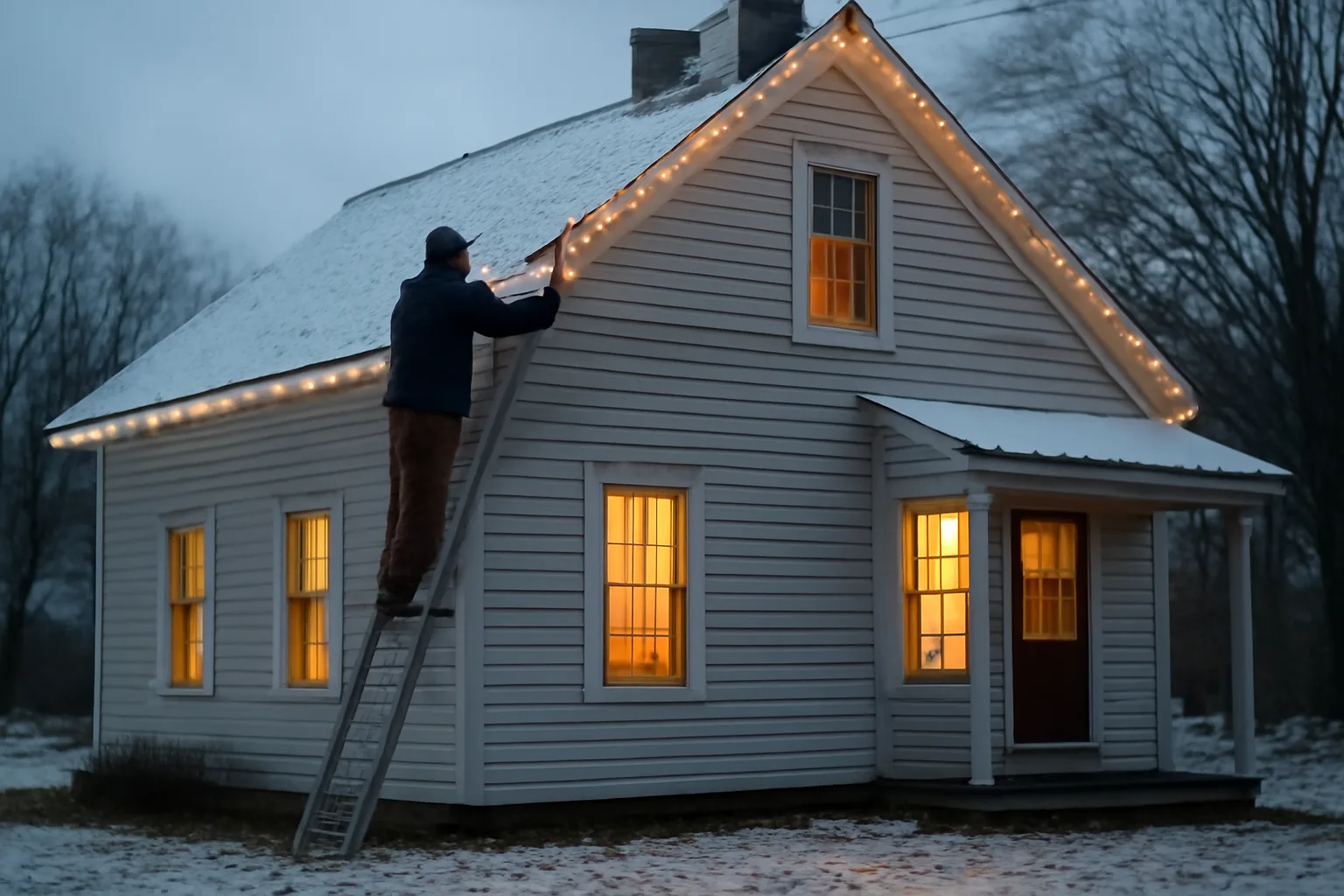
Hang pre-strung LED lights on gutters, wrap trees, take them down. That is general decoration work in Vermont's eyes. It does not trigger an electrical contractor requirement on its own. But the moment you run new circuits, install permanent outlets, wire timers into a panel, or touch the fixed wiring of a home, Vermont requires a licensed electrician for that portion of the work under Title 26, Chapter 15 of the Vermont Statutes [1].
So the practical rule is simple. If every light you hang plugs into an existing exterior outlet, you are outside the electrician-licensing requirement. If you go inside the panel, you need a licensed electrician on your team or as a subcontractor.
Vermont also has a separate contractor registration requirement. Anyone contracting with homeowners for home improvement work over $500 has to register with the Vermont Office of Professional Regulation [11]. Holiday lights installation qualifies as home improvement work. Registration costs $50 and renews annually. Skipping it is a Class A misdemeanor under 9 V.S.A. Chapter 82 [2].
Then there is the business entity itself. You register with the Vermont Secretary of State. An LLC costs $125 to form online [3]. A sole proprietorship filing a trade name (DBA) costs $50 [3]. Neither is optional if you want a business bank account, signed contracts, or protection for your personal assets.
Last, check your town. Burlington, Montpelier, South Burlington, and many Vermont towns want a local business license or home occupation permit if you run the business out of a residence. Fees and rules change town to town, so call your city or town clerk's office directly.
What is Vermont's home improvement contractor registration and do holiday lights installers need it?
Yes, with very high confidence. Vermont's Home Improvement Fraud statute, 9 V.S.A. Chapter 82, requires any person or business that contracts with a homeowner to perform home improvement work for pay to register with the state [2]. "Home improvement" in the statute covers a broad range of residential work, and hanging exterior lighting on a home sits squarely inside that definition.
Registration is straightforward. You file with the Vermont Office of Professional Regulation, pay a $50 annual fee, and give basic business information [11]. There is no exam. There is no state-mandated insurance minimum for the registration itself (though you absolutely need insurance for other reasons), and no apprenticeship requirement. The state can impose fines and injunctions on anyone operating without registration, so this is one credential you do not skip.
The registration is not a license to perform skilled trades. It is consumer protection paperwork. Think of it as Vermont's way of making sure a homeowner can look up who is knocking on the door and whether that contractor answers to the state.
Does Vermont require an electrical license for holiday lights work?
Vermont licenses electricians under Title 26, Chapter 15 of the Vermont Statutes [1]. The Board of Electrical Licensing issues master, journeyman, and apprentice classes. If your business only plugs decorative lighting into existing outlets, none of those licenses apply to that task.
The line gets crossed when you do what the electrical code calls electrical work: installing new wiring, adding circuits, installing GFI outlets, running wire through conduit, or connecting anything to the panel. At that point a licensed master or journeyman electrician has to do the work or supervise it.
Most residential holiday lights businesses in Vermont stay on the right side of this line by sticking to plug-in products and telling homeowners to call an electrician if they need a new outdoor outlet. Some operators keep a licensed electrician on call for any wiring needs and refer that work out. That is clean from both a liability and a legal standpoint.
Want to offer full-service wiring? Then you employ a licensed electrician or become one yourself. A Vermont master electrician license requires passing a state exam, documented hours, and fees. Confirm current exam and licensing fees directly with the Vermont Board of Electrical Licensing [1].
How much does it cost to get licensed and legal in Vermont?
Here is an honest breakdown of the startup costs. These are real fee schedules where available, with notes on where the numbers come from.
| Credential | Fee | Frequency | Source |
|---|---|---|---|
| Vermont LLC formation | $125 | One-time | Vermont SOS [3] |
| Vermont DBA / trade name | $50 | One-time | Vermont SOS [3] |
| Home Improvement Contractor registration | $50 | Annual | Vermont OPR [11] |
| General liability insurance (1M/2M) | $900-$2,500/yr | Annual | Industry range |
| Commercial auto (if using a work vehicle) | $1,200-$2,800/yr | Annual | Industry range |
| Local business/home occupation permit | $0-$100 | Annual | Varies by town |
Insurance is the biggest variable. A solo operator with no employees and under $100,000 in revenue can sometimes find a general liability policy in the $900 to $1,200 range annually. Add employees or grow past $250,000 in annual revenue and premiums climb. Workers' compensation is required for any employees in Vermont under 21 V.S.A. Chapter 9 [4], and that adds another layer of cost.
The state-level paper costs alone, before insurance, run roughly $175 to $225 for a first-year LLC with contractor registration. That is a manageable number. Insurance is where operators most often underestimate their startup costs.
One practical note on tax. The Vermont Department of Taxes requires businesses making taxable sales to collect and remit Vermont sales tax [5]. Whether your holiday lights work is taxable depends on how you structure your invoices. Labor for installation is generally not taxable in Vermont, but if you sell the lights and materials as separate line items, those goods are taxable. Confirm the specifics with the Vermont Department of Taxes before you invoice your first customer.
How long does getting legal for holiday lights in Vermont take?
Most Vermont filings clear faster than people expect.
Vermont LLC formation online through the Secretary of State usually processes in one to three business days [3]. Paper filings drag, sometimes three to four weeks, so file online.
Home Improvement Contractor registration through the Office of Professional Regulation is also online and generally comes back within five to ten business days, though OPR recommends confirming current processing times directly with the office because backlogs shift by season [11].
Insurance is often the longest pole in the tent. Quotes take a few days. Binding a policy and getting your certificate of insurance can happen same-day with some brokers, or take a week if an underwriter needs to review your application. Start in September or October and you have time. Start in late November and you move immediately.
Local permits vary the most. A Burlington home occupation permit might take a few days. A rural town where the zoning administrator works part-time might take three to four weeks. Call first.
Realistic total if you start all filings at once: four to eight weeks from zero to fully operational. Everything smooth and filed online, four weeks is achievable. Build in buffer.
What insurance do Vermont holiday lights businesses need?
General liability insurance is the foundation. It covers property damage you cause (a ladder dents a gutter, a strand shorts out and scorches siding) and bodily injury claims. For a small holiday lights business, a $1 million per occurrence, $2 million aggregate policy is the standard starting point. Many residential clients ask for a certificate of insurance before you set foot on their property, and some HOAs require specific coverage minimums.
Have any employees, even seasonal part-timers? Vermont requires workers' compensation coverage. There is no small-employer exemption for most industry types. Vermont's workers' compensation statute is 21 V.S.A. Chapter 9 [4], and the Vermont Department of Labor enforces it hard.
Commercial auto coverage is required if you use a vehicle for business. Your personal auto policy will not cover a claim that arises while you drive to a job. This catches a lot of first-year operators off guard.
A few insurers specialize in seasonal contractors or exterior decorating businesses. Get quotes from both a local Vermont independent agent and a specialty commercial insurer. Local agents sometimes reach markets that online-only platforms do not, and they know Vermont's rules.
Do you need to collect Vermont sales tax on holiday lights services?
Vermont imposes a 6% sales and use tax on tangible personal property [5]. The tricky part for holiday lights businesses is that Vermont generally does not tax installation labor on its own, but it does tax the sale of goods. How you write your invoices matters.
Charge one combined price for "holiday lights installation" and you may be able to treat the whole amount as a service, but Vermont's guidance on mixed transactions (labor plus materials) takes careful reading. Separately itemize the light strands, clips, and stakes you sell to the customer and those material costs are likely taxable.
The safest move is to register with the Vermont Department of Taxes for a business tax account and ask them directly how to handle your invoice structure [5]. The registration is free. Getting this wrong means back taxes, interest, and penalties, none of which are fun to sort out mid-season.
Renting lights rather than selling them? The tax treatment may differ again. Vermont does tax the rental of tangible personal property. Confirm with the Department of Taxes before you lock in your pricing model.
What local permits do Vermont towns require for holiday lights businesses?
Vermont has 247 municipalities and they all handle business permitting differently. There is no statewide local business license. Some towns want nothing beyond your state registrations. Others, mostly the larger ones, have specific requirements.
Burlington runs a business licensing process through the city, and if you operate out of a home there you also need a home occupation permit, which carries restrictions on signage, employee visits, and storage. Montpelier, South Burlington, and Rutland have similar local structures. Rural towns often ask for nothing beyond zoning compliance.
Zoning is worth checking regardless of town. Store a trailer full of lights at your house and you may be running a commercial operation in a residential zone. That can trigger a zoning violation even with all your state paperwork in order. Call your town's zoning administrator before you sign a storage lease or park a wrapped work truck in your driveway.
The Vermont League of Cities and Towns keeps directories and municipal resources that help you find your specific town's rules [7].
How much does a holiday lights installation business charge in Vermont?
Pricing in Vermont follows Northeast norms, which run higher than national averages because of the shorter season, higher insurance costs, and the skilled labor market. Here is how the numbers stack up.
Residential roofline packages for a standard single-family home (roughly 100 to 150 linear feet of roofline) typically run $350 to $700 for installation, take-down included. Larger homes with dormers, multiple peaks, and heavy tree wrapping run $1,000 to $2,500 and up.
Commercial properties, including retail storefronts, office buildings, and condo common areas, usually price per foot or per zone. Commercial jobs often run $2,000 to $10,000 depending on scope.
Some operators charge separately for lights (selling them or charging a seasonal rental fee) and separately for labor. Others bundle everything. Bundled pricing is simpler for customers but demands careful cost accounting on your end so you actually know your margin.
Sorting the paper path before you launch, not the pricing mechanics? Tools like the HolidayLightPath Hang + HOA + Take-Down Kit at $129 one-time cover the documents and forms side of first-year operations, from HOA approval letters to take-down checklists. That is a different layer than the state licensing in this article.
For comparable licensing structures elsewhere, the holiday lights license in Colorado and holiday lights license in Alaska guides cover states with similarly involved contractor frameworks.
How do Vermont's contractor registration rules compare to nearby states?
Vermont's home improvement contractor registration is common in the Northeast but not universal. Here is how a few neighboring and comparable states handle it.
| State | Home Improvement Registration? | Fee | Electrician License for plug-in lights? |
|---|---|---|---|
| Vermont | Yes (9 V.S.A. Ch. 82) | $50/yr | No (for plug-in only) |
| New Hampshire | No statewide registration | N/A | No (for plug-in only) |
| Maine | Yes (contractor registration) | $25/yr | No (for plug-in only) |
| Massachusetts | Yes (HIC registration) | $150/yr | No (for plug-in only) |
| New York | Yes (varies by county) | Varies | No (for plug-in only) |
Vermont's $50 annual fee sits on the low end for the region. Massachusetts charges $150 for its Home Improvement Contractor registration [8]. New York's requirements depend heavily on county and municipality.
The electrical license requirement for pure plug-in work is consistently "not required" across these states, which reflects how electrical codes define "electrical work" as work involving fixed wiring rather than cord-and-plug-connected equipment. Verify this with your state's electrical board before relying on it, because the line can shift based on local amendments to the National Electrical Code [9].
What is the step-by-step checklist to start legally in Vermont?
Here is the sequence that makes the most sense, in order.
Step 1: Choose your business structure. An LLC protects your personal assets and costs $125 to form online. A sole proprietorship is simpler but gives you no liability shield. For most operators taking on residential clients, an LLC is the right call.
Step 2: Register with the Vermont Secretary of State [3]. File your Articles of Organization for an LLC. File a trade name if you operate as a sole proprietor under a business name.
Step 3: Get an EIN from the IRS at no cost [10]. You need it to open a business bank account and to file business taxes. It takes about five minutes online.
Step 4: Register with the Vermont Department of Taxes for a business tax account, especially if you will collect sales tax [5].
Step 5: Register as a Home Improvement Contractor with the Vermont Office of Professional Regulation [11]. Pay the $50 fee. Keep a copy of your confirmation to show clients if asked.
Step 6: Get general liability insurance before you take your first job. Get workers' compensation if you have any employees.
Step 7: Check your local municipality for any additional business license or home occupation permit [7].
Step 8: Confirm whether any services you plan to offer (panel work, new circuit installation) require a licensed electrician [1].
Done in that order, with online filing where available, you can realistically finish steps 1 through 5 within one week. Insurance takes longer to bind. Local permits add variable time.
Frequently asked questions
Do you need a license for holiday lights in Vermont?
Vermont has no single "holiday lights license." You need a business registration (LLC or DBA), a Home Improvement Contractor registration ($50/year) under 9 V.S.A. Chapter 82, general liability insurance, and possibly a local municipal permit. An electrical license is only required if you do wiring beyond plugging lights into existing outlets. Most operators are fully legal after those three to four steps.
How much does it cost to start a holiday lights business in Vermont?
State-level fees run roughly $175 to $225 for the first year: $125 for an LLC plus $50 for the Home Improvement Contractor registration. The bigger cost is insurance. General liability runs $900 to $2,500 per year depending on revenue and limits. Workers' compensation is required for any employees. Budget $1,500 to $4,000 total for first-year compliance costs, equipment not included.
How long does it take to get legal for holiday lights in Vermont?
Vermont LLC formation online takes one to three business days. Home Improvement Contractor registration takes five to ten business days through the Office of Professional Regulation. Insurance can bind in days with the right broker. Local municipal permits are the wildcard, from a few days in cities to several weeks in smaller towns. Realistically, budget four to eight weeks total from a standing start.
Does Vermont require an electrical license to hang holiday lights?
Not for plug-in decorative lighting. Vermont's electrical licensing law under Title 26, Chapter 15 applies to work involving fixed wiring, panels, and circuits. Hanging pre-strung lights that plug into existing outdoor outlets does not trigger the license requirement. If you want to install new outlets, run wire, or touch a panel, that work requires a Vermont-licensed electrician.
Does Vermont require workers' compensation for seasonal holiday lights employees?
Yes. Vermont's workers' compensation law under 21 V.S.A. Chapter 9 requires coverage for employees. There is no small-employer exemption for most business types. Even a part-time seasonal hire triggers the requirement. Penalties for non-compliance include fines and liability for any injury claims. Get workers' comp in place before your first employee's first day.
Do I need to collect sales tax on holiday lights installation in Vermont?
Vermont imposes a 6% sales tax on tangible personal property. Pure installation labor is generally not taxable, but materials sold to clients (light strands, clips, extension cords) likely are. How you write your invoices matters. Register with the Vermont Department of Taxes for a business tax account and confirm how your specific service structure is treated before you send your first invoice.
What is Vermont's Home Improvement Contractor registration and how do I get it?
It is a $50 annual registration required under 9 V.S.A. Chapter 82 for anyone contracting with homeowners for home improvement work. You file with the Vermont Office of Professional Regulation. There is no exam. You provide basic business information, pay the fee, and get confirmation. Processing typically takes five to ten business days. Operating without it is a Class A misdemeanor.
Do local Vermont towns require additional permits for holiday lights businesses?
Many do. Burlington, Montpelier, and South Burlington have local business licensing requirements. Home occupation permits are common if you operate from a residential address. Rural Vermont towns often require nothing beyond state registration. Call your town clerk or zoning administrator directly. Do not assume state registration covers local requirements. They are separate systems.
Can I operate a holiday lights business in Vermont as a sole proprietor?
Yes. You can operate as a sole proprietor under your own name or register a trade name (DBA) with the Vermont Secretary of State for $50. You still need the Home Improvement Contractor registration and all applicable insurance. The main drawback versus an LLC is that you have no liability shield. If a client sues you, your personal assets are at risk.
What insurance do Vermont holiday lights businesses need?
At minimum, general liability insurance covering property damage and bodily injury. A $1 million per occurrence, $2 million aggregate policy is the standard starting point. If you have employees, workers' compensation is legally required. If you use a vehicle for work, commercial auto coverage is required because personal auto policies exclude business use. Many residential clients ask to see a certificate of insurance before work starts.
How does Vermont's licensing compare to other states for holiday lights?
Vermont's $50 annual Home Improvement Contractor registration sits on the low end for the Northeast. Massachusetts charges $150 for its equivalent HIC registration. New Hampshire has no statewide registration requirement. All these states share the same rule on electrical licensing: plug-in decorative lighting does not trigger the electrician license requirement. Vermont's overall compliance cost is moderate compared to neighboring states.
What happens if I skip the Vermont Home Improvement Contractor registration?
Operating as a home improvement contractor without registration in Vermont is a Class A misdemeanor under 9 V.S.A. Chapter 82. Penalties include fines and potential injunctions barring you from the work. Beyond the legal risk, unregistered contractors can face trouble enforcing payment in court. The $50 fee and five-minute online application make skipping it a bad trade-off.
Do I need a separate EIN for my Vermont holiday lights business?
If you form an LLC or hire any employees, yes. An EIN (Employer Identification Number) from the IRS is required for business banking, tax filing, and payroll. You can apply free at IRS.gov and get your EIN immediately online. Sole proprietors with no employees can use their Social Security Number for federal tax, but most banks still prefer an EIN for a business account.
How do I price holiday lights installation in Vermont?
Residential roofline packages for a standard single-family home typically run $350 to $700 including seasonal take-down in Vermont. Larger homes with complex rooflines can run $1,000 to $2,500. Commercial jobs range from $2,000 to $10,000 and up. Vermont's prices track the broader Northeast market, which runs higher than national averages due to the shorter season, higher insurance costs, and the regional labor market.
Sources
- Vermont Secretary of State, Office of Professional Regulation, Electricians: Vermont licenses electricians (master, journeyman, apprentice); work involving fixed wiring and panels requires a licensed electrician
- Vermont Secretary of State, Business Services Division: Vermont LLC formation costs $125 online; trade name (DBA) filing costs $50
- Vermont Department of Taxes, Sales and Use Tax: Vermont imposes a 6% sales and use tax on tangible personal property; businesses making taxable sales must register with the Department of Taxes
- Vermont League of Cities and Towns: Vermont has 247 municipalities with varying local business permit requirements; VLCT provides municipal directories and resources
- Massachusetts Office of Consumer Affairs, Home Improvement Contractor Program: Massachusetts charges $150 for its Home Improvement Contractor registration, compared to Vermont's $50
- National Fire Protection Association, NFPA 70 (National Electrical Code): The National Electrical Code defines electrical work as involving fixed wiring; cord-and-plug-connected equipment (plug-in lights) is generally excluded from electrician licensing triggers under state adoptions of the NEC
- IRS, Apply for an Employer Identification Number (EIN) Online: EIN registration is free from the IRS and can be completed online in approximately five minutes
- Vermont Office of Professional Regulation, Contractor Registration: Home Improvement Contractor registration is administered by the Vermont Office of Professional Regulation with a $50 annual fee and online filing