Last updated 2026-08-18
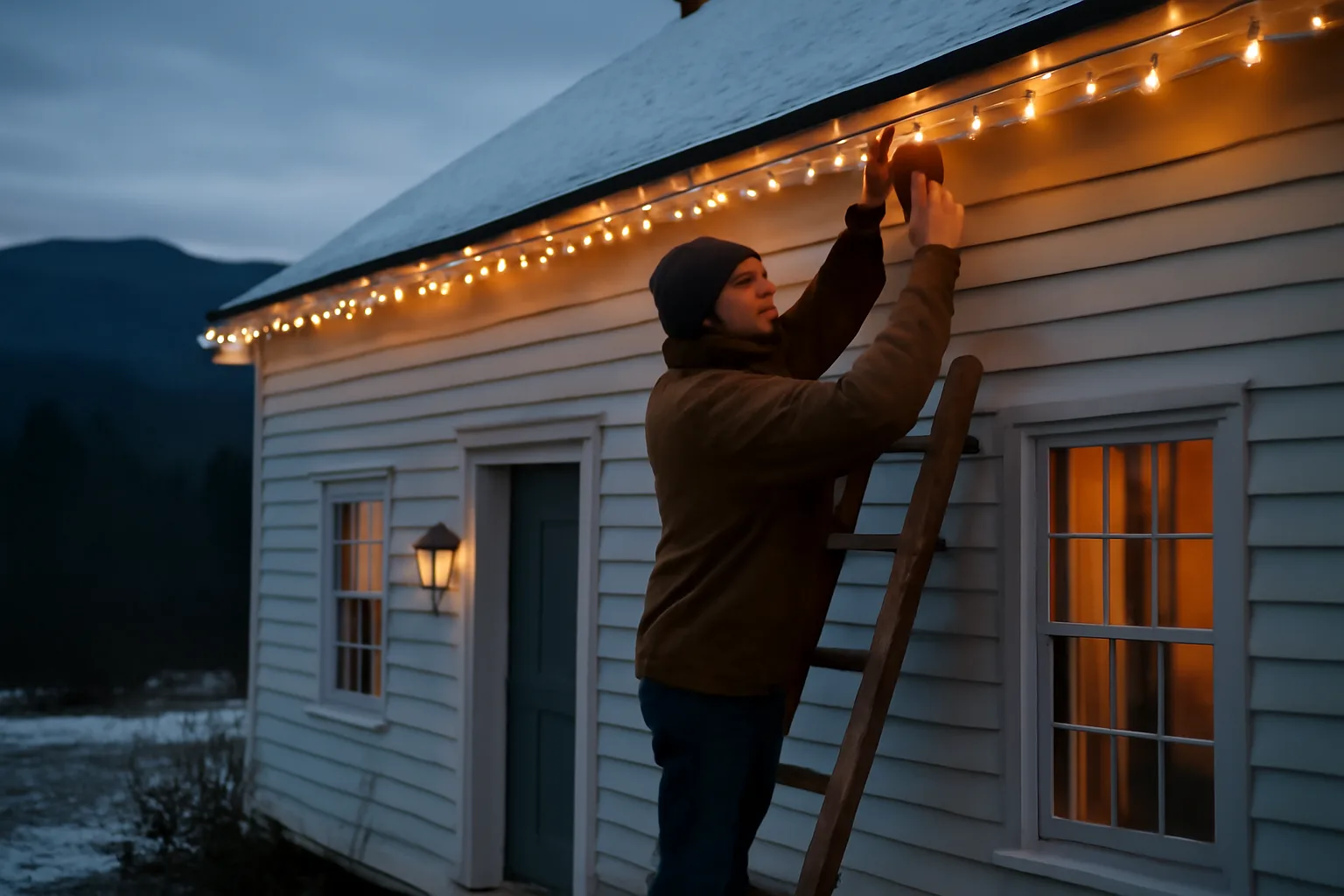
TL;DR
Vermont has no dedicated "holiday lights board." The Department of Labor runs electrical licensing. The Secretary of State handles business registration. Hardwired work needs a master or journeyman electrician license. Plug-in-only work does not, but it still needs business registration and insurance. Town permits and liability coverage add the third layer. First-year operators miss the permit step, not the license step.
Does Vermont have a holiday lights licensing board?
No. Vermont has no dedicated licensing board for holiday lighting as a standalone trade. The work is split across two state bodies: the Vermont Department of Labor, which runs electrical licensing under Title 26 of the Vermont Statutes [1], and the Vermont Secretary of State's Corporations Division, which handles business registration. [2]
Here is what that means on the ground. If your holiday lights business connects to a building's electrical system, permanently mounts fixtures, or runs new wiring, you are doing electrical work under Vermont law. That work needs a licensed electrician on the job. If you stay strictly with plug-in decorative lighting and no hardwired connections, the licensing threshold drops, but you still register your business and carry insurance.
No board does not mean no rules. Vermont is not a free-for-all. The electrical licensing statute is real, enforced, and carries fines for unlicensed work.
Do you need a license for holiday lights in Vermont?
It depends on what you're installing. Hardwired work needs an electrical license. Plug-in-only work does not, at the state level.
Vermont requires electrical contractor licensing under Title 26 of the Vermont Statutes for anyone installing, altering, or repairing electrical wiring or equipment. [1] Connecting lighting to a structure's wiring, installing outlets, or mounting permanent fixtures all count as electrical work. That means you hold a Master Electrician license to own the contracting business, or a Journeyman license to perform the work under supervision.
Strictly plug-in lights, extension cords, and clips with no hardwired connections? The state electrical statute does not require a license for that scope. Municipalities are a different story. Burlington, South Burlington, and other Vermont towns require local contractor registration or a property permit for commercial exterior lighting even when nothing gets hardwired.
Confirm these before your first job:
| Requirement | Governing body | Where to confirm |
|---|---|---|
| Electrical contractor license | VT Dept. of Labor | labor.vermont.gov |
| Business entity registration | VT Secretary of State | sos.vermont.gov |
| Trade name (DBA) registration | VT Secretary of State | sos.vermont.gov |
| Local contractor permit | Town clerk or DPW | Varies by municipality |
| Liability insurance certificate | Your insurer | Required by most clients |
Most trades operating in Vermont register their business entity whether or not they need a professional license. [2] That registration step trips up more new operators than the license exam does.
What does Vermont's electrical licensing require?
Vermont's Department of Labor administers two licenses that matter to holiday lighting contractors doing any hardwired work: Master Electrician and Journeyman Electrician. [8]
A Master Electrician license lets you own and operate an electrical contracting business and pull permits. You pass a state exam, complete the required supervised experience (typically four years as a journeyman before applying for master status), and pay the licensing fee. Confirm the current fee with the Department of Labor, since fees are set by rulemaking and change.
A Journeyman Electrician license lets you perform electrical work under a licensed master. You complete an approved apprenticeship (generally a four-year program through a union or approved trade school) and pass the journeyman exam.
A strictly plug-in operation needs neither license under the statute. But here is the practical reality: many commercial property managers and HOAs in Vermont will not hire you without proof of electrical licensing, or at minimum a Certificate of Insurance showing general liability and workers' compensation. The license is often the easier sell, not the hurdle.
Licenses renew on a schedule the Department of Labor sets. Confirm current renewal periods and continuing education requirements with the department, because these details change. [8]
How much does holiday lights cost in Vermont?
Two cost conversations run here: what you spend to get licensed and compliant, and what you charge customers.
Compliance costs stack up like this. Business entity registration with the Secretary of State runs roughly $75 for an LLC filing, though confirm the current fee at sos.vermont.gov because the legislature adjusts these periodically. [2] Electrical exam and license fees are set by the Department of Labor; confirm current amounts directly. [8] General liability insurance for a small exterior lighting contractor in Vermont typically runs $800 to $2,000 per year depending on revenue and coverage limits, based on commercial carrier rate ranges reported for the region. Workers' compensation is required if you have employees, and Vermont rates for construction-adjacent classifications have historically run $5 to $12 per $100 of payroll, though you must confirm current rates through the Vermont Department of Financial Regulation. [3]
On the revenue side, holiday lights pricing follows regional market rates. Residential installs typically run $200 to $600 for a smaller single-story home and $600 to $2,000 for larger or more complex properties once you factor in design, hanging, takedown, and storage. Commercial installs scale well past that. These are market observations from public contractor pricing pages and industry guidelines, not a guaranteed rate. Your local market, your labor costs, and your equipment mix set what you can actually charge.
Vermont winters start early. Columbus Day weekend is roughly when the install rush begins up north. In southern Vermont, some pricing pressure comes from Massachusetts-based companies pushing north for the season.
How long does holiday lights take in Vermont?
"How long" has two meanings: how long to get set up legally, and how long each job takes on the ground.
Legal setup runs like this. Business entity registration through the Vermont Secretary of State can be done online and usually processes in a few days to a couple of weeks. [2] Electrical licensing is the long road. A Master Electrician license from scratch means years of apprenticeship and journeyman experience before you sit the master exam. Already hold a journeyman or master license from another state? Vermont offers a reciprocity pathway that can compress the timeline. Confirm current reciprocity agreements with the Department of Labor. [8]
A plug-in-only operation with no hardwiring can be legally operating in two to four weeks if you finish business registration and secure insurance quickly. That does not count getting a local contractor registration in towns that require one.
On the job, a standard residential install runs one to four hours for a single-story home with a basic roofline and shrub package. Multi-story homes, steep pitches common in Vermont's older housing, and heavy tree coverage add time fast. Vermont's older clapboard and colonial homes often have irregular rooflines that slow gutter-clip work compared to newer construction.
Plan your calendar around late October through mid-December for installs and January through February for takedowns. Snow is the variable nobody budgets for correctly in year one.
What business registration does a Vermont holiday lights company need?
Every business operating in Vermont registers with the Secretary of State's office. [2] The form and structure depend on how you organize.
A sole proprietorship under your own legal name does not technically require formal state registration, but you need a trade name registration (DBA) to operate under any other name. An LLC is the most common structure for small contractors because it separates personal liability from business liability. Vermont LLC formation means filing Articles of Organization with the Secretary of State and paying the fee. You also need a registered agent with a Vermont address.
After entity formation, get a Federal Employer Identification Number (EIN) from the IRS. It is free and available online through IRS.gov. [4] Vermont also requires a Business Tax Account registration with the Department of Taxes if you have employees or collect sales tax. [5]
Vermont charges a meals and rooms tax and a sales tax, but decorative holiday lighting installation services are generally not subject to sales tax under current guidance. Materials you sell separately (lights, clips) may be taxable. Confirm the current rules with the Vermont Department of Taxes. [5]
Working through an HOA or commercial property manager? They almost always require a Certificate of Insurance before the first install. Get that certificate from your insurer before you chase your first contract.
What permits and local approvals do Vermont towns require?
Some Vermont towns require a local permit or contractor registration for exterior lighting work. Others do not. Vermont's home rule tradition gives municipalities real authority to add requirements on top of state licensing, and there is no single statewide list. You call the town clerk or building department for each municipality where you plan to work.
Burlington and its surrounding communities are the most likely to require a local permit or contractor registration for commercial exterior lighting. Smaller towns in the Northeast Kingdom or the Upper Valley are less likely to have formal processes, but they are not guaranteed permit-free. Some towns require permits for any exterior electrical connection, even a plug-in extension cord powering temporary decorations on a commercial building.
Historic district rules add another layer in towns like Woodstock, Middlebury, and Montpelier. The Vermont Division for Historic Preservation oversees the state's historic preservation program, and some installations on or near listed structures may need coordination with town historic review boards. [6] This is rare for typical holiday lights, but check if your client has a property on the National Register of Historic Places.
Practical advice: build a two-week buffer into any commercial client's timeline for permit processing. Residential clients rarely need permits for plug-in installs, but tell them to check with their town before you show up.
What insurance does a Vermont holiday lights contractor need?
Vermont has no single statutory minimum for general liability insurance specific to holiday lights contractors. Your requirements come from client contracts, commercial property rules, and common sense.
General liability insurance is the baseline. Most commercial clients and property managers in Vermont require a minimum of $1 million per occurrence and $2 million aggregate. Residential clients rarely ask for a certificate but will absolutely pursue you if something goes wrong and you have none.
Workers' compensation is required by Vermont law if you have one or more employees. [7] The program is administered by the Department of Financial Regulation. Sole proprietors with no employees are generally exempt, but the moment you bring on a seasonal helper the requirement kicks in. Misclassifying an employee as an independent contractor to dodge workers' comp is not a gray area in Vermont. The state has enforcement mechanisms and penalties.
Rooftop work is inherent to most holiday lighting, and some insurers add a roofing exclusion or a height restriction to standard general liability policies. Read your policy line by line and ask your broker directly whether installation from a ladder or on a roof is covered.
How does Vermont compare to neighboring states for holiday lights licensing?
Vermont sits in the middle of the New England regulatory range. Connecticut requires electrical contractor licensing for a broader scope of work and has a more formal board structure. See holiday lights board in Connecticut. New Hampshire is lighter than Vermont for plug-in-only exterior work. Maine runs roughly parallel to Vermont.
The table below is a rough comparison of key licensing variables across some New England and adjacent states. These are general characterizations from public state licensing information; confirm current requirements with each state's authority.
| State | Dedicated holiday lights board | Electrician license required (hardwired) | Business registration required |
|---|---|---|---|
| Vermont | No | Yes (Title 26 V.S.A.) | Yes |
| Connecticut | No | Yes | Yes |
| New Hampshire | No | Yes (hardwired) | Yes |
| Colorado | No | Yes (hardwired) | Yes |
| Florida | No | Yes (hardwired) | Yes |
No state has a dedicated holiday lights licensing board. Every state that regulates the work routes it through electrical contractor licensing. The variation is in how strictly each state defines "electrical work" and how actively it enforces the rules. Vermont's enforcement is real. The Department of Labor investigates complaints about unlicensed electrical work. [1]
For how other states handle this, holiday lights board in Connecticut and holiday lights board in Colorado walk through those state-specific paths in detail.
What should a first-year Vermont holiday lights operator do in order?
There is a logical sequence, and skipping steps creates problems that are hard to fix mid-season.
First, decide your scope. Plug-in only, or hardwired installs too? That single call decides whether you need an electrical license.
Second, register your business entity with the Vermont Secretary of State. Do not take money before this step. [2]
Third, get your EIN from the IRS. Free, fast, online. [4]
Fourth, register with the Vermont Department of Taxes for any required tax accounts. [5]
Fifth, secure general liability insurance before any site visit or install. A certificate of insurance is table stakes for commercial work.
Sixth, doing hardwired work? Confirm your electrical license status with the Vermont Department of Labor. If you are not licensed, hire a licensed electrician or restrict your scope to plug-in work. [8]
Seventh, call the town clerk in every municipality where you plan to work and ask whether a local contractor registration or permit is required for exterior lighting.
The paper side of this (the forms, the HOA approval templates, the takedown agreements) is what HolidayLightPath's Hang + HOA + Take-Down Kit (one-time $129 at /start) covers for operators who want the document templates without building them from scratch. That is the only place this publication covers that ground. The regulatory steps above require direct contact with Vermont agencies.
Curious how neighboring states structure their requirements? Holiday lights board in Connecticut, holiday lights board in Colorado, and holiday lights board in Florida are worth reading alongside this guide.
Where do you actually file and confirm requirements in Vermont?
Here are the primary contacts, mapped to each requirement. Do not rely on secondary sources, including this article, for current fees and processing times. Requirements change.
Vermont Department of Labor (electrical licensing): labor.vermont.gov. Confirm license requirements, exam schedules, reciprocity agreements, and current fees here. [8]
Vermont Secretary of State, Corporations Division (business registration): sos.vermont.gov. LLC formation, trade name registration, and entity status searches all live here. [2]
Vermont Department of Taxes (tax registration): tax.vermont.gov. Business Tax Account registration for employers and sales tax questions. [5]
Vermont Department of Financial Regulation (workers' compensation): dfr.vermont.gov. Workers' comp carrier approval lists and employer requirements. [3]
Vermont Division for Historic Preservation (historic property questions): accd.vermont.gov/historic-preservation. Relevant only if you work on or next to listed historic structures. [6]
Your town clerk. No URL covers this because every municipality is different. Call them. It takes ten minutes and can save you a stop-work notice.
Frequently asked questions
Do you need a license for holiday lights in Vermont?
If your work involves any hardwired electrical connections, yes: Vermont requires an electrical contractor license under Title 26 of the Vermont Statutes. For strictly plug-in lighting with no hardwiring, the state electrical license is not required, but you still need a registered business entity, insurance, and possibly a local permit depending on the municipality. Confirm with the Vermont Department of Labor and your town clerk before starting work.
How much does holiday lights cost in Vermont?
Business registration for a Vermont LLC runs roughly $75 in filing fees, though confirm the current amount with the Secretary of State. General liability insurance typically runs $800 to $2,000 per year for a small contractor. Electrical licensing fees vary; confirm with the Vermont Department of Labor. On the revenue side, residential installs in Vermont typically run $200 to $2,000 depending on home size and complexity.
How long does holiday lights take in Vermont?
Business registration through the Vermont Secretary of State typically processes in days to a couple of weeks online. Electrical licensing from scratch takes years of apprenticeship. A plug-in-only operation can be legally operational in roughly two to four weeks if insurance is secured quickly. On the job side, a standard residential install takes one to four hours; larger or more complex Vermont properties take longer, especially with the state's older roofline styles.
Does Vermont have a dedicated holiday lights licensing board?
No. Vermont has no dedicated holiday lights board. Electrical licensing runs through the Vermont Department of Labor under Title 26 of the Vermont Statutes. Business registration runs through the Secretary of State. Municipal permits are handled by individual town clerks. There is no single agency that covers all aspects of holiday lighting regulation in Vermont.
Can I start a holiday lights business in Vermont without an electrician's license?
Yes, if you limit your work to plug-in decorative lighting with no hardwired connections. Vermont's electrical licensing requirement applies to installation, alteration, or repair of electrical wiring or equipment. Plug-in-only work typically falls outside that definition. You still need business registration, insurance, and local permits where required. Commercial clients often demand electrical licensing credentials regardless of scope.
Do I need workers' compensation insurance for a holiday lights business in Vermont?
Vermont law requires workers' compensation if you have one or more employees. The Vermont Department of Financial Regulation administers the program. Sole proprietors with no employees are generally exempt. If you bring on any seasonal helpers, even part-time, the requirement applies. Misclassifying employees as independent contractors to avoid coverage is a violation with penalties under Vermont law.
What is the Vermont Secretary of State's role in holiday lights businesses?
The Vermont Secretary of State's Corporations Division handles business entity registration, which is required before operating any business in Vermont. You file Articles of Organization for an LLC or register a trade name (DBA) for a sole proprietorship there. This is a separate process from professional licensing and applies to all businesses regardless of whether they need a state-issued trade license.
Do Vermont towns require separate permits for holiday light installations?
Some do. Vermont municipalities have home rule authority to require local contractor registrations or installation permits for exterior lighting work, even when no state license is required. Burlington and its surrounding communities are the most likely to have formal requirements. There is no statewide list; you need to call the town clerk for each municipality where you plan to work before starting your first install.
Is holiday lights installation considered electrical work under Vermont law?
Vermont's electrical licensing statute under Title 26 of the Vermont Statutes covers installing, altering, and repairing electrical wiring and equipment. If your installation involves hardwired connections, new wiring, or permanent fixture mounting, that qualifies as electrical work. Plug-in decorative lighting generally does not. The line matters because electrical work requires a licensed electrician on the job, while plug-in work does not trigger that requirement.
How does Vermont handle electrician license reciprocity for out-of-state holiday lights contractors?
Vermont offers reciprocity for electrician licenses from other states, which can significantly shorten the timeline for licensed electricians from neighboring states who want to operate in Vermont. The specific states covered by reciprocity agreements and current application requirements are set by the Vermont Department of Labor. Confirm current reciprocity terms directly with the department before assuming your out-of-state license transfers cleanly.
What is the busiest season for holiday lights in Vermont and how does it affect business planning?
Installations in Vermont typically ramp up from Columbus Day weekend through mid-December. The northern part of the state runs earlier than the southern counties because of snow. Takedowns run January through February. Weather is the biggest variable most first-year operators underprice. Plan for days lost to ice and snow and build that into your client agreements. Vermont's older housing stock also means more difficult rooflines than newer-construction markets.
Do historic district rules affect holiday lights installations in Vermont?
Potentially, yes. The Vermont Division for Historic Preservation oversees the state's historic preservation program. Some towns with significant historic districts, such as Woodstock, Middlebury, and Montpelier, have local historic review boards that may have authority over exterior modifications on or near listed structures. This is rarely a factor for typical plug-in holiday lighting, but worth checking if your client's property is on the National Register of Historic Places.
What taxes apply to a Vermont holiday lights business?
Holiday lighting installation services are generally not subject to Vermont sales tax, but materials sold separately may be taxable. Vermont also requires a Business Tax Account registration with the Department of Taxes if you have employees or collect sales tax. Income from the business is subject to Vermont income tax. The Vermont Department of Taxes is the authoritative source on current taxability rules; confirm before you invoice your first client.
Is general liability insurance required by law for holiday lights contractors in Vermont?
Vermont does not have a single statute mandating a specific general liability insurance minimum for holiday lights contractors. The requirement is driven by client contracts and commercial property managers, who typically demand $1 million per occurrence and $2 million aggregate. Workers' compensation is legally required if you have employees. For rooftop ladder work, confirm with your insurer that exterior holiday lighting installation is explicitly covered under your policy.
Sources
- Vermont Department of Labor, Electrical Licensing: Vermont requires electrical contractor licensing under Title 26 of the Vermont Statutes for installing, altering, or repairing electrical wiring or equipment
- Vermont Secretary of State, Corporations Division: Vermont businesses must register with the Secretary of State's Corporations Division; LLC formation requires filing Articles of Organization and paying the applicable fee
- Vermont Department of Financial Regulation, Workers' Compensation: Vermont's Department of Financial Regulation administers workers' compensation requirements for employers in Vermont
- IRS, Apply for an Employer Identification Number (EIN) Online: Federal EIN is available free and online from the IRS for any business entity
- Vermont Department of Taxes, Business Registration: Vermont requires businesses with employees or sales tax obligations to register a Business Tax Account with the Department of Taxes
- Vermont Division for Historic Preservation: The Vermont Division for Historic Preservation oversees the state's historic preservation program, which can affect exterior work on or near listed structures
- Vermont Department of Labor, Workers' Compensation for Employers: Vermont law requires employers with one or more employees to carry workers' compensation insurance
- Vermont Department of Labor, Electrical Licensing: Vermont Department of Labor administers Master Electrician and Journeyman Electrician licensing, including exam requirements and reciprocity