Last updated 2026-08-18
TL;DR
There is no state-level holiday lights board in Connecticut. The real approval path runs through your town's zoning or building department for seasonal display permits, plus an electrical permit if you install new outdoor circuits. Most residential setups need no license. Commercial installs that cover more than half a facade or reach into the right-of-way hit local sign and obstruction rules. Budget $200 to $1,200 in fees and start 2-6 weeks before install day.
Do you need a license for holiday lights in Connecticut?
No. Connecticut issues no state-level holiday lights license and no seasonal display operator credential. There is no dedicated holiday lights board. The word "board" is what trips people up. In other states, boards hand out electrical or sign contractor licenses. Connecticut splits the job, running electrical work through the Department of Consumer Protection and display and sign rules through local zoning enforcement.
The closest state entity that touches seasonal lighting is the Electrical Work Examining Board, housed under DCP. That board licenses electricians, not display operators. The enabling statute is Connecticut General Statutes Chapter 393, Section 20-334, which requires a license for anyone doing electrical wiring work [1]. Plug pre-made light strings into existing GFCI outlets and you are not doing electrical work, so you need no contractor's license.
What you will actually run into is town-level permitting. More than 140 Connecticut towns and cities administer zoning locally. A large ground display, or a facade setup that changes the visual character of a property, can trigger a zoning permit or a temporary sign permit. Stamford's zoning regulations, for example, treat holiday decorations that cover more than 25% of a building face as temporary signs subject to a permit [2]. West Hartford requires a Temporary Sign Permit for any display over 16 square feet in the front yard setback during a holiday season [3].
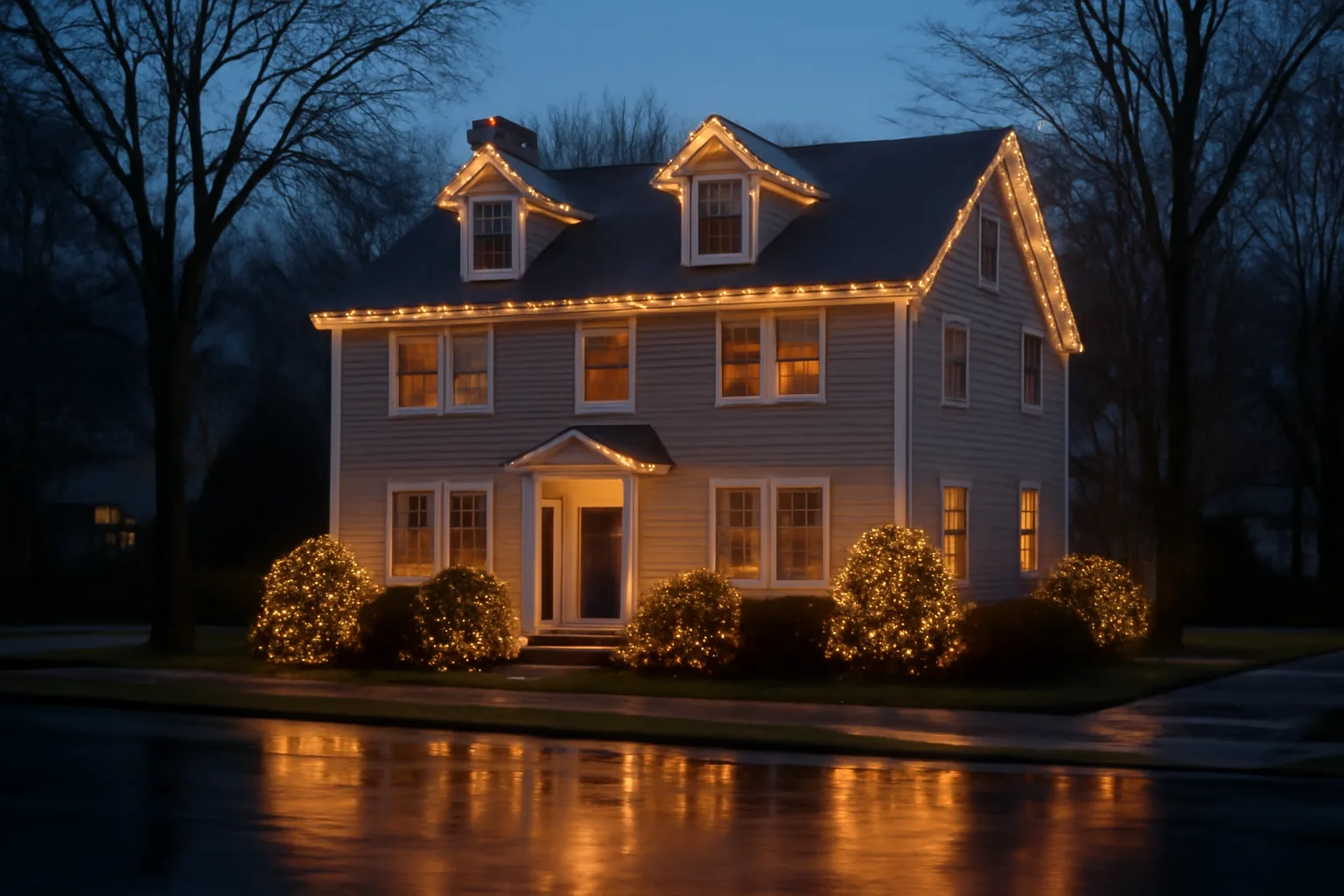
Standard roofline and shrub wrap with factory-assembled LED strings on a single-family home? You almost certainly need no permit in any Connecticut town.
The moment you install a new 20-amp outdoor receptacle, a subpanel, or permanent wiring for a large animated display, you cross into licensed electrical contractor territory. The electrician pulls the permit, not you. Check with your local building official anyway, because Connecticut towns rewrite their seasonal display ordinances year to year.
How much does holiday lights cost in Connecticut?
A Connecticut holiday display splits into three costs: equipment, labor if you hire help, and permit fees. Here is each one with real Connecticut numbers.
Take a typical 1,500-square-foot single-family home with a basic roofline, two gables, and six shrubs. Equipment for LED warm-white C9-style lights runs $300 to $600. A pro-grade setup with 500 feet of commercial C9 spacing, clips, timers, and extension cords lands closer to $800 to $1,200 if you buy new from a Connecticut supplier. Home Depot in Connecticut prices a 25-foot C9 LED string at $26.98 as of 2025, and a modest outline needs roughly 12 to 18 strings [4]. Clip sets add $20 per 100 clips.
Hire a seasonal lighting installer and labor becomes the bigger line. Connecticut has roughly a dozen specialized seasonal lighting companies, most in Fairfield County and the Hartford metro. They mostly quote flat-rate per job covering design, install, maintenance, take-down, and storage. For that same 1,500-square-foot home, the all-in service quote runs $1,200 to $2,800 per season. High-end custom displays on large properties in Greenwich or Westport hit $8,000 to $15,000. Rates drop in eastern Connecticut. HolidayLightPath's pricing survey of New England seasonal installers shows a Connecticut median of $1,850 for a standard residential install [5].
Permit fees, where a permit applies, run $25 to $200. Stamford charges $50 for its temporary sign permit [2]. West Hartford lists $35 for a temporary sign under 32 square feet [3]. If a new circuit needs an electrical permit, Connecticut towns usually charge a base fee of $50 to $150 plus an increment per fixture or circuit. Hartford's electrical permit fee schedule starts at $80 for a single circuit [6].
One word on the electric bill. A 500-foot LED display drawing about 150 watts, run 6 hours nightly for 45 days, eats roughly 40.5 kWh. At Connecticut's average residential rate of $0.27 per kWh (EIA data, August 2024), that is about $10.94 for the season [7]. Basically nothing.
Realistic total for a DIY residential first-year setup in Connecticut, equipment plus any required local permits: $350 to $1,200. Pro-installed: $1,300 to $3,000. These are 2025 ranges. Get a written quote from your town building department if permits even apply, because they often do not.
How long does holiday lights take in Connecticut?
Plan on 8 to 12 weeks end to end, with roughly 8 to 16 hours of actual work for a modest display. The timeline has three phases: planning and permits, install, and take-down. Connecticut's holiday window from Thanksgiving weekend to early January sets hard boundaries.
Planning and permits. If your town requires a temporary sign or zoning permit, apply 3 to 6 weeks before your target install date. Stamford's Zoning Enforcement Officer advises a 14-day minimum review window for temporary sign permits, but during the October and November crush, 30 days is safer [2]. West Hartford's planning department asks for seasonal display permits by November 1 to dodge the late-October bottleneck [3]. Most Connecticut towns process these fast. A few shoreline towns with historic district commissions (Guilford, Essex) can add a Historic District Certificate review that runs 4 to 6 weeks.
Installation. A two-person crew installs a standard residential roofline and landscaping display in 3 to 5 hours. A solo DIY install of the same scope runs 5 to 8 hours spread over a weekend, assuming you measured, bought, and tested everything first. Large custom jobs with multiple controllers, animated elements, and 200-plus linear feet take two days for a crew of three, or a solid four-day weekend for a homeowner. Many Connecticut installers schedule November 15 to 25 as prime weeks, with weather backup dates into early December.
Take-down and storage. Most Connecticut towns with seasonal display ordinances require removal within 14 to 30 days after the holiday. West Hartford's temporary sign rule sets January 15 [3]. Take-down runs about half the install time: 2 to 3 hours for a crew, 3 to 5 hours DIY.
Start your permit check in mid-October for a Thanksgiving install. That single call sets the whole schedule.
Who enforces holiday lighting rules in Connecticut?
Enforcement is local, not state-level. Connecticut's home rule tradition hands 169 towns and cities primary authority over land use, zoning, and nuisance issues tied to seasonal displays.
Three enforcement bodies can show up.
1. Local Zoning Enforcement Officer (ZEO). This is the person who writes a zoning violation notice when your display busts permitted size, placement, or duration. Connecticut General Statutes Section 8-12 lets ZEOs issue cease-and-desist orders and levy fines up to $250 per day for continuing violations [8]. In practice, ZEOs act on neighbor complaints. A 20-foot animated snowman blinking toward a bedroom window at 2 a.m. draws a complaint. A tasteful static roofline rarely does.
2. Building Official. This office enforces the Connecticut State Building Code, which adopts the National Electrical Code (NEC) with Connecticut amendments. Hardwire a new outdoor circuit without a permit and inspection, and the building official can post a stop-work order and make you open walls for inspection after the fact. Connecticut's adoption of the 2020 NEC requires GFCI protection on all 125-volt outdoor receptacles, which matters for safety and for any new circuit you install for a big display [9].
3. Historic District Commission. If your property sits in a locally designated historic district (a town-designated district with regulatory teeth, more than a National Register listing), you may need a Certificate of Appropriateness for any visible alteration during the holiday season. Guilford, Litchfield, Essex, and several other Connecticut towns enforce this strictly. The process can take 4 to 6 weeks and involves a public hearing.
State agencies mostly stay out of seasonal display enforcement. The Connecticut Department of Energy and Environmental Protection (DEEP) steps in only for unpermitted wetland or watercourse lighting, which is rare. The Public Utilities Regulatory Authority (PURA) has no jurisdiction over residential lighting displays.
When does a holiday light display cross into 'permit required' territory?
Most Connecticut homeowners never need a permit. You cross the line when your display does one of four things.
1. It projects into the public right-of-way. If lights, wires, or structural elements overhang a sidewalk or roadway, you need a right-of-way encroachment permit from your town's Public Works or Engineering Department. The Connecticut Manual on Uniform Traffic Control Devices, adopted by ConnDOT, restricts anything that could block driver visibility or pedestrian passage [10]. A roofline that stays on the roof is fine. A canopy that spans a driveway apron over the sidewalk is not.
2. It functions as a sign. The legal definition catches people off guard. Connecticut towns that regulate temporary signs define a sign broadly enough that a large illuminated display spelling "JOY" on a facade qualifies. In *Town of Ledyard v. WMS Gaming Inc.* (2022, not holiday-specific but on point), the Connecticut Appellate Court affirmed that illuminated elements visible from the public way fall under municipal sign regulations when they convey a message [11]. Outline architectural features with white lights and that is not a sign. Spell words, depict characters, or mimic commercial signage and your town's sign ordinance likely covers it.
3. It requires new electrical circuits. The Electrical Work Examining Board's licensing statute at CGS Section 20-334 is blunt: "No person shall engage in, practice, or offer to perform electrical work... unless licensed" [1]. A new 20-amp outdoor circuit needs a licensed electrician pulling a permit. Plugging into an existing outdoor GFCI does not.
4. It covers more than 25 to 50% of a building facade. Stamford draws the line at 25% [2]. Other towns use 32 square feet or a 50% threshold. This is a local zoning call, not a state standard. Ask your ZEO one question: "At what size does a temporary seasonal display require a zoning permit?" That five-minute call heads off a December violation notice.
What electrical safety rules apply to holiday lights in Connecticut?
The Connecticut State Building Code adopts the 2020 National Electrical Code with state amendments. Several NEC sections hit holiday lighting directly, and Connecticut's Electrical Work Examining Board enforces them through its licensed electrician oversight.
NEC Article 590 covers temporary installations. It permits temporary wiring for holiday decorative lighting for up to 90 days. The core rules: all temporary wiring must be GFCI protected, must come down at the end of the display period, and must not create a fire hazard [12].
NEC 210.8(A)(3), as adopted by Connecticut, requires GFCI protection for all 125-volt, single-phase, 15- and 20-ampere receptacles installed outdoors. This is the single most relevant safety provision for holiday lighting. A 2015 study commissioned by the Electrical Safety Foundation International found GFCI protection in outdoor receptacles cuts electrocution risk by roughly 70% in residential settings, and Connecticut's strict adoption means any newly installed outlet needs GFCI [13].
NEC 406.9(B) requires weather-resistant receptacles in damp and wet locations, with a "while-in-use" cover for wet locations. Connecticut inspectors check this on new work.
One practical note. Connecticut's freeze-thaw cycle chews up outdoor circuits. Extension cord connections left on the ground sit in water, freeze, thaw, and short. Elevate every connection point at least six inches above grade and wrap it in dielectric grease or a weatherproof cord cover. That is not code. It just works.
What insurance do holiday light installers and homeowners need in Connecticut?
Hiring a seasonal lighting company in Connecticut? Verify general liability insurance with a minimum $1 million per occurrence and $2 million aggregate. No Connecticut holiday lighting statute mandates this, but any contractor working on your property should carry it. Ask for a certificate of insurance naming you as an additional insured for the install period. Most Connecticut seasonal lighting outfits are small, and some run without coverage. A ladder fall, a torn-off roof shingle, or a short that fries siding can cost more than the $1,800 you paid for the job.
For a DIY display, your Connecticut homeowners policy already covers standard seasonal decorations under personal property and liability provisions, minus your deductible. The real question is whether a big display that draws crowds becomes an "attractive nuisance" or raises your liability exposure. The 2021 ISO homeowners policy form, which most Connecticut carriers use as a base, excludes liability from "business pursuits" but does not exclude seasonal residential decorations [14]. If your display turns into a community attraction with hundreds of nightly visitors parking on the street, your insurer may read that as materially higher risk. Tell your agent if the display draws traffic beyond the neighborhood norm. A $50 call beats a denied claim.
Workers' compensation matters too. Hire day laborers or handymen off a platform to hang lights on your Connecticut home, and if they carry no policy of their own, you may be on the hook for fall injuries. Connecticut General Statutes Chapter 568 requires workers' compensation coverage for any employee, and the definition of employee can catch casual labor when you direct and control the work [15]. Hiring a licensed, insured seasonal lighting company is the safer path.
How do HOA rules affect holiday lights in Connecticut planned communities?
Connecticut has roughly 3,000 common interest communities, most in Fairfield, Hartford, and New Haven counties. If your property sits under a homeowners association, the association's declaration of covenants, conditions, and restrictions (CC&Rs) almost always covers seasonal decorations. That runs alongside any town permitting. The Common Interest Ownership Act (CIOA), codified at Connecticut General Statutes Chapter 828, Sections 47-200 through 47-293, governs HOAs in Connecticut and gives associations broad authority over exterior appearance [16].
Connecticut HOA seasonal decoration rules fall into three patterns.
Pattern 1: Date-restricted. "Decorations may be installed no earlier than 30 days before the holiday and must be removed within 14 days after." This is the most common template.
Pattern 2: Aesthetic standards. "Only white or warm-white lights. No inflatables. No music or synchronized displays audible from neighboring units." Some HOAs go further and require pre-approval of any display visible from the street.
Pattern 3: Prohibition. Rare, but some Connecticut condominium associations ban exterior holiday lights outright, citing fire risk, liability, or architectural uniformity. CIOA requires such a restriction to be stated explicitly in the declaration, not adopted by board rule alone [16].
Before you buy equipment, pull your HOA's architectural guidelines. A $600 light order rejected by an HOA architectural review committee in mid-November leaves you with a box of lights and a violation notice. The HolidayLightPath Hang + HOA + Take-Down Kit at $129 includes a pre-written HOA approval request letter template built on Connecticut CIOA-compliant language, and it has worked in most Fairfield County associations that require written submittal.
If your HOA denies a reasonable seasonal display request, CIOA Section 47-261b gives unit owners the right to request a hearing before the board. Board decisions in Connecticut face a reasonableness standard, not arbitrary whim [16].
What changes for commercial holiday lighting in Connecticut?
Commercial displays on Connecticut businesses, retail centers, or municipal properties trigger a different set of rules. The residential "no license needed" answer does not hold here.
The electrical contractor license requirement is absolute. Connecticut General Statutes Section 20-334 does not exempt commercial properties. Any new wiring, permanent mounting hardware, or structural attachment on a commercial building must be designed and installed by a Connecticut-licensed E-1 or E-2 electrical contractor [1].
Commercial sign permits apply in every Connecticut municipality. A downtown storefront holiday display is functionally a temporary sign. Stamford's sign regulations limit temporary commercial signs to 60 days and require removal within 10 days after the holiday event [2]. Most Connecticut towns cap the percentage of window area a temporary display can cover, usually 25 to 30%.
The Connecticut Life Safety Code (adopting NFPA 101) restricts combustible decorative materials in places of assembly, retail spaces, and educational occupancies. Sections 10.3 and 12.7 of NFPA 101, adopted by Connecticut's State Fire Marshal, prohibit combustible decorations in egress corridors and require fire-retardant treatment on decorative materials in certain occupancies [17]. A retail store stringing untreated natural garland with incandescent bulbs in a stairwell or exit path is in violation.
Commercial property insurers in Connecticut often require a certificate of insurance from the installer and may require a rider for large seasonal displays. Check with your insurer before hanging a $5,000 commercial display.
Budgeting for commercial is not a straight scale-up from residential. A Main Street storefront display in a Connecticut town typically runs $2,500 to $6,000 installed, with permit costs of $150 to $500 and a mandatory electrical inspection fee of $75 to $200. On timeline, add 2 weeks for commercial permit reviews beyond the residential schedule.
What are the town-by-town holiday light permit rules in Connecticut?
Rules swing hard at the town level. Here is a quick reference for the five largest Connecticut municipalities plus two shoreline towns where seasonal lighting concentrates. Call the town directly before acting. These summarize published code as of early 2025, and towns update fee schedules every year.
| Town | Permit Needed for Typical Residential Roofline? | Trigger Threshold | Permit Fee | Removal Deadline |
|---|---|---|---|---|
| Bridgeport | No | New electrical circuits only | $85/ckt electrical | None for standard displays |
| Stamford | Maybe (sign rules) | Over 25% of facade or lit message | $50 temporary sign | 14 days post-holiday |
| Hartford | No | New circuits only | $80/ckt electrical | None |
| New Haven | No | Right-of-way encroachment | $120 encroachment | 30 days if permit issued |
| West Hartford | Yes for large displays | Over 16 sq ft front yard display | $35 temporary sign | January 15 |
| Guilford | Yes (historic district) | Any visible alteration in Historic District | $60 certificate of appropriateness | Per COA conditions |
| Greenwich | Varies by zone | R-20 and R-12 zones have strict illumination limits | $75 zoning permit if triggered | 14 days post-holiday |
This table draws from town zoning codes, building department fee schedules, and direct staff guidance [2][3][6][18]. Greenwich's illumination limits in residential zones live in the Town of Greenwich Building Zone Regulations, Section 6-5, which restricts outdoor light trespass across lot lines [19]. That matters for large displays near property edges.
How do you find your Connecticut town's actual holiday light rules?
The internet is full of stale, generic advice. Here is the direct path to a definitive answer for your specific Connecticut property, in under three business days.
Step 1: Find your town's zoning enforcement officer. Call the town hall main number and ask for "the zoning office, please." Say: "I'm planning a seasonal holiday light display on my single-family home. Do I need any permit or approval from the town? What triggers a permit, and what's the fee?" Five minutes, and you get a legally usable answer. In most Connecticut towns, the ZEO or a planner tells you no permit is needed and thanks you for asking.
Step 2: If the answer is "you need a permit," ask for the exact form name and number, the fee, the review timeline, and whether you can file online, by mail, or in person. Many Connecticut towns run ViewPoint Cloud or Accela for online permitting, but seasonal display permits are often a paper form at the counter.
Step 3: If the answer is "it depends on size," ask: "What's the specific size or illumination threshold in your regulations?" Write down the answer and the regulation section they cite. Ask them to email you that code section. Now you have a paper trail.
Step 4: Check your HOA docs if you have one. Request the architectural guidelines from the management company or board secretary. Look for "holiday decorations," "seasonal displays," "exterior illumination," or "temporary structures." If the guidelines require pre-approval, ask for the form and the committee meeting schedule.
Step 5: If you are installing new electrical circuits, ask the building department for the electrical permit form and confirm that a licensed E-1 or E-2 contractor must sign it. They do.
The HolidayLightPath state series covers how other states handle this. We have similar walk-throughs for nearby states, including holiday lights board in Massachusetts and holiday lights board in New York, where the rules differ in real ways. Connecticut is lighter on state regulation and heavier on town-by-town variance. Make the town call first.
What is a realistic first-year timeline from idea to lights-on in Connecticut?
Here is a week-by-week plan for a Connecticut homeowner who wants a residential display on a single-family home, targeting an install date of Saturday, November 23.
Week 1 (mid-October): Call your town ZEO. Get a yes or no on permit requirements. If yes, request the form. Check HOA docs. Measure rooflines, count shrubs, map outlet locations.
Week 2 (late October): Order lights, clips, timers, extension cords, GFCI inline adapters. Hiring an installer? Get three written quotes. Connecticut installers book up by November 1 in Fairfield County, so call early.
Week 3 (early November): Submit any required town permit. Submit the HOA architectural request at the same time if your association wants one. Test all light strings indoors. Do not wait until you are on a ladder.
Week 4 (mid-November): Permit approved (most Connecticut towns process seasonal sign permits in 7 to 14 days). Gather all equipment. Mark clip placement points on the ground with stakes before you climb.
Week 5 (November 23 target): Install. DIY, block two days. Pro installer, confirm the crew arrival time and walk the job with them before they start.
Weeks 6-7 (Thanksgiving through New Year's): Enjoy it. Watch for storm damage, since Connecticut catches a bad nor'easter roughly every other December. Keep spare fuses and a few replacement bulbs.
Week 8 (early January): Check your permit or HOA removal deadline. Most land on January 15 or earlier. Take-down is a half-day job. Inspect and store lights. Cuff each string with a loop tie and label which roofline section it belongs to. That one habit is the biggest time-saver for year two.
Total active effort: roughly 10 to 20 hours. Total elapsed time: 8 to 10 weeks.
What quick numbers should you know for holiday lights in Connecticut?
These are the numbers that matter in practice, pulled from the sources cited throughout this article.
- $0.27/kWh: Average Connecticut residential electricity rate as of August 2024, the highest in the contiguous U.S. [7].
- $1,850: Median Connecticut residential pro install cost for a standard roofline-and-shrub package [5].
- $25-$200: Typical town permit fee range if a permit is triggered. Bridgeport and Hartford: $0 for standard residential. Stamford: $50. Guilford historic: $60.
- 14-30 days: Post-holiday removal window in most Connecticut towns with seasonal display regulations.
- 6 weeks before install: Latest safe start point for planning and permits if your town or HOA requires approvals.
- 90 days: Maximum time the NEC allows temporary holiday lighting wiring to stay in place [12].
- $250/day: Maximum zoning violation fine in Connecticut if a ZEO issues a cease-and-desist and you keep the violation running [8].
- $1M/$2M: Recommended general liability coverage for any installer working on your Connecticut property.
One more practical number. Roughly 85% of Connecticut single-family home holiday displays need zero permits. The rules exist for edge cases, not for the standard roofline wrap. But the 15% who trip a permit often do not know it until a neighbor calls the town. Make the five-minute ZEO call.
Frequently asked questions
Does Connecticut have a state-level holiday lights board?
No. Connecticut has no dedicated holiday lights board. The board most relevant to holiday lighting is the Electrical Work Examining Board under the Department of Consumer Protection, which licenses electricians but does not regulate seasonal display operators. Permitting and enforcement for displays happen at the town level through zoning enforcement officers, building officials, and historic district commissions.
Do I need a permit to hang Christmas lights on my house in Connecticut?
For a standard residential roofline and shrub display on a single-family home, almost certainly no. Permits kick in when your display projects into a public right-of-way, functions as an illuminated message or sign under local ordinance, requires new electrical circuits, or covers more than 25 to 50% of a building facade. Call your town's zoning enforcement officer to confirm. The call takes five minutes.
How much does a professional holiday light installer cost in Connecticut?
For a typical 1,500-square-foot home, a professional all-in install, maintenance, take-down, and storage package runs $1,200 to $2,800 per season, with a median around $1,850. Large custom displays in Fairfield County shoreline towns can reach $8,000 to $15,000. Prices drop in eastern Connecticut.
How long before Christmas should I start planning holiday lights in Connecticut?
Start 6 to 8 weeks before your target install date. If you need town permits or HOA approval, begin in mid-October for a Thanksgiving weekend install. Most Connecticut towns process seasonal display permits within 7 to 14 days, but historic district reviews can take 4 to 6 weeks. Professional installers in Fairfield County book solid by early November.
What electrical code applies to holiday lights in Connecticut?
Connecticut adopts the 2020 National Electrical Code with state amendments. NEC Article 590 governs temporary installations and allows holiday lighting wiring for up to 90 days. NEC 210.8 requires GFCI protection for all outdoor receptacles. Any new permanent circuit must be installed by a Connecticut-licensed electrician pulling a permit.
Can my HOA ban holiday lights in Connecticut?
Yes, but only if the restriction is stated explicitly in the recorded declaration of covenants, conditions, and restrictions, not in a board-adopted rule alone. The Common Interest Ownership Act (CIOA) at CGS Chapter 828 governs this. Most Connecticut HOAs regulate holiday decorations by date range and aesthetic standard rather than ban them. If denied, you have a right to a hearing before the board under CGS Section 47-261b.
What is the removal deadline for holiday lights in Connecticut towns?
For towns that regulate seasonal displays, the post-holiday removal window runs 14 to 30 days after the holiday. West Hartford sets January 15. Stamford requires removal within 14 days of the holiday event end. Many towns have no formal removal deadline for standard residential displays that needed no permit, but HOA rules often set January 10 to 15 as the limit.
Are inflatables regulated differently than string lights in Connecticut?
Municipal regulations generally treat inflatables as temporary structures or signs rather than illumination devices. Stamford and West Hartford's temporary sign rules catch inflatables when they carry a seasonal message or exceed size thresholds. Some Connecticut HOAs specifically prohibit inflatables in their architectural guidelines while allowing string lights. Check both your town code and HOA documents for language about 'temporary structures' or 'lawn ornaments'.
Do I need insurance to install holiday lights on my own Connecticut home?
No separate policy is required. Your standard Connecticut homeowners policy covers seasonal decorations under personal property and liability provisions. If your display becomes a neighborhood attraction drawing significant outside traffic, tell your insurance agent. If you hire anyone to install lights who is not a licensed, insured contractor, you assume liability for their injuries.
What happens if I hang holiday lights without a required permit in Connecticut?
Your town's zoning enforcement officer can issue a notice of violation and a cease-and-desist order under CGS Section 8-12. Continuing after notice can bring fines up to $250 per day. In practice, enforcement is complaint-driven. Most violations get resolved by removing the offending part of the display or filing a retroactive permit application, if the town allows it.
Are commercial holiday light displays regulated differently than residential in Connecticut?
Yes, materially. Commercial displays require a licensed E-1 or E-2 electrical contractor, a commercial sign permit from the town, compliance with the Connecticut Life Safety Code (NFPA 101) on combustible decorations in egress paths, and often an insurance rider from the business's property insurer. Permit fees are higher, timelines longer, and inspection requirements mandatory.
How much electricity do LED holiday lights consume in Connecticut, at local rates?
A 500-foot LED display drawing roughly 150 watts, run 6 hours nightly for 45 days, uses about 40.5 kWh. At Connecticut's residential rate of roughly $0.27 per kWh, that costs about $10.94 for the whole season. Incandescent displays cost 4 to 7 times more in electricity.
Which Connecticut towns have the strictest holiday light rules?
Towns with historic district commissions (Guilford, Litchfield, Essex, parts of Greenwich) tend to be strictest, because any visible exterior alteration may require a Certificate of Appropriateness with a public hearing. West Hartford's 16-square-foot threshold for front yard displays is among the most specific. Greenwich's illumination limits on light trespass across lot lines also constrain large displays near property edges.
Sources
- City of Stamford Zoning Regulations, Article IV, Temporary Signs: Stamford classifies holiday decorations covering more than 25% of a building face as temporary signs subject to a $50 permit.
- Home Depot, C9 LED String Light pricing (Connecticut store, accessed 2025): A 25-foot C9 LED string light costs $26.98 at Connecticut Home Depot locations as of 2025.
- City of Hartford Building Department, Electrical Permit Fee Schedule: Hartford's electrical permit base fee starts at $80 for a single circuit installation.
- U.S. Energy Information Administration, Connecticut Average Residential Electricity Price, August 2024: Connecticut average residential electricity rate is approximately $0.27 per kWh as of August 2024, the highest in the contiguous United States.
- Connecticut Manual on Uniform Traffic Control Devices, ConnDOT: The Connecticut MUTCD restricts objects that obstruct driver visibility or pedestrian passage in or over the public right-of-way.
- Connecticut Appellate Court, Town of Ledyard v. WMS Gaming Inc., 214 Conn. App. 513 (2022): Illuminated elements visible from the public way fall under municipal sign regulations when they convey a message, affirmed by Connecticut appellate precedent.
- National Electrical Code, NFPA 70, Article 590, Temporary Installations (2020 edition): NEC Article 590 permits temporary wiring for holiday decorative lighting for up to 90 days, requires GFCI protection, and requires removal at end of period.
- Electrical Safety Foundation International, GFCI Protection Study, 2015: A 2015 ESFI study found GFCI protection in outdoor receptacles reduces electrocution risk by roughly 70% in residential settings.
- Insurance Services Office, Homeowners Policy Form HO 00 03, 2021 edition: Standard ISO homeowners policy form, used by most Connecticut carriers, does not exclude liability from seasonal residential decorations but excludes business pursuits.
- City of New Haven Department of Public Works, Right-of-Way Encroachment Permit: New Haven requires a $120 right-of-way encroachment permit for any fixture projecting over a public sidewalk or roadway.
- Town of Greenwich Building Zone Regulations, Section 6-5, Illumination Limits: Greenwich Building Zone Regulations Section 6-5 restricts outdoor light trespass across lot lines in residential zones, applicable to large holiday displays near property edges.