Last updated 2026-08-18
TL;DR
Delaware has no standalone holiday lights license. You need a Delaware business license from the Division of Revenue, plus any municipal business license where you work and HOA approval before hanging on community property. Budget a national average of $230-$650 per install, allow 2-8 hours, and carry general liability insurance. Start the paper trail before you buy a single strand.
What actually starts a holiday lights business in Delaware?
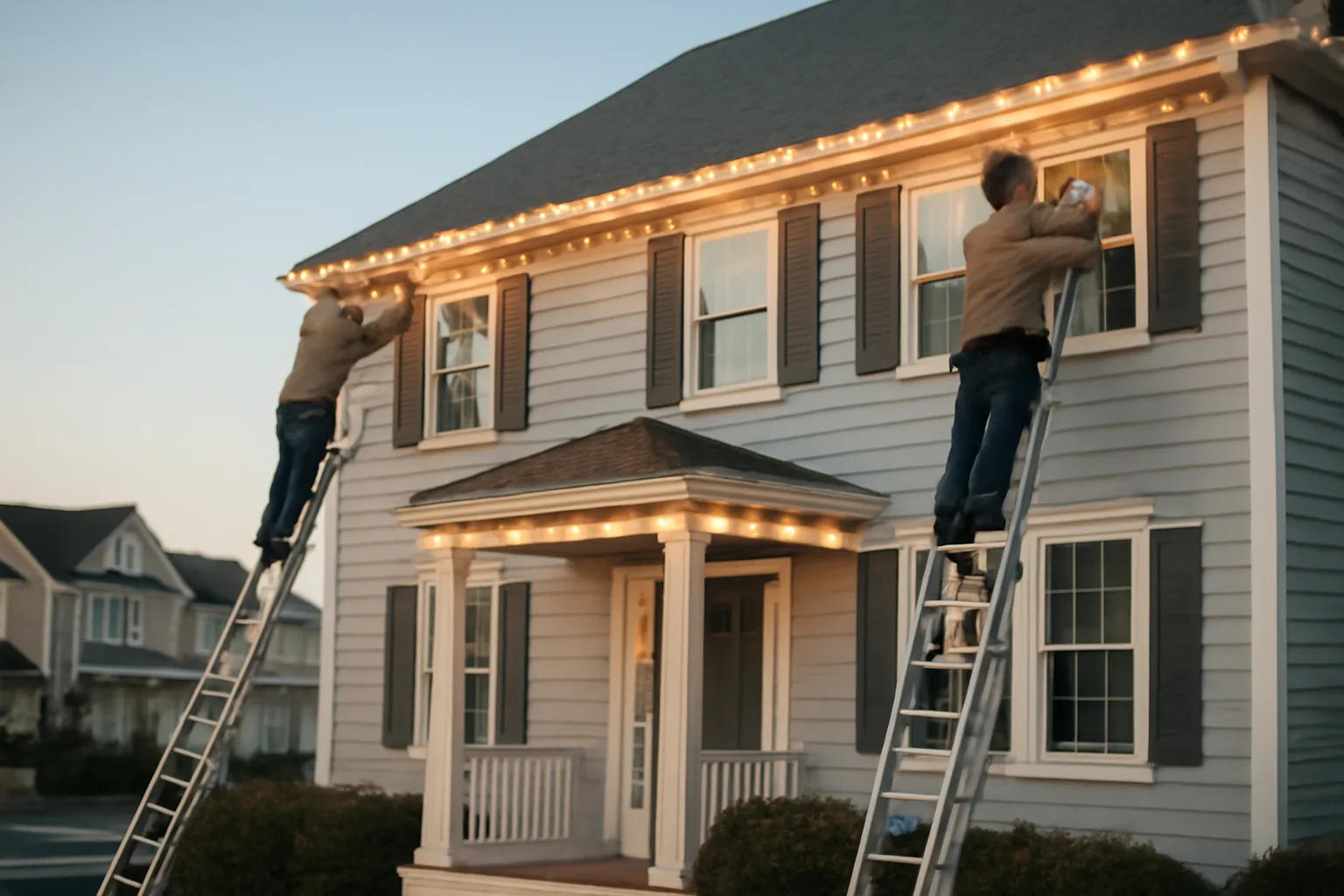
You're starting a seasonal residential service business, not filing for a special permit. Delaware has no holiday lights license. The season runs on a hard clock: hang after Thanksgiving, pull it all down before mid-January. The legal setup is short, but Delaware adds one requirement that trips up new installers. Every business operating in the state holds a Delaware business license, even a one-person roofline crew. The Division of Revenue issues it, not any lighting board. Most new installers also need an HOA approval letter before their ladder touches community property.
The state has three counties. The market splits three ways too: New Castle County neighborhoods up north, Dover-area homes in the middle, Sussex County beach towns down south. Timing differs by area. Beach rentals want installs done before Thanksgiving and takedown by New Year's, so the season compresses hard.
Don't confuse a short December rush with an easy side job. Crews that make money in Delaware pre-sell the HOA-heavy communities, reuse LEDs and clips, and keep a clean takedown log for next year.
Do you need a license for holiday lights in Delaware?
Yes. You need a Delaware business license. There is no separate holiday lights license. Delaware Code, Title 30, Chapter 23 says, "No person shall engage in or carry on any business in this State without first having obtained the appropriate license" [2]. The Division of Revenue enforces that through Delaware One Stop registration [1]. You file once, pay the license fee, and renew on the schedule the Division assigns.
Some service businesses see a starting fee around $75, but Delaware sets fees by business type. Confirm your exact fee in One Stop before you build it into a quote.
Run under your own legal name as a sole proprietor and you still need the license. Use a trade name, and you register that name at the same time. A Delaware LLC or corporation needs a business license on top of formation. Skip the license and the state can hit you with penalties and interest on past-due license fees. The Division compares gross receipts activity against active licenses, so unlicensed income gets found. Paper the state license first. Then worry about ladders.
What Delaware state registrations come before your first install?
Start with a legal structure. A Delaware LLC costs a filing fee and puts some separation between your personal assets and a slip-and-fall claim. A sole proprietorship is cheaper and faster, but there's no liability wall. Get a federal EIN from the IRS online if you form an entity or hire anyone [3]. A sole proprietor with no employees can use a Social Security number instead.
Then register through Delaware One Stop. That filing opens your business license. It also opens a withholding account if you hire, plus an unemployment insurance account [8]. Delaware has no sales tax, so you won't collect any on installs. The state does charge a gross receipts tax tied to your business category. Confirm your category with the Division of Revenue, because service categories carry their own rate and the rates and thresholds change [4].
Want an LLC? File the certificate with the Delaware Division of Corporations before you print contracts. Staying a sole proprietor? Skip the entity and file the license only. Online approval is often fast, but the state doesn't guarantee a turnaround. No bank should open a business account until you have the EIN or Social Security number and the Delaware business license in hand.
What does the Delaware business license actually cost?
Delaware does not publish one flat price for every business. The Division of Revenue sets fees by business type and sometimes by headcount. Many first-year service businesses see a starting fee near $75, but that is not guaranteed. The license year may not match the calendar year for every filer. Check the fee schedule in Delaware One Stop when you apply [1].
You also owe gross receipts tax on your revenue once you start billing [4]. The rate is low for many service firms, but it isn't zero. File the return even in a month with no revenue. Some Delaware businesses file monthly, some quarterly, and the state assigns the schedule based on revenue.
Don't confuse the business license fee with your LLC certificate fee. They're two separate payments to two separate offices.
Does Delaware require an electrical contractor license for holiday lights?
No, not for plug-in temporary lights. Delaware licenses electrical contractors under 24 Del. C. ch. 14 [5]. Low-voltage, plug-in, temporary holiday lights don't count as electrical contracting in most cases. Hanging a strand from an existing outdoor outlet needs no Delaware electrical license.
The line moves when you cut into a wall, hardwire a permanent transformer, run new line-voltage circuits, or install permanent landscape lighting. At that point, hand the electrical portion to a licensed Delaware electrician.
The Board of Electrical Examiners runs the contractor exams and permits. You don't sit for that exam to hang temporary lights. Keep your first season free of permanent wiring. If a client wants a new outdoor receptacle before install, refer it to a licensed electrician, then schedule the lights after the inspection passes. That referral protects you and keeps your paper path simple. For how another state draws this line, see holiday lights license in Alabama. Delaware's version is narrow: temporary plug-in lights stay on the unlicensed side.
What town permits and HOA board approvals matter in Delaware?
Delaware towns issue their own business licenses. Wilmington and Dover require one for businesses working inside city limits. Some beach towns require a transient vendor or contractor registration during the holiday season. Newark and Lewes run their own processes.
You don't need a stack of state contractor papers. You do need to call the town clerk where the house sits and ask one question: do you require a business license or contractor registration for a roofline lighting installer? Write down the town, the clerk's name, and any fee. Keep that log, because an HOA may ask for proof.
HOA approval is a separate game. It's not a state license, but it's a paper requirement for many Delaware communities. Some HOAs want the installer's certificate of insurance naming the HOA as additional insured. Some also want the installation plan, the takedown date, and proof of the business license. Ask the property manager for the architectural request form before you quote. A board that rejects a bid because you skipped the right form costs you the job and the referral. No HOA in Delaware can waive the state's business license, so don't ask them to try.
How much does holiday lights cost in Delaware?
Plan on a national baseline of $230 to $650 per residential install, with a typical job around $400, according to HomeGuide's cost data [6]. Delaware isn't a high-cost state, but beach house rooflines and two-story colonials push toward the top of the range. Simple one-story ranchers near Dover sit near the bottom.
Materials are a small slice of the quote. LED clips, zip ties, extension cords, and storage bins run $100 to $300 for a basic first setup. Labor is the real cost. A two-person crew at $50 to $90 per hour combined, depending on experience, eats most of the margin. Add 20 to 30 percent for HOA-heavy work, because the paperwork and insurance certificate requests take real time.
| Item | Typical range |
|---|---|
| Client quote | $230-$650 |
| Materials | $60-$150 |
| Labor | $100-$350 |
| Overhead, insurance, fuel | $20-$60 |
| Net before taxes | $50-$90 |
Here's a rough first-year cost model for one job.
These are planning figures, not Delaware-specific published rates. Delaware has no official price schedule, so quote from your own time and material cost. For a state cost benchmark outside Delaware, see Holiday lights cost in Utah.
What should you charge for holiday lights in Delaware?
Charge by the job, not the hour. Clients want a number before you unfold the ladder. Price by roofline length for the install, then add takedown and storage as separate line items. That way the HOA board sees a clear winter commitment. A $230 to $650 range covers most basic homes, but full home wraps with trees and garland can run $800 to $2,500. Use a rough per-linear-foot figure of $2 to $4 for LED roofline work, with the higher end for two-story roofs and steep pitches [6].
Add a 20 percent materials markup on top of your actual receipts. Don't price below $250 for any Delaware job once you count three trips: measuring, installing, taking down. Clients who ask for a deep discount are usually the same ones who want a same-day takedown before New Year's. Your calendar can't absorb that for free.
Quote a return trip fee for same-week changes. Delaware customers understand weather delays. HOA boards won't accept them as an excuse unless the contract says so.
How long does holiday lights take in Delaware?
A small roofline install takes two to five hours for a two-person crew. A full home with trees and second-story peaks takes four to eight hours. Takedown runs about half the install time if you labeled the strands and stored the clips right. So a crew can handle two small jobs in a day during late October, then one or two takedowns per day in January [6].
Delaware weather is the wildcard. Nor'easters roll in during late fall, and a rainy November weekend pushes three installs into Monday. Book one weather day per week in November.
Watch the daylight, too. You need roof access before 4:30 p.m. by mid-November. Quote a job without counting daylight and rain and you'll miss the date the HOA approved. Build a 15-minute buffer for photos and board paperwork at the end of every install. That log is what wins the renewal next year.
What insurance and contracts do Delaware crews need?
Delaware has no statewide liability insurance mandate for seasonal installers. Most HOAs and property managers do. A standard $1 million per occurrence general liability policy is the floor, and many HOAs ask for $2 million aggregate. Workers' compensation is mandatory if you have one or more employees in Delaware, even seasonal helpers [7]. Use independent contractors and you'd better be sure they actually meet Delaware's independent contractor test. Misclassification penalties aren't worth the cheap help.
Use a written contract that lists the install date, takedown date, exact fixture count, storage location, and what happens if a strand fails. Add a clause requiring the client to provide a grounded outdoor outlet within 25 feet of the roofline. Never promise a specific light count without a site measure. Let the contract say 'approximate count, confirmed at install.' That one line wins disputes. Add a certificate of insurance requirement if the HOA wants additional insured status. Your agent can issue that in a day.
What records and tax filings does a Delaware holiday lights business keep?
Keep a simple monthly ledger: customer name, address, install date, takedown date, amount collected, materials cost. Delaware's gross receipts tax return asks for revenue by category, so a basic spreadsheet does the job [4]. Hire an independent contractor and you issue a 1099 if the IRS threshold applies. Have employees and you keep time records and file unemployment and withholding on the schedule the Division of Revenue gives you [8].
Save every HOA approval and insurance certificate. Those aren't tax records, but they cover you when a board questions whether you were approved. Scan them by address. One crew running a full year can produce 100 separate documents. A folder in Google Drive named by street address is enough. Don't lean on texts from the property manager as proof of approval.
What does the first Delaware season actually look like?
Start the paper in July. The Delaware business license and One Stop registration take time mostly because you'll sit on a fee question or wait for an LLC certificate. Marketing starts in September for the HOA-heavy communities. October is measure week. November is install month. December is repairs and replacements. January is takedown, then storage.
First year, aim for 10 to 20 homes, not 60. A small SUV with a ladder rack covers 15 homes. Don't buy a box truck. Don't buy a cherry picker. Buy good clips and a label maker.
The jobs that repeat next year are the ones where your takedown was clean and your HOA packet was already sitting in the board file. Want the board-facing document set without building it from scratch? HolidayLightPath sells a $129 one-time Hang + HOA + Take-Down Kit at /start. That's optional. A plain Google Doc with the same fields works if you stay disciplined.
Where does Delaware differ from nearby states?
Delaware differs from most states in two ways that matter. There's no sales tax, but the gross receipts tax ties your business license and revenue category together at tax time [4]. Second, the state has no general contractor license for low-voltage seasonal hanging. Plenty of states don't either, but Delaware's electrical board line is clean: temporary plug-in work isn't electrical contracting, permanent wiring is [5].
Expand into nearby Maryland, Pennsylvania, or New Jersey and you'll need a fresh state registration and local permits. For a start-from-scratch comparison of the state paper path, see how to start holiday lights in Alabama and how to start holiday lights in Vermont. Delaware's answer stays short: one state business license, no seasonal light board, local door checks.
Final Delaware paper checklist for a first season
Here's the Delaware paper checklist for a first season. 1. File and pay the Delaware business license through One Stop. 2. Register any trade name if you use one. 3. Get a federal EIN if you form an entity or hire anyone. 4. Confirm your gross receipts tax category with the Division of Revenue. 5. Create a certificate of insurance template naming the HOA as additional insured. 6. Call the town clerk for local license or contractor registration. 7. Prepare a one-page HOA packet: license, insurance, install plan, takedown date. 8. Keep a dated photo log for every roofline, before and after.
That list handles most Delaware boards. The rest is showing up when the weather allows. HolidayLightPath's $129 one-time Hang + HOA + Take-Down Kit exists for the installer who wants that packet standardized from day one. You can run the same checklist on paper instead. The state and the HOA don't care which tool you use. They care that the license number matches and the insurance certificate names the right party.
Frequently asked questions
Do you need a license for holiday lights in Delaware?
Yes. Delaware requires a state business license from the Division of Revenue for any business, including a solo holiday lights installer. There's no separate holiday lights license. Apply through Delaware One Stop, register any trade name, and renew on the schedule the state assigns. Local towns and HOAs may also require their own approval before install.
How much does holiday lights cost in Delaware?
Plan $230 to $650 for a typical residential roofline, around $400 nationally, per HomeGuide. Delaware has no official price list. Full home wraps can run $800 to $2,500. Your quote depends on roofline length, number of stories, materials, labor, and HOA paperwork.
How long does holiday lights take in Delaware?
A small roofline takes two to five hours for a two-person crew. A full home with trees and peaks takes four to eight hours. Takedown is about half that if strands are labeled. Weather and short November daylight push Delaware installs, so book a weather buffer day each week.
Do I need an electrical license to hang holiday lights in Delaware?
No, for plug-in low-voltage temporary lights. Delaware electrical licensing under 24 Del. C. ch. 14 covers hardwired or permanent line-voltage work. If the job needs new circuits or permanent outdoor lighting, use a licensed Delaware electrician for that part.
Does Delaware require a general contractor license for holiday lighting?
No. Delaware does not require a general contractor license for seasonal low-voltage holiday lights. The state requires a business license. Towns may have their own contractor registration, so call the local clerk.
What towns in Delaware require a local business license for installers?
Wilmington and Dover require local business licenses for most activity inside city limits. Some beach towns require transient vendor or contractor registration during the holiday season. Call the town clerk before your first job and log the answer.
Can I run a holiday lights business from home in Delaware?
Yes, in most areas. Your home address can be the business address on the Delaware license. Some HOAs or deed restrictions limit home businesses with multiple ladder crews and customer visits. Check your own HOA rules before registering.
Do I need insurance for holiday lights in Delaware?
State law doesn't require general liability for a solo seasonal installer, but most HOAs and property managers do. A $1 million occurrence policy is typical, often with the HOA named as additional insured. Workers' comp is mandatory if you hire employees.
When should I apply for the Delaware business license?
Apply in July or August before your first season. Online filing can process quickly, but the turnaround isn't guaranteed. Starting early gives you time to handle LLC formation, EIN, local permits, and HOA packet requests before October measures.
Does Delaware charge sales tax on holiday light installation?
No. Delaware has no state or local sales tax. The state does charge gross receipts tax based on your business category. You file that with the Division of Revenue on the schedule assigned to your revenue level.
What happens if I skip the Delaware business license?
Delaware can assess penalties and interest on unpaid license fees. The Division of Revenue cross-checks business activity and gross receipts, so unlicensed income is discoverable. HOA boards and property managers may also refuse to approve an unlicensed installer.
Can I use a seasonal helper without workers' comp in Delaware?
If the helper is a true employee, no. Delaware requires workers' compensation for employers with employees, including seasonal help. A properly classified independent contractor with their own insurance is different, but Delaware applies a strict test. Confirm classification before you pay.
Sources
- Delaware Division of Revenue, Business License: Delaware requires a state business license for any person or entity conducting business in the state.
- Delaware Code, Title 30, Chapter 23, Business License: State law requires a business license to carry on any business in Delaware.
- IRS, Apply for an Employer Identification Number (EIN) Online: Sole proprietors with no employees may use a Social Security number; entities and employers can get an EIN online.
- Delaware Division of Revenue, Gross Receipts Tax: Delaware has no sales tax but charges gross receipts tax based on business activity category.
- Delaware Division of Professional Regulation, Board of Electrical Examiners: Delaware licenses electrical contractors; temporary plug-in low-voltage holiday lights are not generally treated as electrical contracting.
- HomeGuide, Christmas Light Installation Cost: National cost baseline: typical residential Christmas light install $230-$650, average around $400; small installs 2-5 hours, full homes 4-8 hours.
- Delaware Department of Labor, Workers' Compensation: Delaware requires workers' compensation for employers with employees, including seasonal helpers.
- Delaware Department of Labor, Unemployment Insurance: Employers must register for unemployment insurance and file wage reports on the assigned schedule.